In a groundbreaking advancement poised to redefine wireless communication and sensing technologies, researchers have unveiled a novel transmissive metasurface engineered with an ultrathin layer of liquid crystals measuring just 3.5 micrometers in thickness. This innovation promises dynamic beamforming capabilities within the subterahertz frequency spectrum, a regime that holds immense potential for next-generation high-speed data transmission and sophisticated imaging systems. The study, undertaken by Kitayama, Kagami, Pander, and their team, showcases the marriage of metasurface design and liquid crystal technology to achieve unprecedented control over electromagnetic wave propagation at subterahertz frequencies.
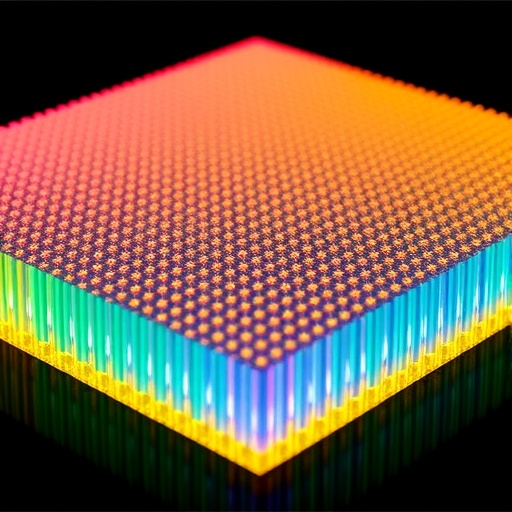
At the heart of this research lies the metasurface—a two-dimensional, artificially structured interface capable of manipulating electromagnetic waves with remarkable precision. Unlike traditional bulky optical components, metasurfaces offer compactness and versatility by tailoring the phase, amplitude, and polarization of incident waves. The integration of liquid crystals, materials well-known for their electrically tunable refractive indices, enhances dynamic reconfigurability, effectively enabling real-time modulation of beam direction and shape. This synergistic combination opens a new frontier in beamforming technology, crucial for improving the efficiency and flexibility of wireless communication networks.
The choice of a 3.5-micrometer-thick liquid crystal layer is a testament to the team’s innovative approach to material engineering and device miniaturization. Achieving such a thin active layer without compromising performance demands exceptional precision in fabrication and meticulous control of material properties. This slender thickness not only reduces device footprint but also enhances response speed due to decreased material volume, enabling rapid beam steering essential for dynamic communication environments. The researchers demonstrated that despite its minimal thickness, the liquid crystal layer remains effective in modulating electromagnetic waves at subterahertz frequencies, a challenging feat given the wave’s short wavelengths and high absorption characteristics.
Subterahertz waves, often defined in the frequency range of 100 GHz to 1 THz, represent a relatively untapped portion of the electromagnetic spectrum offering vast bandwidth for data transmission and high-resolution sensing capabilities. However, controlling waves in this spectrum has been historically difficult due to a lack of suitable materials and devices capable of dynamic beam manipulation. The newly developed metasurface addresses these challenges by providing adaptive control over the transmission phase profile, which enables steering of the transmitted beam in real time without mechanical movement. This capability holds great promise for applications requiring agile and precise beam delivery.
A significant aspect of the study involves the engineering of the metasurface unit cells, meticulously designed to interact with the subterahertz waves and the liquid crystal layer in a coherent and controlled manner. These unit cells are patterned with subwavelength features that create resonances finely tuned to the operating frequency. Upon applying an electric field across the liquid crystal layer, its refractive index can be modulated, thereby altering the phase delay encountered by the transmitted wave. By spatially varying the electric field, the researchers can impose a desired phase gradient across the metasurface, steering the beam to specific angles dynamically.
The integration of liquid crystals introduces a level of tunability previously unattainable in transmissive metasurfaces operating at subterahertz frequencies. Unlike their conventional static counterparts, which require mechanical adjustments or rely solely on fixed nanostructures, these liquid crystal-based metasurfaces exhibit continuous, fine-grained control over wavefront modulation. The team detailed protocols for voltage-driven reorientation of the liquid crystal molecules, allowing swift and reversible adjustment of the transmission phase. This implies that communication devices employing this technology could adapt beam directions on demand, optimizing signal strength and reducing interference in real-world environments.
Fabrication challenges were addressed through a combination of advanced nanolithography and liquid crystal alignment techniques. The metasurface was constructed on a transparent substrate compatible with subterahertz wave transmission, ensuring minimal insertion losses. The liquid crystals were carefully aligned using rubbed polyimide layers, achieving uniform orientation and maximizing modulation depth. The researchers optimized electrode configurations to apply uniform and controllable electric fields, facilitating accurate phase shift profiles necessary for beam steering. These technical achievements represent a significant stride toward scalable and practical implementations of dynamic subterahertz beamforming devices.
Experimental validation included detailed characterization of beam steering performance using terahertz time-domain spectroscopy and angle-resolved transmission measurements. The results revealed a wide steering angular range surpassing 40 degrees with high transmission efficiency and low signal distortion, a benchmark performance compared to existing devices. The metasurface could dynamically redirect beams across diverse angles within tens of milliseconds, highlighting its potential for real-time communication systems and adaptive sensing applications. Moreover, the device demonstrated stable operation under various environmental conditions, suggesting robustness suitable for commercial deployment.
The implications of this technology extend beyond communication networks. In radar and imaging systems operating in the subterahertz band, the ability to swiftly steer beams dynamically improves target detection capabilities and resolution. This can benefit fields such as security screening, biomedical imaging, and non-destructive evaluation where precise control over wave propagation enhances performance. Furthermore, the compactness and flat form factor of the metasurface facilitate integration into portable and wearable devices, expanding the practical use cases of subterahertz technologies.
Looking toward the future, the team’s approach could pave the way for multifunctional metasurfaces combining beamforming with other electromagnetic functionalities such as polarization control, frequency filtering, and amplitude modulation. By engineering more complex liquid crystal configurations and electrode architectures, it may be possible to create adaptive surfaces capable of simultaneously handling multiple signals or frequencies, ushering in highly versatile communication platforms. Additionally, scaling the fabrication techniques for larger-area metasurfaces could enable widespread adoption in infrastructure for 6G and beyond wireless networks.
Despite the promising results, challenges remain in further enhancing modulation depth and reducing power consumption associated with electrical tuning of liquid crystals. The intrinsic losses and response speed limitations of liquid crystal materials need continual improvement, potentially through the exploration of novel liquid crystal chemistries or hybrid materials incorporating graphene or other two-dimensional materials. Integration with complementary metal-oxide-semiconductor (CMOS) electronics for seamless voltage control and signal processing represents another critical milestone to be addressed for practical deployment.
This landmark study underscores an important shift in the design philosophy of electromagnetic devices, from rigid static structures toward flexible, reconfigurable metasurfaces capable of intelligent response to environmental cues and user demands. The convergence of nanofabrication, materials science, and electromagnetic engineering embodied in this work illustrates how interdisciplinary collaboration drives innovation. As the demand for higher bandwidth, lower latency, and more reliable wireless communication accelerates, dynamic beamforming metasurfaces stand out as a compelling technological cornerstone.
In the context of emerging applications like autonomous vehicles, augmented reality, and smart cities, where real-time data exchange and sensing are critical, the significance of dynamically steerable subterahertz devices becomes clear. The ability to shape and direct electromagnetic energy efficiently while maintaining compact device dimensions aligns perfectly with the requirements of modern interconnected systems. This research thus not only advances fundamental understanding but also sets the stage for transformative commercial products.
Ultimately, the demonstration of a transmissive metasurface with a 3.5-micrometer liquid crystal thickness for subterahertz dynamic beamforming heralds a new era in wave manipulation technologies. By enabling rapid, voltage-controlled reconfiguration of beam direction within a flat optical device, it breaks away from the limitations of mechanical steering and static metastructures. As scientists and engineers continue to refine these devices, their impact promises to resonate across telecommunications, sensing, and beyond, bringing us closer to the vision of truly adaptive electromagnetic systems.
Subject of Research: Transmissive metasurfaces with liquid crystals for dynamic beamforming at subterahertz frequencies.
Article Title: Transmissive metasurface with 3.5-μm-thick liquid crystals for subterahertz-wave dynamic beamforming.
Article References:
Kitayama, D., Kagami, H., Pander, A. et al. Transmissive metasurface with 3.5-μm-thick liquid crystals for subterahertz-wave dynamic beamforming. Commun Eng (2026). https://doi.org/10.1038/s44172-026-00635-2
Image Credits: AI Generated
Tags: advanced subterahertz imaging systemscompact metasurface designdynamic beam steering in wireless communicationelectromagnetic wave manipulation metasurfacesliquid crystal metasurface technologyminiaturized optical components for communicationnext-generation high-speed data transmissionreal-time beam modulation techniquesreconfigurable beamforming devicessubterahertz beamforming applicationstunable refractive index materialsultrathin liquid crystal layers