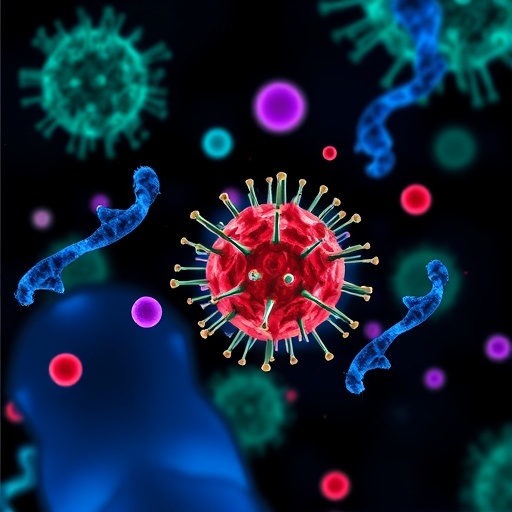
In the relentless pursuit of more effective cancer therapies, researchers have turned their attention to an unlikely ally residing within our bodies—the gut microbiota. This complex community of microorganisms plays a pivotal role in modulating human health and disease. A breakthrough study published in Nature Microbiology now highlights a promising strategy that manipulates this microbial ecosystem to significantly enhance the efficacy of anti-programmed cell death protein 1 (PD-1) immunotherapy, a frontline treatment for non-small-cell lung cancer (NSCLC). The research harnesses a defined consortium of gut bacteria derived from patients who responded favorably to immunotherapy, illuminating new avenues for combating resistance and improving patient outcomes.
Cancer immunotherapy, particularly therapies targeting immune checkpoints such as PD-1, has revolutionized oncology by empowering the immune system to attack tumors. However, despite their transformative effects, response rates remain limited, with many patients exhibiting resistance. Emerging evidence suggests that the gut microbiota substantially influences this variability, yet translating these insights into consistent clinical benefits has proved challenging. The innovation of this study lies in combining metagenomic profiling and sophisticated in silico prediction models to pinpoint specific bacterial species that correlate strongly with successful immunotherapy responses in NSCLC patients.
The researchers meticulously curated a defined microbial consortium, termed RCom, composed of 15 bacterial species predominantly isolated from fecal samples of patients who demonstrated favorable responses to anti-PD-1 therapy. This precision-engineered community represents an attempt to replicate and harness the beneficial immunomodulatory effects observed in the gut milieu of responders. Unlike previous approaches using broad-spectrum probiotics or fecal microbiota transplantation, this defined consortium offers a reproducible and mechanistically informed intervention.
To understand RCom’s potential and stability, the team employed computational metabolic modeling alongside rigorous in vitro experiments. These analyses revealed that the consortium members exhibit remarkable cooperative interactions, fostering a stable, resilient community structure capable of sustained activity. This metabolic synergy is critical, as it ensures the consortium’s persistence after administration and its ability to synthesize a repertoire of metabolites implicated in immune regulation.
Subsequent in vivo studies in mouse models featuring syngeneic tumors demonstrated that oral administration of RCom not only successfully engrafted within the host gut microbiota but also significantly augmented the anti-tumor efficacy of anti-PD-1 immunotherapy. This enhancement was associated with increased infiltration of cytotoxic CD8+ T cells into tumor tissues and amplified T cell-mediated cytotoxic functions, key hallmarks of an effective anti-cancer immune response. The findings underscore the consortium’s role in recalibrating the tumor microenvironment towards a more immunogenic state.
Importantly, the consortium’s benefits transcended baseline variations in gut microbiota composition across different mice, suggesting broad applicability despite inter-individual microbiome heterogeneity. This aspect is especially critical, as gut microbial diversity is notoriously variable among patients, often complicating microbiota-based interventions. RCom’s capacity to overcome this obstacle bodes well for its translational potential in heterogeneous human populations.
Furthermore, the study addressed the challenge posed by anti-PD-1 resistance, a significant barrier in current cancer immunotherapy. Using fecal microbiota transplantation from non-responsive patients into mice, the researchers recapitulated resistance phenotypes. Remarkably, supplementation with RCom mitigated this resistance, restoring responsiveness to checkpoint blockade. This finding positions RCom not only as an enhancer of primary therapy but also as a potential adjuvant to overcome acquired or intrinsic treatment failures.
Mechanistic insights into RCom’s function revealed its production of immunomodulatory metabolites that likely mediate cross-talk between the gut microbiota and systemic immune responses. Such metabolites can influence T cell activation, differentiation, and trafficking, thereby orchestrating a cascade that culminates in improved tumor immunosurveillance. These molecular details pave the way for future investigations into specific microbial metabolites as therapeutic targets or biomarkers.
This constellation of experiments—from patient-derived microbial profiling to functional assessments in complex biological systems—constitutes a compelling narrative that elevates the microbiota’s role in cancer therapy from association to actionable intervention. The thoughtful design and thorough characterization of RCom serve as a paradigm for precision microbiome therapeutics that could revolutionize adjunct treatments in oncology.
Additional implications of this research extend beyond lung cancer. Given the ubiquity of PD-1 blockade in various malignancies, such microbiota-based adjuvants could potentially be tailored to improve outcomes across diverse tumor types. Moreover, the study highlights the feasibility of constructing defined microbial consortia, an approach that could be adapted to other diseases where gut microbiota imbalances play a pathogenic role.
While the findings are compelling, clinical translation will require careful consideration of safety, dosing regimens, and manufacturing scalability of such microbial consortia. Longitudinal human trials will be essential to validate efficacy, determine precise microbiome-host interactions, and avoid unintended perturbations to the gut ecosystem. Nonetheless, this work lays a robust foundation for moving microbiota modulation from experimental curiosity to a cornerstone of personalized cancer treatment.
The success of RCom also prompts a reflection on the evolving landscape of cancer immunotherapy—where the microbiome is not merely a passive player but an active and tunable component of therapeutic strategy. Such insights underscore the promise of integrative approaches that harmonize immunotherapy, microbial ecology, and systems biology to surmount the limitations of current therapies.
Ultimately, this study exemplifies how cutting-edge genomics, computational biology, and experimental oncology can converge to reinvigorate the fight against cancer. By exploiting the synergy between microbes and immune checkpoints, researchers have charted a path toward more effective, durable, and accessible cancer treatments that could benefit millions globally.
As this research garners attention in scientific and clinical communities, it heralds a new era where the gut microbiota is deliberately harnessed as a therapeutic ally. The defined consortium RCom stands at the vanguard of this revolution, offering hope for enhanced cancer immunotherapy efficacy and underscoring the intricate interdependence of human and microbial biology.
The continuing exploration of microbiome-based therapies promises to redefine oncological paradigms, potentially transforming how we understand, prevent, and treat cancer. With the advent of increasingly sophisticated consortia like RCom, precision medicine inches closer to fully actualizing its potential—personalizing interventions not only to the human genome but also to its microbial companions.
This landmark study thereby not only enriches our scientific understanding but also inspires a paradigm shift that may one day translate into improved survival and quality of life for patients with lung cancer and beyond.
Subject of Research: Enhancing the efficacy of anti-PD-1 cancer immunotherapy through a defined gut microbial consortium derived from clinical responders.
Article Title: A clinic-responder-derived defined microbial consortium enhances anti-PD-1 immunotherapy efficacy in mice.
Article References:
Zhou, H., Sun, R., Nie, X. et al. A clinic-responder-derived defined microbial consortium enhances anti-PD-1 immunotherapy efficacy in mice. Nat Microbiol (2026). https://doi.org/10.1038/s41564-026-02279-6
Image Credits: AI Generated
DOI: https://doi.org/10.1038/s41564-026-02279-6
Tags: anti-PD-1 immunotherapy enhancementgut bacteria and immune checkpoint therapygut microbiome modulation for cancer therapygut microbiota and cancer immunotherapyimmune system modulation by gut bacteriain silico prediction models in microbiome researchmetagenomic profiling of gut microbiotamicrobial consortium in cancer treatmentnon-small-cell lung cancer immunotherapyovercoming immunotherapy resistancepatient-derived microbial consortiapersonalized microbiome-based cancer therapies