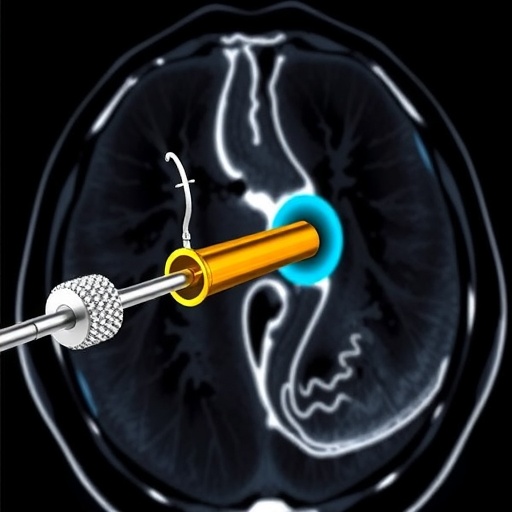
In the rapidly evolving world of medical technology, the development of novel tools that enhance precision and safety in surgical interventions holds unparalleled importance. A team of researchers led by P. Lloyd, N. Murasovs, and Y.L. May have unveiled a groundbreaking innovation: a concentric tube catheter designed specifically for endoluminal interventions. This device is distinguished not only by its unique structural configuration but also by its ability to be both steered and imaged through magnetic resonance imaging (MRI), marking a significant leap forward in minimally invasive surgical techniques.
Traditional catheter-based procedures, while less invasive than open surgery, face limitations in navigation within complex, tortuous anatomical pathways. These challenges often result in extended procedure times and increased risks of unintended tissue trauma. The concentric tube catheter proposed by this research team addresses these concerns through a meticulously engineered structure composed of nested, pre-curved tubes. The arrangement allows the catheter to achieve multiple degrees of freedom, enabling it to navigate intricate luminal pathways with unparalleled dexterity and control.
What truly sets this catheter apart is its integration with MRI technology. MRI, renowned for its exceptional soft tissue contrast and non-ionizing nature, provides real-time visualization of internal structures without exposing patients to harmful radiation. In this innovation, the catheter is designed with MRI-compatible materials and embedded with specialized markers. These features allow clinicians to precisely monitor the catheter’s position and trajectory inside the body throughout the intervention, facilitating dynamic adjustments and reducing reliance on less precise imaging modalities such as fluoroscopy.
The synergy between mechanical design and imaging capability represents a monumental step forward. By enabling continuous MRI guidance, surgeons gain enhanced situational awareness during procedures performed within the delicate confines of blood vessels, airways, or other endoluminal spaces. This heightened precision translates into improved procedural outcomes, minimized collateral damage to surrounding tissues, and ultimately a reduction in patient morbidity and recovery time.
From a biomechanical perspective, the concentric tube catheter leverages the properties of elasticity and superelasticity in its constituent tubes. Each tube, possessing its own curvature and stiffness profile, interacts with the others in a manner that can be finely tuned to produce complex, smooth shapes. This novel paradigm allows the catheter to adapt its configuration in response to the constraints imposed by anatomical structures, optimizing reach and stability during navigation.
Another critical aspect of the design is the meticulous selection of materials. The catheter must maintain compatibility with strong magnetic fields generated by MRI machines while ensuring structural integrity and biocompatibility. The research team employed advanced alloys and non-magnetic composites, overcoming the challenges posed by traditional metallic components that can induce artifacts or interfere with image quality. These material innovations ensure that the catheter’s presence does not compromise the diagnostic or procedural imaging fidelity.
The control mechanisms for steering the catheter are equally sophisticated. Utilizing a robotic actuation system, operators can manipulate the nested tubes independently with precise input commands. This robotic control is coupled with feedback from the MRI imaging system, creating a closed-loop control environment where the device’s movements are continuously refined based on live imaging data. Such integration reduces human error and enables complex maneuvers that were previously unfeasible or too risky to attempt.
This technology has profound implications for a variety of clinical applications. Endoluminal interventions encompass a broad spectrum of procedures including vascular surgeries, gastrointestinal endoscopy, and pulmonary interventions. The ability to perform these procedures with enhanced accuracy and safety could transform treatment standards for conditions such as aneurysms, tumors, or blockages within luminal organs. Particularly in cases where conventional approaches are limited by anatomical complexity, the concentric tube catheter promises to open new therapeutic possibilities.
Moreover, the real-time MRI steering capability holds potential to revolutionize interventional radiology. Instead of relying on X-ray-based methods that pose cumulative radiation risks to patients and healthcare providers, MRI-guided interventions offer a safer alternative with superior imaging detail. The catheter’s design ensures that practitioners can operate with confidence even in challenging environments like the brain or heart, where precision is paramount.
From an innovation standpoint, this work exemplifies the fruitful intersection of mechanical engineering, materials science, and medical imaging. The researchers’ collaboration across these disciplines was crucial in overcoming the multifaceted challenges inherent in creating a functional, MRI-compatible catheter system. Their approach may also inspire future developments in other medical devices that seek to harness advanced imaging modalities for guidance and control.
Looking ahead, the potential development pathways for this catheter system are expansive. Clinical trials will be essential to validate safety profiles and procedural efficacy in human subjects. Furthermore, integrating artificial intelligence algorithms with MRI data streams could further enhance the catheter’s steering automation, enabling semi-autonomous or fully autonomous navigation through highly complex vascular or luminal structures.
The practical implementation of this technology also hinges on the refinement of MRI infrastructure. While MRI machines are commonplace in many medical centers, adapting them to accommodate and optimize real-time interventional workflows will require dedicated hardware and software improvements. Such advancements could transform operating suites into multimodal hubs where diagnostic imaging and therapeutic interventions proceed seamlessly in tandem.
From a patient perspective, the promise of reduced invasiveness, less radiation exposure, and expedited recovery timelines is compelling. Surgeons equipped with this catheter will be empowered to execute interventions that were previously considered too risky or logistically challenging. This may expand access to life-saving procedures for patient populations who currently face limited options due to anatomical or clinical complexities.
In sum, the concentric tube catheter for endoluminal interventions represents a paradigm shift in minimally invasive medicine. By uniting the precise mechanical articulation afforded by nested tube design with the unparalleled imaging prowess of MRI, the innovation delivers an advanced surgical instrument built for the demands of future medicine. As this technology progresses from bench to bedside, it bears the potential to redefine standards of care, improve patient safety, and catalyze new frontiers in interventional therapies.
The research presented by Lloyd, Murasovs, May, and their colleagues stands as a testament to the power of interdisciplinary collaboration. Their work not only charts a course for enhanced catheter-based interventions but also signals a broader movement toward medical devices deeply integrated with real-time imaging modalities. As such, it points toward a future where surgical precision is elevated by a fusion of mechanical ingenuity and imaging excellence, opening endless possibilities for innovation in healthcare.
Subject of Research: Development of a concentric tube catheter for endoluminal interventions, capable of being steered and imaged via magnetic resonance imaging (MRI).
Article Title: A concentric tube catheter for endoluminal interventions, steered and imaged via magnetic resonance imaging.
Article References:
Lloyd, P., Murasovs, N., May, Y.L. et al. A concentric tube catheter for endoluminal interventions, steered and imaged via magnetic resonance imaging.
Commun Eng (2026). https://doi.org/10.1038/s44172-026-00636-1
Image Credits: AI Generated
Tags: advanced surgical precision toolscatheter dexterity in tortuous anatomycomplex vascular pathway navigationenhanced safety in catheter proceduresinnovations in minimally invasive surgerymagnetic resonance imaging in catheter steeringminimally invasive endoluminal interventionMRI-compatible medical devicesMRI-guided concentric tube catheternon-ionizing imaging in surgerypre-curved nested tube catheter designreal-time MRI navigation