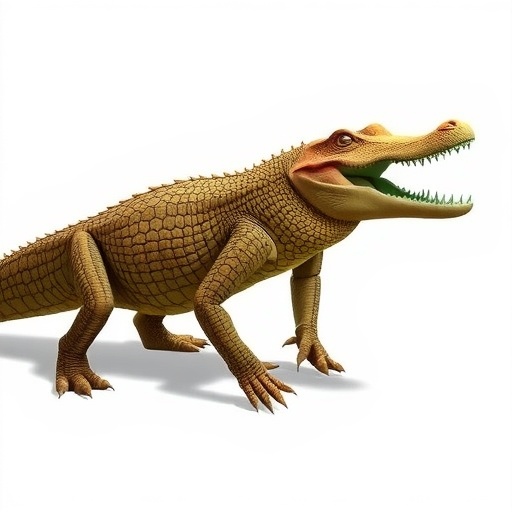
A remarkable discovery from the depths of Late Triassic strata has brought to light an extraordinary reptilian ancestor of modern crocodiles that challenges longstanding views about locomotion in early archosaurs. Named Sonselasuchus cedrus, this diminutive, roughly 25-inch-tall shuvosaurid from the petrified wood-laden landscape of present-day Petrified Forest National Park in Arizona exemplifies a surprising evolutionary adaptation: it appears these creatures abandoned quadrupedal movement as they matured, transitioning to a bipedal gait. This trait, both unexpected and scientifically significant, emerges from an extensive examination of its fossilized limb proportions and offers fresh insights into the complexity of archosaur evolution nearly 215 million years ago.
Researchers from the University of Washington’s Department of Biology, in conjunction with scientists at the Burke Museum, have unveiled these findings in the Journal of Vertebrate Paleontology, presenting a meticulous osteological analysis of Sonselasuchus fossils unearthed since 2014. These fossils belong to the Sonsela Member of the Upper Triassic Chinle Formation, a geologic unit richly endowed with well-preserved archosaur remains that continue to shed light on Late Triassic ecosystems. Analyzing over 950 specimens from this species, the team observed a differential growth pattern affecting limb proportions that strongly suggests a shift in locomotor strategy during ontogeny.
Elliott Armour Smith, the study’s lead author, articulates the fundamental observation: juveniles possessed relatively balanced forelimbs and hindlimbs, consistent with quadrupedal locomotion. However, as these animals reached adulthood, their hindlimbs elongated and thickened disproportionately relative to the forelimbs. This ontogenetic transformation, realized through changes in limb skeletogenesis and muscle attachments inferred from bone morphology, indicates a functional shift toward bipedalism. Such developmental plasticity is extraordinary among pseudosuchians, which traditionally are understood to have retained sprawling or semi-erect quadrupedal postures throughout life.
This bipedal tendency in Sonselasuchus is particularly compelling given its phylogenetic position within Poposauroidea, a clade of croc-line archosaurs often overshadowed by their bird-line contemporaries—namely theropod dinosaurs. Morphologically, shuvosaurids, including Sonselasuchus, exhibited convergent evolution toward traits reminiscent of ornithomimid (ostrich-like) dinosaurs: a toothless beak, extensive hollowing of bones, and enlarged orbital regions. Yet, these features arose independently on the croc-line evolutionary trajectory, underscoring a fascinating example of ecological convergence as archosaur lineages exploited similar niches within Late Triassic terrestrial ecosystems.
The ecological implications of Sonselasuchus’ locomotion and morphology are profound. Its denizen status in densely forested habitats, dominated by coniferous flora such as cedar-like trees hence the species epithet cedrus, suggests selective pressures favoring agile bipedal movement possibly for foraging or predator avoidance. The toothless beak hints at an omnivorous or herbivorous diet, diverging from the carnivorous norms seen in many contemporaneous pseudosuchians. Hollow bones, a trait typically associated with weight reduction in high-mobility animals, further denote an adaptation towards increased locomotive efficiency.
The Petrified Forest bonebed from which Sonselasuchus fossils derive is a paleontological treasure trove, amassing over 3,000 bones that chronicle an intricate snapshot of Late Triassic biodiversity. This rich assemblage includes fishes, amphibians, and various reptiles and dinosaurs, allowing researchers an unprecedented window into ecosystem dynamics. The collaborative effort over the past decade between the University of Washington, Burke Museum, and the National Park Service, involving students and volunteers, continues to yield new species and refine our understanding of the evolutionary pathways of archosaurs.
The elucidation of Sonselasuchus’ anatomical and functional characteristics advances broader questions about the evolutionary origins of bipedalism, a hallmark locomotor pattern significantly impacting vertebrate diversification. While bipedality is well-documented in bird-line archosaurs (dinosaurs and their avian descendants), its independent emergence on the croc-line challenges previous assumptions about muscular and skeletal constraints within pseudosuchians. Morphometric analyses in this study emphasize the critical role of ontogenetic trajectories in facilitating such locomotor shifts.
Moreover, the discovery underscores the complexity of convergent evolutionary processes in ecosystems where multiple archosaur clades coexisted and competed. The parallel acquisition of features such as toothless beaks, large orbits, and bipedal stance across these distinct lineages testifies to similar selective pressures shaping their morphology and behavior, despite divergent ancestries. This reinforces the notion that analogous ecological roles can drive remarkably similar evolutionary outcomes.
This research not only enriches the taxonomic and functional understanding of shuvosaurids but also prompts reevaluation of Late Triassic archosaur diversity and adaptive strategies. As ongoing excavations at Petrified Forest National Park unearth more skeletal elements, refined biomechanical modeling and histological studies are anticipated, potentially unveiling further insights into growth patterns, metabolism, and phylogenetic relationships within Poposauroidea.
Ultimately, Sonselasuchus cedrus embodies a fascinating chapter in archosaur evolution, illustrating how developmental plasticity and ecological opportunity can lead to atypical locomotor adaptations. Its story, emerging from Arizona’s fossil-rich strata, resonates with the broader quest to decode the evolutionary experiments that predate the more familiar dinosaur-dominated Mesozoic landscapes. With its blend of croc-line ancestry and dinosaur-like morphology, Sonselasuchus challenges our conventional paradigms and invites deeper inquiry into the multifaceted nature of archosaur diversification.
Subject of Research: Evolutionary osteology and locomotor adaptations of the Late Triassic shuvosaurid Sonselasuchus cedrus from the Chinle Formation.
Article Title: Osteology and relationships of a new shuvosaurid (Pseudosuchia, Poposauroidea) from the Upper Triassic Chinle Formation of Petrified Forest National Park, Arizona, U.S.A.
News Publication Date: 9-Mar-2026
Web References: https://tandfonline.com/doi/full/10.1080/02724634.2025.2604859
Image Credits: Artwork by Gabriel Ugueto
Keywords: Sonselasuchus cedrus, shuvosaurid, Pseudosuchia, Triassic, bipedalism, archosaur evolution, Petrified Forest National Park, Chinle Formation, convergent evolution, limb ontogeny, osteology, croc-line archosaurs
Tags: archosaur ontogenetic locomotion shiftevolutionary adaptations in archosaursfossilized limb proportions analysisLate Triassic archosaur evolutionLate Triassic terrestrial ecosystemsPetrified Forest National Park fossilsprehistoric crocodile ancestorsquadrupedal to bipedal transitionshuvosaurid growth patternsSonselasuchus cedrus locomotionUniversity of Washington paleontology researchUpper Triassic Chinle Formation discoveries