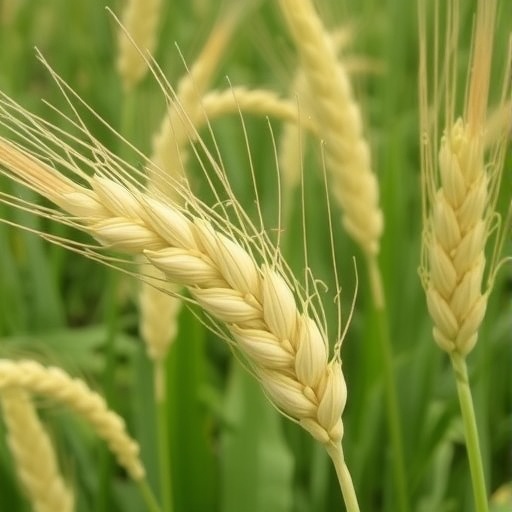
In a groundbreaking advancement for global agriculture, scientists have unveiled a novel genetic weapon against the devastating wheat disease known as stripe rust. Caused by the fungal pathogen Puccinia striiformis f. sp. tritici, stripe rust poses a formidable threat to wheat production worldwide, imperiling food security and farmer livelihoods. Now, an international team of researchers has identified and characterized a unique resistance gene derived from rye, offering broad-spectrum protection against this dangerous pathogen and promising to reshape the future of wheat breeding.
The journey toward this discovery began with an extensive screening project involving 100 distinct hexaploid triticale accessions. Triticale, a wheat-rye hybrid species, often combines the favorable traits of both parent cereals but had not been fully explored for disease resistance potential. Using the most prevalent Chinese races of stripe rust—CYR32, CYR33, and CYR34—the researchers meticulously tested diverse genetic lines to pinpoint sources of durable resistance. Remarkably, the vast majority of these accessions exhibited significant immunity, with the cultivar Rozovskaya standing out for its near-complete resistance, a rare and highly desirable trait.
Building on this promising screening result, the research team embarked on a sophisticated map-based cloning strategy to locate the underlying resistance gene within the triticale genome. They succeeded in pinpointing a locus on chromosome 6RL, the long arm of rye chromosome 6. This genetic locus harbored a gene with the ability to confer resistance when introgressed into wheat, representing a valuable genomic resource for wheat improvement efforts.
To validate their findings and understand the natural variation of this gene, the scientists delved into resequencing data from a comprehensive panel of 117 rye accessions, spanning globally diverse lineages. This analysis delineated two major haplotypes, both closely associated with nearly complete immunity to stripe rust. Intriguingly, when these haplotypes were introduced into wheat through transgenic approaches, they retained their potent protective effect, confirming their broad efficacy against multiple stripe rust races.
The gene, now designated Yr83, encodes a highly atypical protein that fuses classical immune recognition domains with a transposase-derived nuclease domain. More specifically, Yr83 encodes a nucleotide-binding leucine-rich repeat (NLR) protein fused to a domain derived from a Harbinger transposase (HTDND), a class of mobile genetic elements. This fusion is unusual and highlights the dynamic evolutionary interplay between plant immunity and transposable elements, which may contribute to innovation in plant defense.
Functional characterization revealed the critical importance of the transposase-derived nuclease domain to the gene’s resistance function. Truncation experiments showed that removal of the HTDND abolished the protective phenotype, unequivocally demonstrating that this integration is not a passive relic but an essential component of immune activation. This finding opens exciting new vistas for understanding how plants harness and repurpose transposable elements in the arms race against pathogens.
Phylogenetic analyses placed the NLR–HTDND fusion proteins within a narrowly defined clade restricted to the Pooideae subfamily, which includes major cereal crops such as wheat, barley, and rye. This specificity suggests that the evolutionary innovation represented by Yr83 might be a relatively recent event adapted to the unique challenges faced by temperate grasses, underpinning their complex immunity strategies.
From a practical standpoint, the research team succeeded in developing a small translocation line of wheat incorporating the 6RL segment containing Yr83. Far from being a genetic burden, this translocation line exhibited excellent agronomic traits, including not only robust resistance to stripe rust but also improved spikelet number and grain yield per spike. This dual benefit is particularly significant for breeders seeking to enhance both disease resistance and crop productivity simultaneously.
The discovery of Yr83 therefore stands at the nexus of biotechnology, genomics, and traditional breeding, exemplifying the power of integrative approaches in tackling global food security challenges. Beyond direct applications for wheat stripe rust control, this study underscores the potential of transposase-integrated NLR proteins as a novel class of resistance genes, potentially applicable to a wide array of cereal diseases and beyond.
This work also highlights the strategic value of underutilized genetic resources such as triticale and rye, which harbor untapped reservoirs of valuable traits. By leveraging these resources with cutting-edge genomic tools, scientists can accelerate the development of resilient crop varieties capable of meeting the demands of a rapidly growing global population and increasingly unpredictable climatic conditions.
Looking ahead, the team envisions expanding the application of Yr83 through advanced breeding programs and biotechnological innovations. The incorporation of this gene into elite wheat varieties worldwide could revolutionize stripe rust management, reducing reliance on chemical fungicides and minimizing crop losses while promoting sustainable agriculture.
Furthermore, the mechanistic insights gleaned from Yr83 open new research avenues into the molecular biology of plant immunity. Understanding how the HTDND domain modulates NLR function may unlock new strategies for engineering resistance genes with enhanced durability and spectrum, leveraging natural evolutionary innovations to outperform traditional resistance genes.
As the battle against stripe rust intensifies in the coming years, the identification and deployment of Yr83 represent a beacon of hope for farmers struggling to protect their harvests. Its broad effectiveness against diverse pathogen races, coupled with its beneficial agronomic impact, makes it a rare genetic asset with far-reaching implications.
The study serves as a testament to the synergy between classical genetic mapping, state-of-the-art sequencing technologies, and functional genomics in addressing some of the most pressing challenges in crop science. By embracing such interdisciplinary strategies, researchers have not only enriched our understanding of plant-pathogen interactions but have also delivered tangible benefits for agriculture and food systems.
In conclusion, the elegant fusion of an NLR immune receptor with a transposase-derived domain in Yr83 epitomizes nature’s inventive prowess in generating novel defense mechanisms. This discovery heralds a new era where transposable elements are not mere genomic curiosities but vital components actively shaping plant immunity and resilience. The deployment of Yr83 in wheat breeding programs stands poised to markedly diminish the impact of stripe rust, safeguarding yields and contributing to global food stability for years to come.
Subject of Research: Wheat stripe rust resistance mediated by a novel NLR–transposase fusion gene from rye.
Article Title: An NLR–transposase fusion gene from rye provides broadly effective resistance to stripe rust in wheat.
Article References:
Wang, C., Fu, S., Yi, C. et al. An NLR–transposase fusion gene from rye provides broadly effective resistance to stripe rust in wheat. Nat. Plants (2026). https://doi.org/10.1038/s41477-026-02248-1
Image Credits: AI Generated
DOI: https://doi.org/10.1038/s41477-026-02248-1
Tags: broad-spectrum disease resistancedurable stripe rust immunityfungal pathogen resistance geneticsglobal wheat disease managementhexaploid triticale screeningmap-based cloning in triticalePuccinia striiformis f. sp. triticiRozovskaya cultivar resistancerye-derived resistance genewheat breeding for rust resistancewheat stripe rust resistancewheat-rye hybrid disease resistance