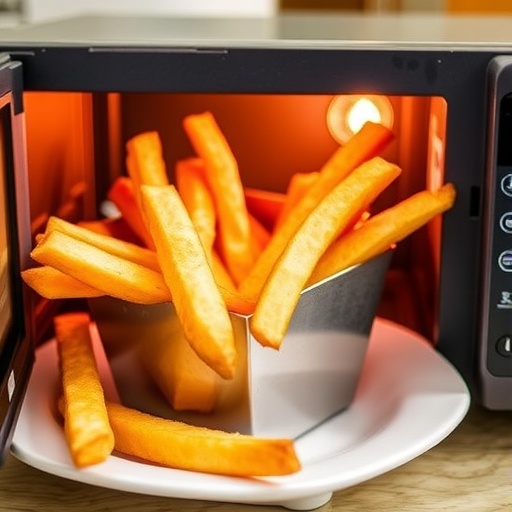
In a world captivated by the crunch and flavor of fried foods, the health implications of consuming these high-fat delights often weigh heavily on consumers’ minds. Obesity, hypertension, and other diet-related health issues have driven a demand for healthier food alternatives without sacrificing the texture and taste that make these foods so irresistible. Recent advancements at the University of Illinois Urbana-Champaign shed light on a groundbreaking method to revolutionize the fried food industry through microwave frying technology, promising lower-fat French fries with uncompromised quality.
The traditional frying process involves immersing potato strips in hot oil, usually heated to around 180 degrees Celsius, where heat gradually penetrates from the surface to the core. While this method yields the desired crispy exterior and fluffy interior, it unfortunately also results in substantial oil absorption. The research led by Professor Pawan Singh Takhar, a food engineering expert, explores how integrating microwave energy into this process can modify the underlying physical dynamics, thereby reducing the oil content in the final product.
Crucial to the team’s discovery is the intricate behavior of pressure and moisture inside the potatoes during frying. Initially, the pores within the potato strips are saturated with water, acting as a barrier to oil penetration. However, as the frying progresses, water evaporates, creating voids that generate negative pressure. This vacuum-like condition effectively draws oil into the food through microscopic channels, much like liquid being sucked through a straw. This phenomenon accounts for much of the oil absorption during frying, predominantly in the latter stages.
Unlike conventional ovens that heat food from the outside inward, microwave ovens uniquely agitate water molecules directly, generating heat internally and uniformly. By applying microwave heating during frying, vapor formation intensifies, maintaining a positive pressure inside the potato pores for a longer duration. This positive pressure counters the suction effect, thereby delaying or even preventing oil from being drawn inside. These insights underpin the proposal to blend conventional frying with microwave technology, marrying texture with healthier oil content.
Collaborating with specialists from Washington State University, the researchers utilized a specialized microwave fryer capable of operating at frequencies of 2.45 GHz—typical in household microwave ovens—and 5.8 GHz. By experimenting with pre-processed potato samples—including rinsing, peeling, cutting, blanching, and salting—they meticulously documented parameters such as temperature gradients, pressure variations, moisture levels, volume changes, texture profiles, and oil absorption rates throughout the frying cycle, revealing compelling distinctions between traditional and hybrid methods.
While microwave frying alone accelerates moisture loss and shortens cooking times, it often compromises the crispiness consumers desire, producing a soggy texture that is unappealing. Hence, Takhar and his team emphasize the complementary nature of conventional and microwave frying: microwaves expedite internal heating and decrease oil uptake, whereas traditional frying finishes the product with a satisfying crunch. Integrating these heating modes within a single apparatus stands as a promising innovation for the food industry aimed at healthier fried products.
To deepen their understanding, the second facet of the research turned to mathematical modeling, applying hybrid mixture theory and electromagnetics equations to simulate the unsaturated transport phenomena during frying. This advanced computational approach enables precise quantification of how variables such as temperature, pressure, texture, and moisture interplay during microwave frying at different frequencies. Not only does this method validate experimental observations, but it also provides predictive capabilities crucial for process optimization.
The findings indicate that microwave frequencies of 2.45 GHz and 5.8 GHz both enhance frying efficiency, with variations in heating uniformity and pressure behavior. Faster evaporation at these frequencies translates into shortened frying durations and diminished oil penetration, directly addressing major health concerns associated with fried foods. Moreover, this dual-mode frying method has the potential to preserve volume and texture integrity, factors essential for consumer acceptance.
From an industrial perspective, continuous frying machines—widely used in large-scale snack and fast-food production—can be economically retrofitted with microwave generators. These components are relatively low cost and reliable, suggesting that widespread adoption of this technology is feasible without prohibitive capital expenditure. Such integration would empower manufacturers to meet growing consumer demand for healthier options without overhauling existing production lines dramatically.
Consumer habits often oscillate between craving indulgent flavors and striving for healthier choices. The research spearheaded by Takhar and doctoral student Yash Shah offers a scientific bridge between these competing desires, potentially steering the market towards fried foods that maintain sensory satisfaction but with a fraction of the typical oil intake. With obesity and hypertension prevalent worldwide, this innovation aligns with public health initiatives aiming to reduce caloric excess and improve nutritional outcomes.
This pioneering work not only elucidates the thermodynamic and material science principles governing frying but also paves the way for future investigations into other food matrices and microwave-assisted culinary techniques. As the food industry increasingly embraces technology-driven solutions, such interdisciplinary research exemplifies how engineering, physics, and nutrition science can converge to enhance everyday products profoundly.
Ongoing research endeavors and collaborative efforts will be pivotal as commercial prototypes emerge, consumer trials advance, and regulatory frameworks adapt to new frying methodologies. Ultimately, marrying microwave and conventional heating could mark a significant milestone in food processing, offering crispy, flavorful, and health-conscious fried foods for the global population.
Subject of Research: Microwave and conventional frying techniques applied to French fries to reduce oil content without compromising sensory qualities
Article Title: Predicting the quality changes during microwave frying of food biopolymers by solving the hybrid mixture theory-based unsaturated transport, and electromagnetics equations
News Publication Date: December 8, 2025
Web References:
– https://ift.onlinelibrary.wiley.com/doi/10.1111/1750-3841.70441
– http://dx.doi.org/10.1016/j.crfs.2025.101264
References:
– Shah, Y., Zhou, X., Tang, J., & Takhar, P.S. (2025). The Effect of Conventional and Microwave Frying on the Quality Characteristics of French Fries. Journal of Food Science. DOI: 10.1111/1750-3841.70441
– Shah, Y., & Takhar, P.S. (2025). Predicting the quality changes during microwave frying of food biopolymers by solving the hybrid mixture theory-based unsaturated transport, and electromagnetics equations. Current Research in Food Science. DOI: 10.1016/j.crfs.2025.101264
Keywords: microwave frying, food biopolymers, oil absorption reduction, hybrid heating technology, pressure dynamics, water vapor, food texture, food engineering, frying optimization, mathematical modeling, health-conscious foods, food production technology
Tags: crispy texture with less oilfood engineering innovationshealthier fried food alternativeslow-fat French fries methodmicrowave energy in food processingmicrowave frying technologymicrowave-assisted cooking techniquesobesity and diet-related health solutionspotato frying process improvementspressure and moisture in fryingreducing oil content in French friesUniversity of Illinois frying research