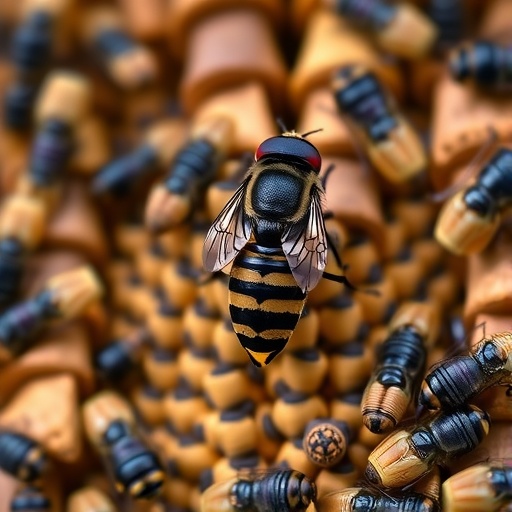
In a groundbreaking advance poised to reshape sustainable waste management, a recent study published in Environmental Science & Technology Letters reveals the remarkable ability of black soldier fly larvae to reduce viral contaminants in organic waste streams. As humanity grapples with escalating waste production from households and livestock operations, traditional disposal methods such as landfilling and incineration pose serious environmental and public health challenges. This innovative biological treatment, harnessing the virus-modulating capacity of Hermetia illucens larvae, may offer a paradigm shift toward more eco-friendly and safe waste processing practices.
The research team, led by Gang Luo and Zhijian Shi, embarked on an ambitious investigation into how black soldier fly larvae interact with RNA viruses commonly found in various types of organic waste, including spoiled food remnants, municipal sewage sludge, and pig manure. This work addresses a critical knowledge gap, as viruses in organic wastes frequently evade detailed scrutiny despite posing infection risks to humans, animals, and ecological systems. By systematically exposing larvae to diverse waste matrices for an eight-day period and evaluating the viral load in feedstock, larvae, and excreted frass, the study provides rigorous insights into viral fate during and after insect-mediated decomposition.
One of the pivotal findings of the study is that black soldier fly larvae not only thrive nutritionally on these challenging substrates—gaining weight variably with food waste supporting the largest biomass increase—but they also substantially decrease the abundance of many human-pathogenic RNA viruses. Analyses revealed a broad RNA viral diversity present initially, encompassing agents capable of infecting bacteria, fungi, plants, animals, and humans. Notably, viruses such as noroviruses, notorious for causing gastroenteritis outbreaks globally, demonstrated significant reductions in fecal wastes following larval digestion. This suggests that bioconversion with black soldier fly larvae may simultaneously support waste valorization and mitigate viral hazards.
However, the research also uncovers complexities in this biological treatment approach. While larvae consuming spoiled food waste harbored a relatively low incidence of insect-specific viruses, which pose minimal ecological or zoonotic threats, those raised on sewage sludge or pig manure exhibited higher viral diversity within their bodies. Furthermore, some human-pathogenic viral sequences—exemplified by picobirnaviruses known to induce digestive symptoms—persisted in both larval tissues and their nutrient-rich frass. These findings raise important questions about the viability and infectious potential of residual viruses post-treatment.
The persistence of certain RNA viruses points to the necessity for integrated treatment strategies if black soldier fly larvae are to be safely incorporated into animal feed chains or if their frass is to be applied as fertilizer. It remains imperative to ascertain whether the detected viral genetic material corresponds to infectious virions or merely degraded, non-viable remnants. The researchers emphasize that confirming viral activity status is a critical next step to ensure biosafety and public confidence in a circular bioeconomy wherein waste is continuously upcycled.
Beyond these immediate findings, the study highlights the massive yet underexplored virome embedded within organic waste systems and the transformative potential of insect-based bioconversion technologies. The metabolic pathways, immune interactions, and microbial ecology governing viral reduction within black soldier fly larvae are promising avenues for future mechanistic investigations. Deciphering these complex interplays could unlock optimized protocols to maximize pathogen elimination while upscaling sustainable insect farming operations.
With global organic waste production burgeoning alongside increasing concerns about antibiotic resistance, chemical contaminants, and pathogen transmission, this research situates black soldier fly larvae at the nexus of environmental remediation and public health protection. Utilizing these insects aligns with principles of biomimicry and green biotechnology, leveraging natural trophic processes without introducing synthetic chemicals or intensive energy inputs. The larvae’s ability to convert wastes into high-protein biomass further contributes to resource circularity by generating promising feedstock alternatives.
The research team’s concerted efforts mark a significant advance in environmental virology and entomological waste treatment, paving the way for scalable applications. Their interdisciplinary approach—combining molecular virology, entomology, and waste science—demonstrates how cutting-edge analytical methods can unravel biological complexities in real-world settings. This work underscores black soldier fly larvae’s dual role as both effective bioconverters of hazardous organic matter and living biofilters capable of modifying viral pathogen profiles.
Moving forward, the study calls attention to several urgent research priorities: quantitative assessments of viral inactivation kinetics within larvae and frass, comprehensive risk evaluations for downstream uses, and exploration of larvae’s immune responses to different viral taxa. By addressing these questions, scientists and policymakers can devise holistic regulatory frameworks that harness insect-based waste bioconversion with stringent safety assurances. Such progress will be vital for integrating this technology into municipal waste management infrastructures worldwide.
Ultimately, this research illuminates an exciting intersection of ecology, microbiology, and sustainable engineering. As black soldier fly larvae emerge as nature’s tiny warriors against viral contamination in organic waste, their deployment heralds more resilient systems for environmental stewardship and pathogen control. Commercial adoption may revolutionize the way society manages burgeoning organic wastes, reduces viral transmission risks, and recycles nutrients, bringing us closer to achieving truly circular, health-conscious bioeconomies.
In conclusion, the findings published by Luo, Shi, and colleagues not only expand our understanding of organic waste viromes but also provide compelling evidence supporting black soldier fly larvae as a promising, eco-friendly solution. While further research is warranted to ensure complete pathogen degradation and safe reuse scenarios, this innovative approach could revolutionize waste management and public health protections globally. Harnessing the virus-reducing potential of black soldier fly larvae offers an inspiring example of how nature-derived technologies can confront modern environmental challenges through scientific ingenuity and sustainable design.
Subject of Research: Using black soldier fly larvae to reduce RNA viruses in organic waste streams.
Article Title: Unveiling the Hidden RNA Virus Diversity in Organic Wastes: Shaping and Reduction Effects of Black Soldier Fly Treatment
News Publication Date: 4-Mar-2026
Web References: https://pubs.acs.org/doi/abs/10.1021/acs.estlett.5c01207
References: National Natural Science Foundation of China funded the research.
Keywords
Black soldier fly, RNA viruses, organic waste, viral reduction, bioconversion, waste management, pathogen control, sustainable biotechnology, frass safety, virus inactivation, circular bioeconomy, environmental virology.
Tags: black soldier fly larvae organic waste managementeco-friendly waste processing methodsHermetia illucens viral contaminationinnovative waste bioconversion techniquesinsect-mediated decomposition of wastemunicipal sewage sludge virus reductionpig manure virus mitigationRNA virus degradation by insectssafe disposal of organic wastesustainable biological waste treatmentviral load monitoring in waste streamsvirus reduction in organic waste