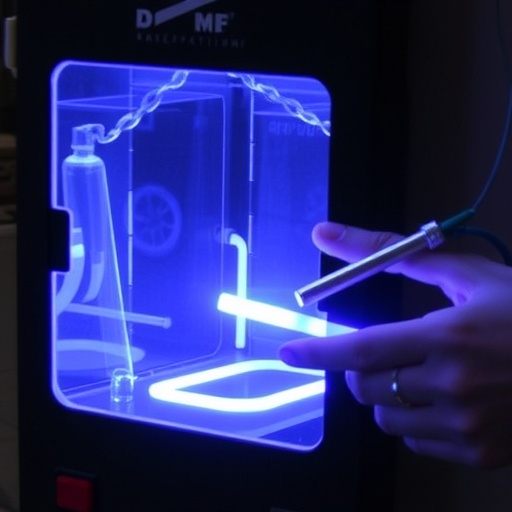
In the evolving landscape of sustainable energy, the rapid and efficient recycling of lithium-ion batteries stands as a critical challenge. Battery recycling not only mitigates the environmental impact of discarded batteries but also recovers valuable materials essential for the production of new energy storage devices. A groundbreaking study published in Communications Engineering reveals that X-ray fluorescence spectroscopy (XRF) can serve as a powerful tool for the rapid identification of cathode chemistry in lithium-ion battery recycling, potentially revolutionizing the way recyclable components are sorted and processed.
At the heart of this innovation lies the complexity of lithium-ion battery cathodes, which are composed of a diverse range of metal oxides, depending on their chemistry. From lithium cobalt oxide (LCO) to nickel manganese cobalt (NMC) and lithium iron phosphate (LFP), each cathode variant requires tailored recycling protocols to efficiently extract metals like lithium, cobalt, nickel, and manganese. The conventional approaches often involve time-consuming chemical analysis and sampling, which slows down the recycling process and increases costs. The new approach with XRF spectroscopy offers a non-destructive, rapid, and highly accurate alternative by precisely determining the elemental composition of cathode materials in a matter of seconds.
X-ray fluorescence spectroscopy works by directing an X-ray beam onto the battery cathode surface, prompting the atoms within the sample to emit secondary, fluorescent X-rays specific to each element present. By measuring these characteristic emissions, the elemental makeup can be deduced without the need to prepare or chemically treat the sample. This capability is particularly vital in battery recycling environments where speed and accuracy are paramount. Ren et al.’s work leverages state-of-the-art XRF instrumentation to differentiate between cathode chemistries, enabling recyclers to categorize large volumes of battery materials quickly.
One remarkable aspect of this research is the fine granularity with which XRF can distinguish subtle variations in elemental ratios within mixed cathode chemistries, a factor that had historically posed a significant challenge. For instance, discriminating between various grades of NMC batteries—such as NMC 111, 532, or 811—requires precise measurement of nickel, manganese, and cobalt proportions. The study demonstrates that through careful calibration and spectral analysis, XRF can identify these differences with remarkable confidence, thus guiding the choice of subsequent processing techniques that optimize metal recovery.
Moreover, this method carries consequential implications for the overall sustainability and economics of battery recycling. Rapid, in situ chemical characterization reduces the need for extensive laboratory testing, cuts waiting times, and lowers operational costs. Recycling facilities equipped with XRF systems could implement real-time sorting lines, increasing throughput while ensuring that materials are funneled into the most appropriate recovery streams. By improving material segregation efficiency, the technology supports higher purity outcomes in recovered metals, enhancing their resale value and usefulness in the battery production cycle.
Another intriguing insight from the study highlights the role of XRF spectroscopy in quality control during the disassembly of spent battery packs. Battery cells often degrade unevenly, with chemical compositions potentially shifting during usage and aging. Utilizing XRF to screen individual cells or modules before recycling allows operators to identify high-value materials or cells suitable for reuse or second-life applications. This multimodal utility of XRF in both recycling and repurposing workflows reflects a holistic approach to battery lifecycle management.
Ren and colleagues also tackle challenges related to sample heterogeneity and surface contamination, which can influence XRF measurements. Their method integrates advanced data processing algorithms that correct for irregularities in sample morphology and surface coatings, ensuring reliable readings from samples directly sourced from battery disassembly lines. This innovation overcomes previous barriers that limited XRF’s applicability in complex industrial materials, propelling the technology into mainstream battery recycling operations.
The environmental implications of adopting XRF-based identification are profound. By enabling faster and more precise identification of cathode chemistries, the method indirectly promotes resource conservation and reduces toxic waste generation. Lithium, cobalt, and nickel extraction from virgin ores is environmentally taxing, often associated with severe ecological degradation and geopolitical concerns. Enhanced recycling efficiency supported by XRF screening contributes to a circular economy model, decreasing reliance on primary mining activities and reducing carbon footprints linked to battery manufacturing.
Industry stakeholders have taken note of these advancements, envisioning integration of XRF spectroscopy into automated sorting robots and conveyor belt systems within battery recycling plants. Embedding XRF sensors along material streams could allow continuous, non-stop chemical profiling without manual intervention. This would not only streamline operations but also enable dynamic adjustments in processing parameters based on real-time data, further amplifying recovery yields and operational flexibility.
Beyond lithium-ion cathode characterization, the potential applications of XRF extend to other battery components and chemistries. Current and future battery technologies incorporating novel materials, including solid-state batteries and lithium-sulfur chemistries, present new identification challenges. The adaptability of XRF spectroscopy to diverse elemental analyses suggests a promising role in these emerging markets, supporting proactive recycling solutions aligned with technological evolution.
The rapid identification capabilities also lend themselves to regulatory compliance and safety assurance in the battery recycling sector. Accurate chemical profiling supports hazardous material classification, ensuring safe handling, transport, and processing according to environmental and occupational health standards. In light of increasing regulations worldwide aimed at reducing battery-related risks, XRF provides operators with a reliable means to meet legal requirements efficiently and transparently.
From a scientific perspective, the publication underscores the importance of multidisciplinary collaboration in tackling the complex issues surrounding battery recycling. The integration of material science, analytical chemistry, environmental engineering, and industrial process design has culminated in this XRF-driven solution. Continued research will likely focus on enhancing spectral resolution, miniaturization of devices, and the development of AI-powered interpretive algorithms, further advancing the field.
In conclusion, the application of X-ray fluorescence spectroscopy to the rapid determination of lithium-ion battery cathode chemistry represents a transformative leap in recycling technology. By enabling swift, accurate, and non-destructive identification of key cathode elements, this approach boosts efficiency, economic viability, and environmental sustainability in battery recovery operations. As lithium-ion batteries become ubiquitous in our energy ecosystem, innovations such as this will be pivotal in crafting a sustainable material flow and closing the loop on battery lifecycles.
With the global push towards electrification and energy storage, waste battery volumes are projected to rise exponentially over the next decade. The scalable and adaptable nature of XRF spectroscopy positions it as a cornerstone technology capable of meeting the demands of this emerging circular economy. The findings shared by Ren et al. signal a compelling future where rapid, precise analytics empower smarter recycling infrastructures, facilitating the green energy revolution while safeguarding natural resources.
The perennial quest for efficient battery recycling gains a potent ally through advanced X-ray fluorescence techniques, reminding us that the convergence of physics and environmental stewardship can yield solutions vital for a sustainable tomorrow. As academia and industry continue to collaborate, the adoption of XRF for cathode chemistry identification may soon become an industry standard, accelerating our journey toward a cleaner and more circular energy future.
Subject of Research: Rapid identification of lithium-ion battery cathode chemistry for recycling purposes using X-ray fluorescence spectroscopy.
Article Title: X-ray fluorescence spectroscopy for rapid identification of cathode chemistry in lithium-ion battery recycling.
Article References: Ren, F., Vidal, V., Campos, A. et al. X-ray fluorescence spectroscopy for rapid identification of cathode chemistry in lithium-ion battery recycling. Commun Eng (2026). https://doi.org/10.1038/s44172-026-00618-3
Image Credits: AI Generated
Tags: advanced recycling technologies for batteriesefficient metal extraction from batteriesenvironmental impact of battery wastelithium cobalt oxide cathode recyclinglithium iron phosphate battery recyclinglithium-ion battery recycling methodsnickel manganese cobalt cathode sortingnon-destructive battery analysis toolsrapid cathode identification techniquesrecycling process optimization for energy storage materialssustainable lithium battery material recoveryX-ray fluorescence spectroscopy in battery recycling