In a groundbreaking comprehensive study conducted in Denmark, researchers have unveiled compelling evidence that a minimally invasive technique known as ablation rivals traditional surgery in effectively managing small kidney cancers. Tracking nearly 1,900 patients over a span of almost ten years, the study underscores ablation’s capacity to deliver outcomes comparable to surgical intervention, but with the added benefits of accelerated recovery times and fewer complications. These findings were recently published in the prestigious journal Radiology, affirming the transformative potential of ablation within urologic oncology.
The investigation centered on stage T1a renal cell carcinoma, a subtype of kidney cancer often detected incidentally during imaging procedures for unrelated medical conditions, such as prostate or ovarian examinations. This incidental discovery phenomenon has led to increasing identification of early-stage renal tumors, prompting urgent calls within the medical community to refine treatment strategies that strike a balance between efficacy and patient quality of life.
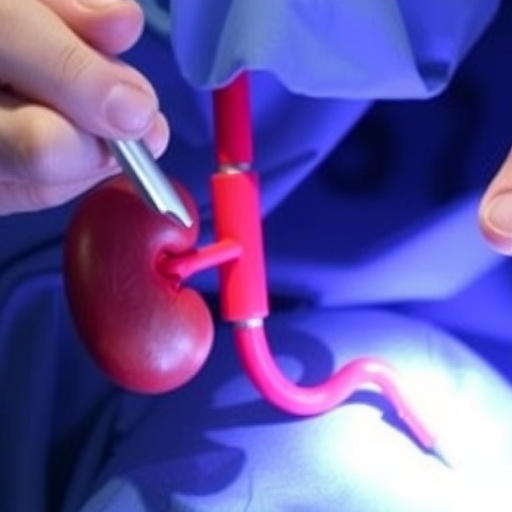
Traditionally, surgical resection—either partial or total removal of the affected kidney tissue—has been the cornerstone of therapy for early-stage kidney cancer. However, advances in image-guided therapeutic modalities have propelled ablation to the forefront as an appealing alternative. The ablation procedure operates by delivering localized extreme temperatures, either heat via radiofrequency ablation or freezing temperatures during cryoablation, to eradicate tumor cells without necessitating large incisions or extensive tissue removal.
Aarhus University’s Professor Iben Lyskjær and her colleagues harnessed Denmark’s robust nationwide health registries to assemble a real-world cohort of patients diagnosed between 2013 and 2021. This extensive data pool allowed for a granular comparison between three treatment arms: ablation, tumor resection, and nephrectomy. Their rigorous analysis incorporated a diverse patient population, with a median age of 64 years, ensuring findings reflected typical clinical scenarios.
Crucially, the study observed no significant disparity in the risk of cancer progression between patients undergoing ablation and those receiving surgical tumor resection. This equivalence signals that ablation can stand shoulder-to-shoulder with surgery in controlling primary cancer growth. Nevertheless, a nuanced observation emerged: local tumor recurrence, defined as the reappearance of cancer at the original site, was slightly more prevalent following ablation procedures than in surgical cohorts. Specifically, the recurrence rates were 2.41% for ablation, 1.20% for resection, and 0% for nephrectomy.
Despite this modest increase in local recurrence, Professor Lyskjær emphasized that these cases did not translate into diminished overall survival. Furthermore, recurrent tumors were effectively treated through repeat ablation or subsequent surgery, reinforcing ablation’s role as a flexible therapeutic strategy. The capacity to retreat with minimally invasive means provides patients additional safety nets sans the elevated trauma associated with open surgeries.
Another striking revelation from the data addressed distant metastasis—where cancer spreads beyond the kidney to other organs or lymph nodes. Paradoxically, patients undergoing nephrectomy experienced the highest rates of distant metastases (4.38%), whereas those treated with ablation and resection exhibited markedly lower incidences (1.67% and 1.90%, respectively). This finding invites further investigation into the biological and clinical implications of different treatment choices on systemic disease control.
Operationally, ablation demonstrated superior logistical and patient-centered advantages. Patients treated with ablation typically enjoyed the shortest hospital stays, often returning home on the same day of the procedure. Post-treatment healthcare interactions within 30 days were fewer for the ablation group, suggesting a tangible reduction in complications and healthcare resource utilization. This aligns with growing healthcare trends advocating for minimally invasive interventions that lessen patient burden and streamline clinical workflows.
The implications of this study are manifold. Emerging early detection of renal cell carcinoma inevitably raises complex dilemmas regarding whether to adopt aggressive surgical approaches or more conservative, organ-sparing treatments. Ablation offers an optimal middle ground, particularly attractive for patients who may not be ideal candidates for surgery due to comorbidities or personal preference. Dr. Lyskjær highlighted the necessity of personalized medicine, advocating for collaborative decision-making that incorporates patient values alongside clinical evidence.
Technically, ablation leverages advanced imaging modalities—such as computed tomography (CT) or ultrasound—to precisely pinpoint tumor location and guide the insertion of probes that generate controlled thermal energy. Radiofrequency ablation induces heat through high-frequency alternating current, causing coagulative necrosis, whereas cryoablation employs rapid freeze-thaw cycles to disrupt cell membranes, leading to tumor destruction. Both techniques require meticulous real-time monitoring to maximize efficacy and minimize collateral damage to surrounding healthy tissue.
Since its introduction in Denmark in 2006, the utilization of ablation for renal tumors has demonstrated a gradual but steady increase, reflecting growing clinician confidence and accumulating evidence base. This dynamic shift toward minimally invasive oncology therapies mirrors broader trends in cancer care driven by technological innovation and patient empowerment.
While the study affirms ablation’s effectiveness and safety profile for managing early-stage kidney cancers, Dr. Lyskjær prudently cautions that the natural history of incidentally detected tumors remains incompletely understood. Some small renal masses may follow indolent courses, underscoring the importance of risk stratification tools and vigilant surveillance protocols. As the field evolves, integrating molecular markers and imaging biomarkers could further refine treatment algorithms.
This landmark Danish registry study not only enriches the current understanding of kidney cancer management but also symbolizes a paradigm shift in oncologic treatment philosophy. By coupling precision imaging, minimally invasive therapy, and robust population-level data, healthcare providers are better poised than ever to offer personalized, effective, and patient-centered care. The ripple effects of these insights could reshape clinical guidelines worldwide, positioning ablation as a first-line option alongside surgery for select patient populations.
The study’s comprehensive scope, encompassing varied treatment modalities and long-term outcomes, underscores the critical interplay between technological innovation and clinical pragmatism. It reinforces a future where less invasive interventions do not compromise oncological control but instead enhance recovery, reduce complications, and respect patient preferences. Emerging from the Danish healthcare system’s integrated data framework, these findings illuminate pathways to refine kidney cancer care on a global scale.
As minimally invasive techniques continue to mature, ablation stands out as a beacon of hope—offering not just new therapeutic possibilities but redefining standards of care with the promise of safer, equally effective, and patient-friendly alternatives to conventional surgery.
Subject of Research: People
Article Title: Ablation and Surgery Show Comparable Long-term Outcomes for T1a Renal Cell Carcinoma: A Danish Nationwide Registry Study
News Publication Date: 3-Mar-2026
Web References:
Radiology Journal
Radiological Society of North America (RSNA)
RadiologyInfo.org – Ablation Therapy
Keywords: Nephropathies, Medical treatments, Cancer, Ablation
Tags: ablation for small kidney canceraccelerated recovery kidney cancer treatmentadvancements in renal cell carcinoma treatmentcomparative study of kidney cancer therapiescomplications of kidney cancer surgeryearly-stage renal tumor managementimage-guided kidney cancer therapyincidental kidney cancer detectionkidney cancer treatment alternativesminimally invasive kidney tumor treatmentradiofrequency ablation in urologic oncologystage T1a renal cell carcinoma management