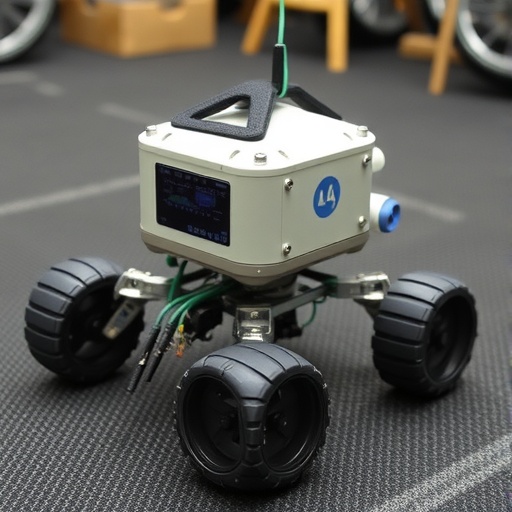
In the rapidly progressing landscape of technology, precision engineering stands as a pivotal challenge, especially when it involves manipulating objects on an extraordinarily small scale. Traditional precision devices often face a dichotomy: they can be either highly accurate but limited in movement range, or mobile but lacking in fine control. Addressing this conundrum, researchers from YOKOHAMA National University have engineered a breakthrough in the form of the Holonomic Beetle (HB), a palm-sized mobile robot that merges precision with versatility, powered exclusively by piezoelectric actuators. This innovation marks a transformative stride toward seamless, sub-micrometer precision in robotic positioning.
The Holonomic Beetle defies the conventional limitations of precision stages, which customarily excel in accuracy within a restricted spatial domain, and mobile robots, which typically sacrifice precision for broad movement capabilities. By fusing the strengths of these traditional systems, the HB achieves an unprecedented combination: high-resolution positioning across a wide range of motion. Central to this advancement is the employment of piezoelectric actuators—devices that harness the piezoelectric effect, wherein electrical stimuli provoke mechanical displacements by altering the internal lattice structure of specialized materials.
Piezoelectric actuators translate electric fields into minute but powerful expansions or contractions within piezoelectric crystals, granting extremely fine mechanical control. These actuators are celebrated for their rapid response times, superior precision, and remarkable resolution capabilities, enabling the HB to navigate precisely across its operating surface with minimal positional error. Such capability is critical when dealing with sub-micrometer to centimeter-scale objects, an essential feature for fields demanding meticulous manipulation such as microsurgery, semiconductor fabrication, and nanotechnology.
The team rigorously evaluated the HB’s performance through a series of path-following experiments on various XYΘ planes. These tests employed proportional-integral-derivative (PID) control mechanisms to navigate the robot along predetermined trajectories. Impressively, the robot exhibited path errors confined within a narrow margin ranging from 0.5 to 4.75 micrometers, affirming its suitability for tasks necessitating exquisite positional fidelity. The root mean square error (RMSE), a statistical gauge quantifying the deviation between intended and actual paths, consistently measured below one micrometer, illustrating HB’s high-precision capabilities.
Such consistency in path accuracy was maintained regardless of trajectory complexity. Whether tracing straightforward linear paths or intricate curves, the HB demonstrated robust suppression of positional errors, showcasing the effectiveness of its integrated control system and piezoelectric actuation. The ultrafine precision achievable by HB can be transformative for applications requiring both high positioning accuracy and flexible mobility, a combination that was elusive prior to this research.
Future development avenues for the HB include enhancing motor response speeds, which would allow for faster positional adjustments without compromising accuracy. Additionally, researchers aim to improve mechanical rigidity to mitigate any deformation that could degrade precision. The integration of vibration reduction techniques is another targeted enhancement to prevent external disturbances from introducing errors during operation. Model-based control algorithms are also envisioned to refine the system’s ability to predict and counteract dynamic perturbations proactively.
Another critical objective is the scalability and adaptability of the HB platform. The research team seeks to deploy the robot in diverse workspace environments, expanding its practical utility beyond laboratory settings. By embedding HB in more realistic operational contexts, the technology could see widespread adoption in industry, biomedical research, and other sectors where precise object manipulation at micro and nano scales is imperative.
The HB’s design philosophy underscores the potential for democratizing ultraprecise positioning technologies. Traditionally, such high-performance systems have been costly and complex, limiting them to specialized applications. The researchers acknowledge this and strive to develop HB into a cost-effective, scalable tool that offers precision positioning accessible to various disciplines. Their goal is to bridge the gap between mobile robotics and stationary precision systems, providing a universal platform capable of handling sub-micrometer objects while traversing large areas.
This pioneering work, led by Associate Professor Ohmi Fuchiwaki of YOKOHAMA National University, epitomizes the integration of control theory, materials science, and mechanical engineering. It represents a significant step forward in robotic kinematics, especially concerning robots with multiple degrees of freedom responding at ultrafine scales. The implications of HB stretch across several scientific and technological domains, including manufacturing automation, nanoscale assembly, and advanced microscopy.
The technological innovations within HB not only contribute significantly to the field of robotics but also open new avenues in research methodologies for metrology and microscopy. Researchers rely on precise positional control to conduct high-fidelity experiments, and the HB presents a new tool that can enhance experimental accuracy and repeatability. As such, HB signifies a convergence of applied sciences and engineering disciplines, demonstrating how multidisciplinary collaborations can yield cutting-edge technologies.
Funding for this breakthrough was generously provided by foundations including the Nakanishi Scholarship Foundation, NSK Foundation for Advancement of Mechatronics, Takahashi Industrial and Economic Research Foundation, Tsugawa Foundation, and Mitsubishi Foundation Research Grants in the Natural Sciences. The convergence of this support enabled the thorough experimental validation and refinement of the HB, accelerating the transition from theoretical concept to a tangible, functional robotic system.
The Holonomic Beetle stands at the precipice of a revolution in precision robotics, offering a glimpse of future technologies where microscopic freight movement and ultraprecise manipulation become routine. With continued enhancements and broader deployment, the HB could serve as an indispensable tool for scientists and engineers worldwide, catalyzing innovations across nanotechnology, biomedical engineering, and precision manufacturing.
Subject of Research: Not applicable
Article Title: Sub-Micrometer-Precision Path Following of Piezo-Actuated Mobile Robot
News Publication Date: 30-Jan-2026
Web References:
https://doi.org/10.1002/aisy.202501141
References:
O. Fuchiwaki et al., Advanced Intelligent Systems 2026, DOI: 10.1002/aisy.202501141.
Image Credits:
Image adapted from O. Fuchiwaki et al., Advanced Intelligent Systems 2026, DOI: 10.1002/aisy.202501141. Used under CC-BY 4.0.
Keywords
Robotics, Piezoelectricity, Precision Positioning, Mobile Robots, Piezoelectric Actuators, Control Theory, Metrology, Sub-Micrometer Accuracy, PID Control, Microscopy, Degrees of Freedom, Robust Control
Tags: advanced piezoelectric materialsfusion of precision and mobilityhigh-resolution robotic positioningholonomic mobility in robotsinnovative robotic actuation methodspalm-sized mobile robotspiezoelectric actuator technologyprecision engineering in roboticsprecision stages vs mobile robotsrobot design for micro-manipulationsub-micrometer precision roboticsultra-accurate mobile positioning robot