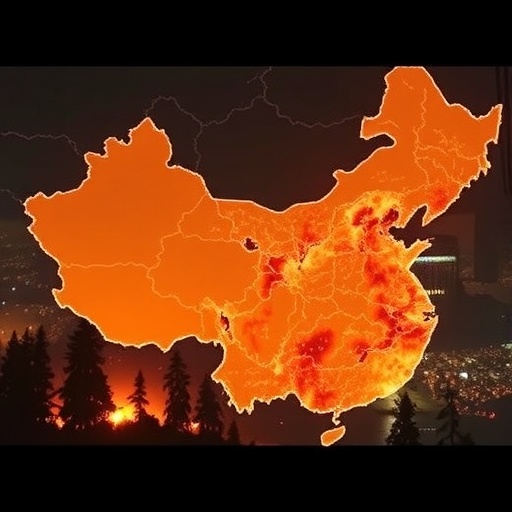
Natural disasters, such as floods, hurricanes, and earthquakes, have long been recognized as formidable threats to sustainable development worldwide. Their devastating effects extend far beyond immediate physical destruction, deeply influencing economic performance at both regional and national levels. Traditional approaches to evaluating the economic impact of natural disasters have largely concentrated on geographic spillovers—essentially, how damage in one locality affects neighboring areas. However, recent groundbreaking research from China offers compelling evidence that this perspective dangerously underestimates the full scope of disaster-induced economic shocks by ignoring the intricate web of economic interdependencies that connect cities through investment flows.
In a novel study that combines geocoded disaster data with granular firm-level investment records, researchers Sheng, He, and Hu leverage advanced spatial econometric techniques alongside complex network theory to unravel how natural disasters propagate through underlying economic networks. By meticulously integrating spatial weight matrices that encapsulate both geographic proximity and intercity economic linkages, the team uncovers a startling revelation: failure to account for these economic ties results in an underestimation of total disaster-related economic losses by a margin ranging from 52.5% to 57.5%. This discovery challenges conventional wisdom and marks a pivotal shift in understanding the dynamics of disaster spillovers.
At the heart of this research lies a sophisticated analytical framework that marries geographic spatial dependence with economic network centrality. Spatial econometrics, traditionally used to model how geographically adjacent entities influence one another, is augmented here with modified weight matrices encoding the intensity of intercity investments. Such a hybrid methodology allows for a more nuanced depiction of how shocks propagate not just across physical space but through economic connectivity, providing a dual lens through which disaster impacts can be quantified more accurately.
The researchers place considerable emphasis on network science metrics, particularly centrality and clustering coefficients, to evaluate the role of cities within the economic investment network. Cities exhibiting higher values of centrality—meaning they are more influential or better connected within the network—tend to act as amplifiers of negative spillovers. Similarly, cities situated in highly clustered sub-networks exacerbate the propagation of economic shocks caused by disasters. This insight points to the non-linear way disaster impacts are magnified when reflected through complex economic interdependencies rather than mere geographic vicinities.
The increasing complexity of intercity investment networks compounds these effects. As modern economies become progressively interconnected, investment ties among cities evolve into dense, multifaceted webs that facilitate rapid transmission of shocks. These intricate linkages mean that a disaster hitting one urban hub can cascade through myriad economic channels to affect distant cities, often leaving traditional geographic models insufficient in capturing the extended reach of the damage. This emerging complexity underscores the urgency of revisiting disaster impact assessments with models that reflect the evolving nature of economic interconnectivity.
China serves as a compelling case study in this context due to its vast and heterogenous urban landscape, characterized by both robust economic linkages and frequent exposure to natural hazards. Integrating high-resolution disaster occurrence data with firm-level investment flows enables the study to offer unprecedented clarity on how disasters resonate across interconnected cities. This methodological rigor facilitates more precise quantification of economic losses and reveals systemic vulnerabilities embedded within China’s intercity networks.
Importantly, by underlining the critical gap in traditional disaster damage evaluations, this research advocates for a paradigm shift in disaster resilience policy. The authors argue that mitigating economic disruptions from natural disasters requires cross-city strategies that extend beyond simple geographic proximity. Policymakers and urban planners must account for the economic dependencies binding cities together, adopting resilience frameworks sensitive to network topology and investment flows rather than spatial contiguity alone.
The implications of these findings are profound, particularly for nations grappling with rapid urbanization and globalization of economic activities. As interconnectedness deepens, the potential for economic shocks to spread swiftly and severely grows, necessitating disaster preparedness plans that incorporate economic networks. Ignoring these linkages could result in systematic under-preparation and misallocation of resources, ultimately exacerbating the socioeconomic fallout when disasters strike.
Moreover, the integration of complex network methods with spatial econometrics represents a methodological breakthrough with broad applicability. Beyond disaster economics, this hybrid analytical approach could illuminate other phenomena where spatial and network effects coalesce—ranging from epidemic spread to infrastructure resilience. Such interdisciplinary tools enrich our capacity to model and respond to multifaceted challenges that transcend conventional spatial boundaries.
The study also casts light on the importance of accurate data collection and sharing. Fine-grained, firm-level investment data paired with precise geocoded disaster records create a detailed landscape for analysis that surpasses aggregate indicators commonly used in prior research. This level of detail enables tracing the propagation of shocks through economic linkages with heightened fidelity, revealing patterns and vulnerabilities invisible to coarser resolutions.
While the primary focus here centers on economic spillovers in China, the broader lessons transcend national borders. Urban networks worldwide operate under similar principles of interdependence and complexity. As such, the cautionary insights about underestimating disaster impacts due to neglecting economic ties bear relevance globally, urging the international community to revisit models guiding disaster risk reduction and economic recovery strategies.
In conclusion, this pioneering research decisively expands our understanding of natural disaster spillovers by bridging geography with economic network science. It exposes the substantial economic losses previously overlooked due to myopic spatial analyses and charts a clear course toward more encompassing, network-aware approaches for disaster resilience. As climate change intensifies the frequency and severity of extreme events, adopting such holistic frameworks will be crucial in safeguarding urban economies and advancing truly sustainable development.
The urgency for policy reform based on these insights cannot be overstated. Investing in cross-city disaster resilience, informed by detailed mapping of economic linkages, promises to enhance mitigation measures and recovery capacity. By acknowledging and incorporating the complex tapestry of intercity economic relationships, governments can anticipate cascading risks more effectively and coordinate resources to minimize systemic disruptions.
This research represents both a call to action and an intellectual milestone, setting a new standard for disaster economics and urban resilience studies. Embracing the interplay between spatial and economic networks holds transformative potential not only for assessing and managing disaster impacts but also for fostering adaptive, interconnected urban systems capable of better withstanding future shocks.
As cities continue to evolve into highly interconnected entities, incorporating this innovative network perspective becomes imperative. Future studies building on this approach are poised to refine our predictive capabilities and inform comprehensive policy frameworks that reflect the realities of modern economic interdependencies amid an increasingly uncertain climate landscape. Ultimately, the integration of spatial econometrics and network theory opens promising pathways to more resilient and sustainable urban futures in the face of natural disasters.
Subject of Research: Economic spillovers of natural disasters through intercity investment networks in China.
Article Title: Intercity economic ties amplify natural disasters spillovers in China.
Article References:
Sheng, H., He, C., & Hu, W. Intercity economic ties amplify natural disasters spillovers in China. Nat Cities (2026). https://doi.org/10.1038/s44284-026-00399-y
Image Credits: AI Generated
DOI: https://doi.org/10.1038/s44284-026-00399-y
Tags: China natural disaster researchcomplex network theory in economicsdisaster loss underestimationdisaster-induced economic shockseconomic interdependencies between citieseconomic network theory applicationsfirm-level investment data analysisgeocoded disaster dataintercity economic spilloversnatural disaster economic impactspatial econometric techniques in disaster analysissustainable development and natural disasters