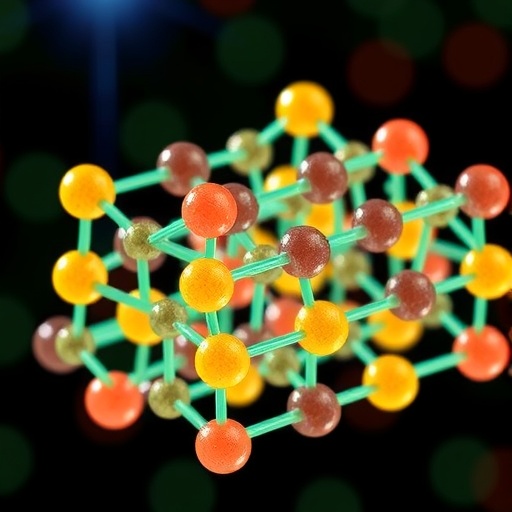
A research breakthrough in the domain of environmental remediation and nuclear waste management has emerged with the development of flexible covalent organic frameworks (COFs) that dramatically enhance photocatalytic uranium extraction from wastewater. Led by scientists Xiangke Wang and Hui Yang at North China Electric Power University, in collaboration with Shenqian Ma at the University of North Texas, this innovative study pioneers a molecular design strategy utilizing flexible units in COFs to control pore curvature and photoelectric properties. This advancement holds immense promise for addressing the critical challenge of uranium contamination in water sources, a persistent environmental and public health threat caused by nuclear energy production and uranium mining activities worldwide.
The strategic design of the flexible COF photocatalysts is grounded in the introduction of flexible connectors with variable bending capabilities into hydrazone-linked frameworks. These molecular units regulate the local curvature of COF pores, thereby tailoring the photocatalytic environment at the nanoscale. This precise architectural modulation promotes efficient separation and transport of photogenerated charge carriers under visible light irradiation, which is crucial for the catalysis process. The optimal flexible COF, termed COF-3, exemplifies this approach by demonstrating superior photoelectric response and cradling the highest bending angle among the series, which directly correlates with its enhanced photocatalytic uranium sequestration capability.
Addressing uranium contamination is of paramount importance given uranium’s ubiquitous presence as a nuclear fuel and its propensity to infiltrate groundwater, tap water, and even seawater through industrial discharge and mining operations. Uranium poses grave risks to ecosystems and human health due to its radioactive toxicity and bioaccumulative nature. Once uranium enters biological systems, it induces internal radiological damage and elevates cancer risks, making its removal from environmental water sources critical. However, existing remediation techniques face significant obstacles due to uranium’s chemical stability and the complexity of competing ions in contaminated water, necessitating efficacious, selective, and cost-effective extraction methods.
The researchers synthesized a series of three hydrazone-connected flexible COFs using solvothermal methods, varying the flexibility of connectors to yield COF-1, COF-2, and COF-3. These frameworks were assembled from 1,3,5-tris(formylphenyl)benzene (TFPB) and different hydrazine-based ligands: hydrazine hydrate (N₂H₄) for COF-1, carbohydrazine (CHYD) for COF-2, and oxaloyldihydrazine (ODH) for COF-3. This controlled variation in ligand architecture induced differing bending angles—180°, 120°, and 60°, respectively—in the frameworks, systematically influencing the COFs’ structural flexibility, pore morphology, and electronic properties relevant to photocatalysis.
Extensive structural and photoelectric characterizations elucidated how the bending angles dictated the photocatalytic efficacy. Synchrotron powder X-ray diffraction (PXRD), Fourier-transform infrared spectroscopy (FT-IR), and scanning electron microscopy (SEM) confirmed the high crystallinity, stability, and porosity of the COFs, while photophysical analyses revealed COF-3’s superior light absorption and charge separation efficiency. Notably, as the bending angle decreased from COF-1 to COF-3, the local pore curvature increased, facilitating improved photogenerated charge carrier dynamics. This structure–property relationship underpins the observed enhancements in photocatalytic uranium removal performance.
In real-world simulated environmental applications using contaminated groundwater with a uranium concentration of 20 ppm, COF-3 achieved a remarkable uranium removal rate of 92% within four hours without the need for additional sacrificial agents, culminating in a high uranium uptake capacity of 403.6 mg/g. By contrast, COF-1 and COF-2 demonstrated substantially lower removal efficiencies of 34.6% and 85.6%, respectively. Similarly, in tap water experiments, COF-3 maintained superior performance, removing over 96% of uranium within ten hours. These findings highlight the critical role of flexible linker-induced pore curvature in enhancing photocatalytic uranium extraction efficiency under practical environmental conditions.
The selectivity and stability of COF-3 were further underscored by its broad pH adaptability and resilience against competing ions at concentrations an order of magnitude higher than uranium. This robustness ensures that COF-3 maintains high photocatalytic selectivity in the presence of common interfering cations and anions, which often diminish the performance of conventional adsorbents and photocatalysts. The versatility and durability of COF-3 make it a promising candidate for scalable water treatment technologies targeting radioactive contaminants.
Mechanistic insights into the photocatalytic uranium removal process reveal that COF-3 facilitates in situ generation of hydrogen peroxide (H₂O₂) under visible light, a reactive intermediate critical for uranium precipitation. Photogenerated H₂O₂ reacts with soluble uranyl ions (UO₂²⁺), transforming them into insoluble uranyl peroxide hydrate ((UO₂)O₂·2H₂O), which can be readily separated from the aqueous phase. This innovative photocatalytic conversion circumvents the limitations of traditional adsorptive capture, providing a chemical pathway to immobilize and remove uranium effectively.
Complementary analyses using PXRD, FT-IR, X-ray photoelectron spectroscopy (XPS), and transmission electron microscopy (TEM) confirmed the successful transformation of soluble uranium species into insoluble minerals on the COF surface post-photocatalysis. These findings elucidate the critical function of COF architecture and reactive oxygen species in uranium speciation and crystallization during photocatalytic treatment. Furthermore, radical quenching experiments identified H₂O₂ as the dominant active species driving this transformation, offering a mechanistic foundation for optimizing photocatalyst design and reaction environments.
The researchers’ approach to controlling the local curvature of COF pores by tuning flexible ligands represents a paradigm shift in photocatalyst engineering. By enhancing the separation and migration of photoinduced charge carriers, this strategy significantly improves catalytic efficiency without compromising structural integrity or surface area. Such molecular-level control offers vast potential not only for radioactive contaminant remediation but also for broader applications in energy conversion, environmental catalysis, and chemical sensing, where precise control of active sites and charge dynamics is essential.
This study also emphasizes the sustainable and operational advantages of flexible COF photocatalysts in environmental remediation. Unlike metal-based photocatalysts, COFs offer tunable organic frameworks that are lightweight, chemically stable, and readily modifiable. Their high crystallinity and porosity provide extensive reactive interfaces, while the ability to function effectively under visible light harnesses abundant solar energy, making them environmentally benign and cost-effective alternatives for large-scale implementation.
In summary, this research presents a groundbreaking design methodology leveraging flexible units in covalent organic frameworks to boost photocatalytic uranium extraction from contaminated water sources. COF-3, characterized by its optimal bending angle and local pore curvature, exhibits unparalleled photocatalytic performance, transforming toxic, soluble uranyl ions into benign insoluble compounds with high efficiency and selectivity under visible light. These findings pave the way for next-generation, high-performance photocatalysts tailored for nuclear pollutant remediation, addressing an urgent environmental challenge with precision-design nanomaterials.
The implications of this work extend beyond uranium remediation, inspiring future studies aimed at rationally engineering COF architectures for diverse catalytic processes. By harnessing the interplay between molecular flexibility, pore geometry, and charge carrier dynamics, researchers can unlock new levels of functional tuning in organic framework materials. As environmental pollution and energy sustainability continue to pose formidable global challenges, innovations such as flexible COF photocatalysts offer scalable, efficient, and green technological solutions to safeguard human health and ecological stability.
Finally, this breakthrough underlines the synergy between advanced materials science and environmental chemistry, demonstrating how fundamental understanding of nanoscale properties can drive transformative applications. The study, published as an open access research article in CCS Chemistry, sets a compelling precedent for collaborative, interdisciplinary efforts to tackle complex pollution issues through cutting-edge nanotechnology.
Subject of Research:
Not applicable
Article Title:
Flexible Units in Covalent Organic Frameworks Promote Photocatalytic Uranium Extraction from Wastewater
News Publication Date:
5-Jan-2026
Web References:
https://www.chinesechemsoc.org/journal/ccschem
http://dx.doi.org/10.31635/ccschem.025.202506940
References:
Not explicitly provided within the article.
Image Credits:
CCS Chemistry
Keywords
Covalent organic frameworks, photocatalysis, uranium extraction, wastewater remediation, flexible linkers, pore curvature, charge separation, hydrogen peroxide generation, radioactive pollutant removal, environmental nanotechnology, hydrazone connectors, structural flexibility
Tags: advanced photocatalytic materialscharge carrier separation in COFsCOF pore curvature controlenvironmental remediation of uraniumflexible covalent organic frameworkshydrazone-linked COFsmolecular design in photocatalysisnuclear waste management technologiesphotocatalytic uranium extractionphotoelectric properties tuninguranium wastewater remediationvisible light photocatalysts