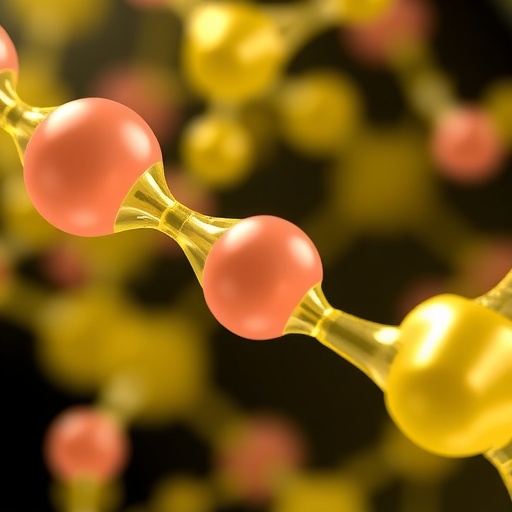
A groundbreaking advancement in the realm of flexible electronics has been announced, promising to dramatically alter the landscape of wearable technology and soft robotics. Researchers Zhang XY, Yu ZD, and Liu NF, along with their team, have unveiled a novel approach to creating intrinsically stretchable, high-performance n-type semiconducting polymers through a biomimetic strategy inspired by the molecular ordering characteristics of oleic acid. This significant work, published in the prestigious journal npj Flexible Electronics in 2026, opens new pathways for developing electronic materials that combine mechanical resilience with superior electrical properties, a duality that has been notoriously difficult to achieve.
The core challenge in developing flexible electronic devices lies in the intrinsic brittleness and limited stretchability of traditional semiconductor materials. Conventional n-type polymers, essential for establishing complementary circuits, typically suffer from a drastic reduction in performance when subjected to mechanical strain. The breakthrough reported by Zhang and colleagues addresses this limitation by ingeniously tuning the side chain ordering of semiconducting polymers to achieve a morphology that is inherently stretchable without sacrificing electrical efficiency.
Central to their approach is the inspiration derived from oleic acid, a naturally occurring monounsaturated fatty acid known for its ability to form well-ordered, yet fluid, molecular assemblies. Oleic acid’s molecular packing enables dense yet flexible structures, allowing membranes in biological systems to maintain integrity under varying mechanical stresses. By mirroring these molecular packing principles, the researchers created side chains in the polymer that mimic the ordering characteristics of oleic acid, which in turn promote a semicrystalline structure that can sustain deformation while facilitating effective charge transport.
The polymer side chains were chemically engineered to encourage an ordered side chain arrangement that preserves backbone planarization while accommodating stretching. This delicate balance prevents the polymer chains from disentangling under strain, a common cause of performance degradation. The intrinsic stretchability arises because the side chains act like molecular springs, absorbing mechanical forces and distributing them evenly, which minimizes strain localization and micro-crack formation.
Electrical characterization demonstrated that the newly designed polymers exhibit unprecedented electron mobilities under strains exceeding 50%, maintaining more than 80% of their original transport capabilities. This level of performance under such extreme mechanical deformation is a testament to the successful integration of molecular design principles from natural systems into synthetic polymer chemistry. The implications extend to a new class of flexible electronics, including stretchable transistors, sensors, and circuits that can comfortably conform to biological tissues or dynamic surfaces.
Furthermore, the study delved into the detailed morphology using advanced characterization techniques such as grazing-incidence wide-angle X-ray scattering (GIWAXS) and atomic force microscopy (AFM). These analyses confirmed the presence of an aligned, semicrystalline phase of the polymer with side chains packed in an oleic acid-like fashion. Notably, this molecular arrangement facilitated enhanced π–π stacking among polymer backbones, which is critical for efficient charge transport, while allowing the polymer matrix to elongate during stretch.
The controlled interplay between side chain ordering and backbone planarity also provided robust environmental stability, an often overlooked aspect in flexible devices. The polymer films retained their electrical and mechanical properties after prolonged exposure to ambient conditions, showing resilience to moisture and oxygen, common degradation agents. This environmental robustness encourages practical applications in wearable health monitoring systems and flexible displays, where device longevity is paramount.
Technical challenges addressed during the study spanned the synthesis of novel monomers amenable to side chain manipulation, optimization of polymerization conditions to achieve high molecular weights, and fine-tuning of processing protocols to induce the desired microstructure. The researchers harnessed computational modeling to predict the conformational behavior of side chains, enabling a rational design approach rather than trial-and-error synthesis. This integration of theory and experiment exemplifies modern materials engineering, accelerating the discovery of functionally superior polymers.
From an application standpoint, the implications are transformative. Intrinsically stretchable n-type polymers unlock opportunities for fully compliant electronic circuits that can undergo mechanical deformation comparable to human skin. Potential uses include smart prosthetics with embedded sensory feedback, electronic textiles capable of real-time physiological monitoring, and next-generation soft robots with integrated logic circuits that do not require rigid components. These possibilities herald a future where electronic devices become seamlessly integrated with form and function in dynamic, deformable environments.
Equally exciting is the prospect of scaling up the production of these advanced polymers. The chemical routes employed are compatible with established industrial processes, suggesting that commercial-scale fabrication of stretchable electronics is achievable without exorbitant costs or complex manufacturing infrastructure. This practical compatibility enhances the attractiveness of the material for widespread adoption across the flexible electronics industry.
The research also touched on biocompatibility, an aspect critical for wearable or implantable devices. Early cytotoxicity tests indicated that these materials exhibit low biological toxicity, supporting their potential safe integration with human tissues. While further in-depth studies are necessary, the initial results validate the polymers’ potential as candidates for medical electronics, including implantable biosensors and drug delivery platforms.
Besides technological advancements, this work provides profound insights into the fundamental physics of polymer packing and its influence on electronic properties. It challenges pre-existing assumptions about the limitations of side chain disorder in semiconducting polymers and sets a new paradigm for designing materials at the molecular level to tune both electronic and mechanical attributes synergistically. The study fosters a deeper understanding of how bioinspired molecular architecture can solve practical engineering problems.
In conclusion, the pioneering breakthrough by Zhang, Yu, Liu, and their team introduces a new class of intrinsically stretchable n-type semiconducting polymers that seamlessly combine high electrical performance with mechanical flexibility. By harnessing the elegant molecular ordering strategies seen in oleic acid, the researchers achieved a delicate yet robust microstructure, setting a new benchmark for stretchable semiconducting materials. This work not only advances flexible electronics technology but also embodies a broader trend towards bioinspired materials engineering that may transform numerous sectors ranging from healthcare to robotics and consumer electronics.
As this innovative research moves from laboratory to real-world application, the scientific community and industry stakeholders eagerly anticipate the emergence of practical devices leveraging these materials. The future of electronics is unquestionably flexible, stretchable, and more intimately connected with the human experience, propelled by ingenious molecular design as demonstrated in this inspiring work.
Subject of Research: Development of intrinsically stretchable high-performance n-type semiconducting polymers inspired by oleic acid molecular packing.
Article Title: Achieving intrinsically stretchable high-performance n-type semiconducting polymers by tuning side chain ordering inspired by oleic acid.
Article References:
Zhang, XY., Yu, ZD., Liu, NF. et al. Achieving intrinsically stretchable high-performance n-type semiconducting polymers by tuning side chain ordering inspired by oleic acid. npj Flex Electron (2026). https://doi.org/10.1038/s41528-026-00547-3
Image Credits: AI Generated
Tags: biomimetic polymer designelectrically efficient stretchable materialsflexible electronics materialshigh-performance wearable technologyintrinsically stretchable polymersmechanical resilience in electronicsmolecular ordering in polymersn-type polymer conductivity under strainoleic acid biomimetic strategysemiconductor side chain tuningsoft robotics electronicsstretchable n-type semiconducting polymers