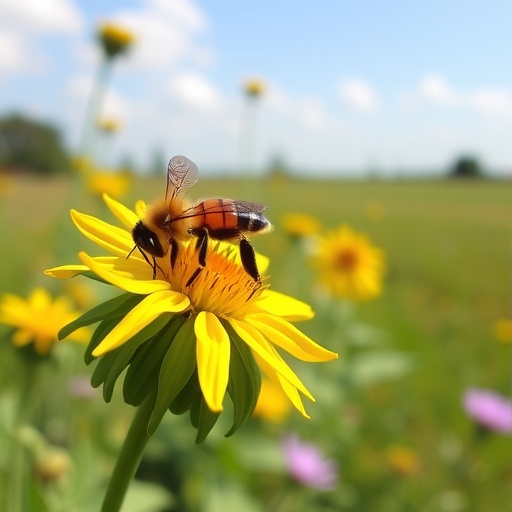

image: Safeguard project
view more
Credit: Safeguard project
Over the course of the Horizon 2020 Safeguard project, researchers, NGOs, social scientists, industry partners, policymakers and other experts from 25 institutions joined forces to expand the understanding of the decline of wild pollinators and explore measures to tackle the issue.
Following an interdisciplinary approach, Safeguard delivered a comprehensive reassessment of the status and trends of European wild pollinators, shed light on the pressures they face, and worked on developing an integrated assessment framework (IAF) to guide evidence-based management and policy at national, European and global levels.
To ensure the lasting legacy of project results, the Safeguard Knowledge Exchange Hub (Safe-Hub) was launched, providing resources and tools on pollinator conservation for decision-makers, conservationists, farmers, and citizens.
In the span of four and a half years, Safeguard established an extensive database, filling data gaps and providing a knowledge base for future actions. Focusing on long-term and large-scale impact, the project produced a number of policy materials with recommendations for pollinator-friendly practices.
To wrap up the project officially, this week, the Safeguard consortium met for one last time in Brussels, showcasing findings and insights to researchers, decisionmakers and practitioners, focusing on: 1) Status and trends of European pollinators, and future directions in monitoring, 2) Main drivers for pollinator decline, emerging pressures, and land-management solutions, 3) Integrated landscape and urban interventions for pollinator protection and 4) Future perspectives and knowledge needs.
While Safeguard is officially coming to an end in February 2026, the exploitation of its results – and their lasting impact – is only just beginning.
A heartfelt thank you to all partners, contributors, field researchers, and supporters who made Safeguard possible.
Access the Safeguard’s open-access collection in the Research Ideas and Outcomes journal to explore all project publications.
################################
This project receives funding from the European Union’s Horizon 2020 research and innovation programme under grant agreement No. 101003476.
Views and opinions expressed are those of the author(s) only and do not necessarily reflect those of the European Union or the European Commission. Neither the EU nor the EC can be held responsible for them.
Media Contact
Iva Boyadzhieva
Pensoft Publishers
Office: 359-287-04281
Funder
Horizon 2020 Framework Programme
Tags
/Life sciences/Plant sciences/Plant physiology/Plant reproduction/Pollination/Pollinators
/Life sciences/Plant sciences/Plant physiology/Plant reproduction/Pollination/Animal pollination
/Life sciences/Plant sciences/Plant physiology/Plant reproduction/Pollination
/Life sciences/Organismal biology/Animals/Invertebrates/Arthropods/Insects/Hymenoptera/Bees
/Life sciences/Organismal biology/Animals/Invertebrates/Arthropods/Insects/Lepidoptera
/Life sciences/Organismal biology/Animals/Invertebrates/Arthropods/Insects
/Life sciences/Organismal biology/Entomology
/Applied sciences and engineering/Environmental sciences/Ecology/Macroecology/Ecological diversity/Biodiversity/Biodiversity conservation
/Applied sciences and engineering/Environmental sciences/Ecology/Macroecology/Ecological diversity/Biodiversity/Biodiversity loss
bu içeriği en az 2000 kelime olacak şekilde ve alt başlıklar ve madde içermiyecek şekilde ünlü bir science magazine için İngilizce olarak yeniden yaz. Teknik açıklamalar içersin ve viral olacak şekilde İngilizce yaz. Haber dışında başka bir şey içermesin. Haber içerisinde en az 12 paragraf ve her bir paragrafta da en az 50 kelime olsun. Cevapta sadece haber olsun. Ayrıca haberi yazdıktan sonra içerikten yararlanarak aşağıdaki başlıkların bilgisi var ise haberin altında doldur. Eğer yoksa bilgisi ilgili kısmı yazma.:
Subject of Research:
Article Title:
News Publication Date:
Web References:
References:
Image Credits:
Keywords
Tags: decline of wild pollinators in EuropeEuropean wild pollinators conservationevidence-based pollinator policyHorizon 2020 environmental projectsintegrated assessment framework for pollinatorsinterdisciplinary pollinator researchNGO and policymaker collaborationpollinator habitat protection strategiespollinator population trends Europesafeguarding biodiversity in Europesocial science in environmental protectionsustainable pollinator management practices