In a groundbreaking advancement that bridges the spheres of biology and artificial intelligence, researchers have unveiled a novel computational framework that fundamentally changes how we represent and understand the complex states of living cells. This innovative methodology, termed partially shared multi-modal embedding, promises to deliver a more holistic and nuanced view of cellular identity by integrating diverse biological data streams into a unified computational language. At a time when biology is awash with high-dimensional datasets capturing various modalities of cellular information, this approach offers a transformative way to decode the intricate orchestration of life at the cellular level.
The challenge has been longstanding: cells are multifaceted entities, and their states cannot be fully described by any single type of data. Genomic sequences, transcriptomic profiles, epigenetic landscapes, proteomic layers, and imaging data all carry distinct yet interconnected pieces of the cellular puzzle. Traditional analytic pipelines often treat these data modalities in isolation or employ simplistic fusion techniques that fail to capture the subtle interplay across scales. Recognizing this, the pioneering work proposed by Zhang, Shivashankar, and Uhler brings a paradigm shift by employing a learning framework that identifies partially shared features across modalities, deeply integrating them to reveal comprehensive insights about cell states.
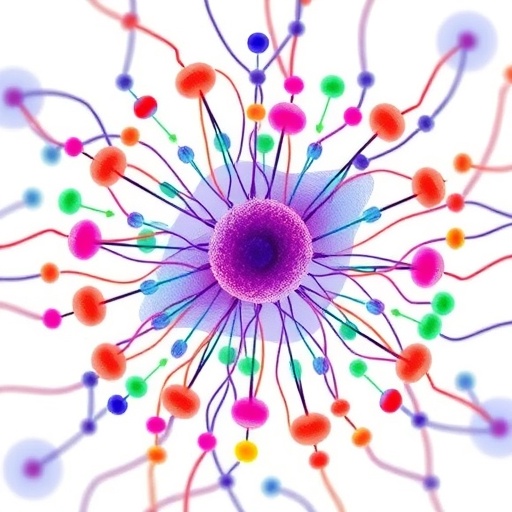
This embedding strategy leverages machine learning architectures designed to discover latent spaces where data from multiple modalities can be compared and combined without compromising their unique characteristics. By allowing for partial sharing of information, the model intelligently distinguishes between modality-specific signals and overlapping biological themes. This crucial distinction ensures that the integrated data representation maintains fidelity to the inherent biological complexity rather than oversimplifying it. The resulting embeddings are not only richer in information but also hold higher predictive power in characterizing subtle differences among cell states, which are often imperceptible when modalities are analyzed independently.
Moreover, the approach stands on the cutting edge of multi-modal data science, advancing beyond earlier methods that presumed either complete independence or total overlap between data types. Instead, it incorporates a more biologically realistic assumption: different data modalities partly overlap while also retaining unique contributions to the overall representation. This nuanced approach mimics the multifactorial nature of cell biology, where genetic, epigenetic, and environmental factors collectively shape cellular behavior in both shared and distinct manners. Such a framework can revolutionize fields requiring integrated cellular analyses, including cancer biology, developmental studies, and precision medicine.
In practical terms, the authors implemented their method in computational experiments involving diverse cell types and data modalities. By applying their partially shared embedding to datasets combining gene expression profiles with chromatin accessibility and imaging features, they demonstrated superior clustering and classification capabilities compared to conventional methods. This increased performance highlights how integrating heterogeneous datasets more thoughtfully can unveil previously hidden subpopulations of cells or transient states within a continuum of cellular phenotypes, crucial for decoding disease progression or cellular responses to treatments.
The implications extend further into translational research. Holistic cellular embeddings can empower predictive algorithms that forecast how cells will behave under various stimuli or perturbations, enabling more precise therapeutic targeting. Furthermore, such integrated models can provide tools to study cellular plasticity and heterogeneity, key aspects of cancer metastasis and drug resistance that pose significant hurdles in clinical oncology. By offering a unified computational language for complex biological phenomena, partially shared multi-modal embedding stands to accelerate discovery pipelines and enhance the interpretability of big biological data.
Beyond biology, this work represents a significant milestone in artificial intelligence applied to life sciences. It illustrates how tailored machine learning models can be designed with deep biological insights to maximize their relevance and efficacy. The study highlights a growing trend where interdisciplinary teams synthesize expertise from computational sciences, molecular biology, and biophysics to tackle challenges that transcend traditional disciplinary boundaries. This synergy is essential to decode life’s complexities and will likely set the foundation for next-generation bioinformatics tools.
Importantly, the method respects and adapts to the technical challenges inherent in multi-modal data integration. Variability in dataset size, quality, and resolution often hampers integrative analyses. The partially shared framework accommodates these disparities by flexibly weighting shared versus modality-specific components of the data, providing robustness against noise and missing values. This adaptability is crucial for real-world applications, where ideal datasets are rare, and measurement technologies evolve rapidly, creating diverse data landscapes.
The visualization of these integrated embeddings also presents an intuitive window into cellular biology. By mapping high-dimensional data into interpretable latent spaces, researchers can explore cellular relationships visually, identifying gradients and clusters that reflect biological processes such as differentiation or disease states. Such visual insights complement quantitative measures and foster hypothesis generation, making data-driven discovery more accessible and engaging to broader scientific audiences.
From a computational perspective, the framework offers scalability and extensibility. It can seamlessly incorporate additional data types—such as metabolomics or spatial transcriptomics—without fundamental redesign. This flexibility ensures that as new measurement technologies emerge, the embedding model can evolve accordingly, keeping pace with the fast-moving frontiers of cellular analysis. Moreover, the model’s architecture supports efficient training on large datasets, harnessing modern hardware accelerations and parallelized computations.
The authors’ contribution thus represents a synthesis of principled theoretical innovation with rigorous empirical validation. Their comprehensive benchmarking against established integration methods confirms the superiority of partially shared multi-modal embedding, offering both improved accuracy and biological interpretability. This balance between performance and insight is critical to engendering trust and adoption among experimental biologists who seek actionable understanding from complex datasets.
Looking ahead, the potential for clinical translation is substantial. Detailed cellular state maps derived from integrated embeddings can guide diagnostic stratification, monitoring patient responses, and tailoring interventions at a personalized level. As health data becomes increasingly multi-dimensional, methods like this will be pivotal in extracting clinically meaningful signals from the noise, ultimately improving patient outcomes.
In addition to individual cellular analyses, the framework has promise for systemic studies. By scaling up to encompass tissue, organ, or organismal levels, the partially shared embedding could facilitate integrative models that link molecular changes to physiological states and disease phenotypes. This multiscale approach aligns with the holistic goals of systems biology and personalized medicine, offering a coherent computational bridge from molecules to medicine.
While the present study marks a major leap, future research will undoubtedly refine and extend the conceptual foundations laid here. Incorporating temporal dynamics, improving interpretability through explainable AI techniques, and enhancing integration with clinical metadata remain exciting avenues for exploration. Collectively, such advances will deepen our grasp of cellular heterogeneity and function, fulfilling longstanding aspirations to decode the living cell in its full complexity.
In summary, Zhang, Shivashankar, and Uhler’s development of a partially shared multi-modal embedding framework represents a pivotal innovation in computational biology. By judiciously blending diverse data streams into a unified, information-rich representation, their method transcends limitations of prior approaches and delivers a more holistic picture of cell states. This advance not only propels our scientific understanding but also equips researchers and clinicians with powerful tools to navigate the complexity of life, heralding a new era in biomedical discovery driven by integrative data science.
Subject of Research:
Article Title:
Article References:
Zhang, X., Shivashankar, G.V. & Uhler, C. Partially shared multi-modal embedding learns holistic representation of cell state. Nat Comput Sci (2026). https://doi.org/10.1038/s43588-025-00948-w
Image Credits: AI Generated
DOI: https://doi.org/10.1038/s43588-025-00948-w
Keywords:
Tags: advanced cell state decoding methodsAI applications in cell biologycomputational frameworks for cellular identityhigh-dimensional biological data integrationholistic cellular state representationintegrating genomic transcriptomic proteomic datamulti-modal embedding in cell biologymulti-omics data fusion techniquesnovel computational methods in systems biologypartially shared features in biological dataproteomics and imaging data integrationtranscriptomic and epigenetic data analysis