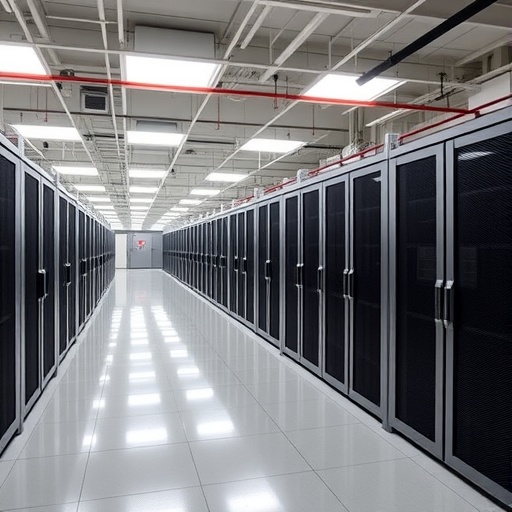
Oak Ridge National Laboratory (ORNL) has announced the creation of the Next Generation Data Centers Institute (NGDCI), a pioneering effort positioned to tackle one of the most pressing challenges of the 21st century: the escalating electricity demand driven by artificial intelligence (AI) data centers. As AI workloads grow exponentially, the strain on energy infrastructure intensifies, threatening the reliability and security of the electrical grid. The NGDCI seeks to harness ORNL’s interdisciplinary capabilities in energy technologies, cybersecurity, high-performance computing, and grid science to redefine the operational landscape of AI data centers in the United States.
The launch of NGDCI coincides with the federal government’s ambitious Genesis Mission, which aims to integrate the nation’s most advanced computing resources directly with the energy systems that sustain them. This national initiative, spearheaded by the U.S. Department of Energy (DOE), projects a doubling in research productivity and impact by enhancing the synergy between computational and energy infrastructure within the next decade. ORNL’s new institute is poised to contribute a vital research platform and collaborative framework toward this transformative goal by ensuring AI infrastructure remains energy-efficient, secure, and reliable at scale.
Stephen Streiffer, Director of ORNL, highlights the unprecedented energy appetite of AI technologies, noting that the electricity consumed by AI data centers is expected to double or even triple within ten years. This surge presents a critical challenge as existing infrastructure is already nearing capacity limits. The NGDCI capitalizes on ORNL’s unique expertise to develop cutting-edge solutions that not only meet this demand but also optimize resource use, maintaining the delicate balance between growth and sustainability.
NGDCI’s mission dovetails with national priorities to affirm U.S. energy dominance by advancing the science and technologies that enable reliable cooling, powering, operation, and cybersecurity of AI infrastructure. This initiative will also play a critical role in supporting the deployment of new AI supercomputers such as Discovery and Lux — systems engineered to push the frontiers of scientific discovery while demanding unprecedented energy management strategies.
Currently, data centers in the U.S. consume over 4% of the nation’s electricity usage, and projections suggest this figure may climb to an alarming 17% by 2030. Such escalation is predominantly fueled by AI workloads, where training a single large language model might consume hundreds of megawatt-hours of energy. This dramatic energy consumption raises concerns around grid reliability, underscored by warnings from the North American Electric Reliability Corporation, which highlights the systemic vulnerabilities created by escalating demand and the electrification of industry.
Corresponding with this demand increase is a surge in investment: McKinsey forecasts that global data center infrastructure expenditure will reach an astonishing $7 trillion by 2030, with the U.S. accounting for over 40% of this investment. The NGDCI aims to harness this growth opportunity responsibly by addressing vulnerabilities in power delivery, cooling, and component supply chains, ensuring that infrastructure expansion does not compromise security or operational stability.
A transformative vision underpins NGDCI’s approach — repositioning data centers from energy consumers to strategic assets that bolster grid stability and resilience. By intelligently integrating facets such as power flow, thermal management, workload scheduling, and AI-driven forecasting, NGDCI aims to demonstrate how next-generation data centers can evolve into dynamic contributors, capable of balancing energy demand and supply, rather than exacerbating grid stress.
A key asset in this endeavor is ORNL’s Modeling Energy Growth Associated with Data Centers (MEGA-DC) project. MEGA-DC provides a sophisticated multi-criteria decision support platform to analyze complex infrastructure upgrade pathways. This modeling capability assists utilities, regulators, data center operators, and policy makers in making informed investments that optimize economic benefits while ensuring the scalability and sustainability of AI data center growth nationwide.
Industry leaders have responded enthusiastically to the NGDCI initiative, recognizing its critical role in addressing the intertwined challenges of AI advancement and energy sustainability. Executives from AMD, Carrier Energy, Chemours, and NVIDIA emphasize the necessity for collaborative innovation in power-aware architectures, thermal management technologies, and secure, efficient system designs. Their partnerships with ORNL underscore a unified commitment to pushing the frontier of efficient AI infrastructure.
Thermal management stands out as a focal area of NGDCI research, addressing the massive energy demands associated with cooling, which historically consume between 40% and 60% of a data center’s total energy use. Next-generation cooling solutions, ranging from chip-level innovations to system-wide thermal designs, are crucial to curbing water and power consumption while maintaining operational performance and reliability in increasingly dense AI server environments.
Reimagining power system architectures to minimize losses and increase efficiency forms another thrust of NGDCI’s research. This includes exploring direct current (DC) power delivery, novel power electronics, and integration strategies that optimize power flow from generation sources directly to servers, thereby reducing conversion losses and enhancing overall energy usage efficacy.
Integrating data centers with the national electrical grid represents perhaps the most complex challenge NGDCI addresses. By leveraging the laboratory’s advanced GRID-C testbeds and intelligent control systems, data centers can be engineered to act as grid-supportive assets — capable of modulating loads, offering demand response, and contributing to grid stability in real-time, all while ensuring computational tasks proceed without interruption.
Autonomous operational platforms employing AI and machine learning algorithms will be developed to optimize workload scheduling and energy consumption proactively. These platforms will analyze real-time energy market signals, grid conditions, and thermal states to adapt data center operations dynamically, striking an optimal balance between computational demands and energy efficiency.
Cybersecurity is integral to NGDCI’s vision, with efforts extending cyber-informed engineering principles and quantum-safe communication technologies into both the physical and digital layers of AI infrastructure. This holistic security approach is paramount in protecting critical systems from emerging threats that target the convergence of cyber and physical domains.
To achieve foresight and strategic planning, NGDCI prioritizes integrated systems modeling that constructs comprehensive system-of-systems frameworks. These models will forecast the multifaceted impacts of AI infrastructure on energy grids, labor markets, materials demands, and national competitiveness well into the 2030s, thus guiding policy and investment decisions with rigor and clarity.
NGDCI embodies a grand collaboration across government, private industry, and research institutions. Oak Ridge National Laboratory’s decades of leadership in managing exascale computing resources, uniquely equipped microgrid testbeds, and expertise spanning materials science to national security make it a natural hub for this transformational project. The DOE’s designation of the Oak Ridge Reservation as a premier site for AI data center advancement underscores the strategic importance of NGDCI’s mission.
As the electricity demands of AI systems mount and the stakes of securing a resilient and sustainable digital future escalate, NGDCI stands at the forefront of scientific innovation. Its integrated approach could redefine AI data centers as pillars of national infrastructure—adaptive, secure, and instrumental in maintaining U.S. leadership in both energy and artificial intelligence technologies.
Subject of Research:
Integration of Artificial Intelligence Data Centers with Energy Systems and Infrastructure Innovation
Article Title:
Oak Ridge National Laboratory Launches Next Generation Data Centers Institute to Transform AI Infrastructure and Energy Integration
News Publication Date:
2024
Web References:
https://www.ornl.gov/nextgendatacenters
https://www.energy.gov/articles/energy-department-launches-genesis-mission-transform-american-science-and-innovation
https://powering-intelligence.epri.com/
https://eta.lbl.gov/publications/2024-lbnl-data-center-energy-usage-report
https://www.energy.gov/science
Keywords
Electricity, Thermal Properties, Power Systems, Cybersecurity, Supercomputing, Computer Architecture
Tags: AI data center energy demandcybersecurity in AI data centerselectrical grid reliability and securityenergy-efficient AI infrastructureGenesis Mission energy integrationhigh-performance computing energy solutionsinterdisciplinary energy technology researchnational AI energy strategynext generation data centers instituteOak Ridge National Laboratory researchscalable AI infrastructure managementU.S. Department of Energy initiatives