In the highland regions of Ethiopia, a groundbreaking study has demonstrated the profound impact of conservation agriculture techniques on soil and water preservation, as well as on agricultural productivity. This investigation, conducted by Alemie et al. and published in PLOS One, offers compelling evidence that integrating no-till farming, crop rotation, and mulching methods can drastically reduce water runoff and soil erosion while simultaneously enhancing crop yields by up to 122%. The findings mark a significant advancement in sustainable farming practices for vulnerable highland ecosystems, where soil degradation and water management are critical challenges.
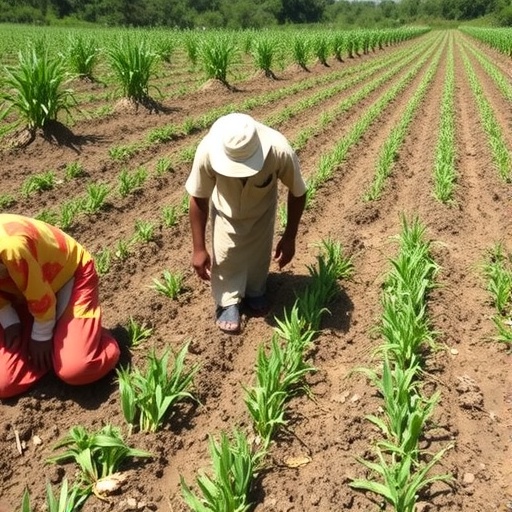
Conservation agriculture, as an umbrella term, refers to a set of farming principles designed to maintain and improve the productive capacity of agricultural land. In this Ethiopian trial, no-till planting essentially eliminates the practice of plowing, thereby preserving soil structure and organic matter. Crop rotation, meanwhile, helps to break pest cycles and enhance soil fertility by alternating crops with different nutrient requirements and root characteristics. Mulching—covering the soil surface with organic residue—further mitigates erosion by shielding the soil from the impacts of raindrops and reduces evaporation, thereby conserving soil moisture.
One of the most remarkable outcomes of this study is the quantifiable reduction in water runoff. Traditional tillage methods often disturb soil aggregates, leaving surface soil vulnerable to detachment and transport by heavy rains. This trial incorporated meticulously designed runoff and sediment collection tanks adjacent to each plot, enabling precise measurement of erosion rates. The comparative analysis indicated a significant decrease in both surface runoff and sediment loss under conservation agriculture practices relative to conventional methods. This illustrates the potential for conservation agriculture not only to mitigate soil degradation locally but also to reduce downstream sedimentation in water bodies.
Soil quality indicators, such as organic carbon content, soil moisture retention, and aggregate stability, also showed notable improvement. The preservation of soil structure through minimized soil disturbance fosters an environment conducive to microbial activity and nutrient cycling. Enhanced soil organic matter helps to increase cation exchange capacity and water-holding capability, both vital factors to sustaining crop growth during dry periods typical of the Ethiopian highlands. These changes in soil health underpin the increases in crop productivity reported in the study.
Crop yields experienced impressive gains, with some plots under conservation agriculture yielding up to 122% more than those managed with traditional tillage. This yield boost is attributed to several synergistic factors: improved soil moisture conservation through mulch cover, better nutrient availability from crop rotations, and reduced soil loss maintaining fertile topsoil layers. Such yield improvements are critical for food security in Ethiopia, where smallholder farmers dominate agriculture and face recurrent challenges from climate variability and land degradation.
Beyond the immediate agronomic benefits, conservation agriculture has broader ecological and economic implications. Reduced erosion curtails nutrient runoff into aquatic ecosystems, thereby mitigating eutrophication risks. Additionally, enhanced water infiltration promotes groundwater recharge, contributing to stable local water cycles. Economically, the reduction in labor-intensive plowing operations can lower input costs for farmers, while increased yields translate into higher incomes and improved livelihoods.
The Ethiopian highlands’ unique geo-climatic conditions, characterized by steep slopes and seasonal heavy rains, often exacerbate soil erosion and nutrient leaching. Previous efforts to address these problems have met with limited success due to socio-economic constraints and lack of tailored agronomic practices. The present study’s holistic approach, combining no-till, diversified cropping systems, and mulching techniques, provides an integrated and locally adaptable solution that aligns with farmers’ resource availability and cultural practices.
Critical to the success of this conservation agriculture trial was the rigorous data collection framework. Adjacent runoff and sediment collection tanks per plot enabled researchers to monitor hydrological responses accurately, while systematic soil sampling allowed for the assessment of changes in soil physicochemical properties over time. Such methodological rigor ensures that the observed benefits are both statistically robust and practically meaningful, setting a high standard for future agricultural research in the region.
Moreover, the absence of specific funding for this study highlights the researchers’ commitment to addressing pressing agricultural challenges despite limited financial resources. The transparent declaration of no competing interests reinforces the credibility of their findings. This independent research may serve as a catalyst for policy shifts and wider adoption of conservation agriculture techniques in the Ethiopian highlands and similar environments globally.
The implications of this research extend beyond Ethiopia. In the broader context of climate change, sustainable agricultural practices that protect critical resources like soil and water are indispensable. Conservation agriculture, as demonstrated by this trial, can contribute to the resilience of farming systems by improving resource use efficiency and buffering against climatic shocks. It also dovetails with global goals of reducing greenhouse gas emissions by enhancing soil carbon sequestration through minimal disturbance and organic residue retention.
Efforts to scale up conservation agriculture must consider socio-cultural barriers, access to knowledge and inputs, and extension services. Farmer training, participatory approaches, and supportive policies are essential to translating experimental successes into widespread practice. The promising results from this Ethiopian trial offer a robust evidence base to motivate stakeholders, from local communities to international development agencies, to invest in and promote these sustainable farming practices.
In conclusion, the study conducted by Alemie et al. rigorously illustrates how conservation agriculture methods—namely no-dig farming, crop rotation, and mulching—can revitalise degraded soils and boost agricultural yields in the Ethiopian highlands. With careful monitoring and adaptive management, such practices hold the potential to transform the livelihoods of smallholder farmers while safeguarding vital environmental resources. This research paves the way for a sustainable agricultural future that balances productivity with conservation in some of the most vulnerable agricultural landscapes worldwide.
Subject of Research: Conservation agriculture and its effects on soil and water conservation and crop yield improvement in Ethiopian highlands
Article Title: Conservation agriculture enhances soil and water conservation and crop yield in the Ethiopian highlands
News Publication Date: 25-Feb-2026
Web References: http://dx.doi.org/10.1371/journal.pone.0341622
Image Credits: Alemie et al., 2026, PLOS One, CC-BY 4.0
Keywords: conservation agriculture, no-till farming, crop rotation, mulching, soil erosion, water runoff, crop yield, Ethiopian highlands, sustainable agriculture, soil quality, hydrology, sustainable farming practices
Tags: agricultural productivity improvementboosting crop yields in Ethiopiaconservation agriculture in Ethiopiacrop rotation for soil fertilityerosion control in agriculturemulching to reduce soil erosionno-till farming benefitsorganic mulching benefitssoil loss prevention techniquessustainable farming practices highlandssustainable land management strategieswater runoff reduction methods