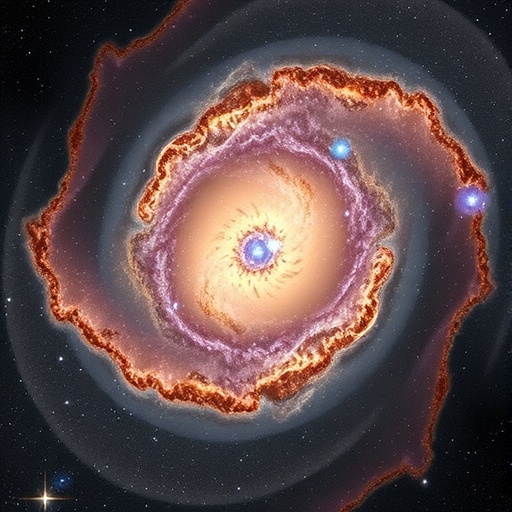
Astronomers have unveiled an extraordinary new image that captures the heart of our Milky Way with unprecedented clarity and detail, revealing the intricate distribution of molecular gas within the galaxy’s Central Molecular Zone (CMZ). This groundbreaking image, obtained using the Atacama Large Millimeter/submillimeter Array (ALMA), represents the largest ALMA mosaic ever assembled, covering an expanse equivalent to three full moons stretched side-by-side across the night sky. It offers an insightful glimpse into the violent and chaotic environment near the supermassive black hole at the galaxy’s core and promises to deepen our understanding of star formation under extreme cosmic conditions.
The CMZ spans more than 650 light-years and is characterized by dense molecular clouds laden with gas and dust, enveloping the supermassive black hole known as Sagittarius A*. While it is the closest galactic nucleus to Earth, its complexity and high levels of turbulence have rendered it difficult to study with prior instruments. By employing ALMA’s unparalleled sensitivity and spatial resolution, astronomers have mapped this region in exquisite detail, spanning structures from vast filaments dozens of light-years across down to compact gas condensations adjacent to individual nascent stars.
This survey, known as the ALMA CMZ Exploration Survey (ACES), specifically targets cold molecular gas—the primary fuel for star formation. The team deployed ALMA’s state-of-the-art receivers to detect a broad array of molecular fingerprints previously unresolved in this region. Dozens of molecular species with varying chemical complexities have been identified, including simple molecules like sulphur monoxide, silicon monoxide, and carbon monosulphide, as well as more intricate organic compounds. These signatures provide a detailed chemical atlas that enables researchers to trace the physical conditions, chemistry, and dynamics of the gas clouds responsible for giving rise to stellar nurseries.
Cold molecular gas within the CMZ is observed flowing along a complex network of filaments that feed dense clumps of matter, where gravitational collapse precipitates star formation. However, the CMZ’s environment is distinctly more extreme compared to the relatively quiescent outskirts of the Milky Way. High densities, intense magnetic fields, strong radiation, and energetic feedback from massive stars and supernova explosions contribute to an environment that challenges our conventional theories of how gas transforms into stars. ACES strives to unravel these complexities by providing an empirical dataset against which theoretical models of star formation and galactic evolution can be tested.
One of the more striking aspects revealed by ALMA’s data is the prominence of dynamic feedback processes. Many of the massive stars born within the CMZ live brief yet turbulent lives, culminating in powerful supernova or hypernova explosions. These cataclysmic events inject energy back into the molecular gas, dispersing clouds, triggering new waves of star formation, or, conversely, quenching it. These interactions sculpt the morphology and chemistry of the region and hold clues about the lifecycle of galaxies in environments resembling the early universe, where such extremes were commonplace.
The ACES project is a collaborative effort led by an international team of over 160 scientists spanning continents and expertise. The richness of the data, combining molecular line emissions with continuum imaging, provides a multidimensional view of the CMZ. Notably, the image presented multi-colored overlays representing different molecules: sulphur monoxide (cyan), silicon monoxide (green), isocyanic acid (red), cyanoacetylene (blue), and carbon monosulphide (magenta), painting a vibrant chemical tapestry of the galactic center.
Complementing the ALMA data, stars in the foreground of the image were observed using ESO’s VISTA telescope at infrared wavelengths. This dual approach allows astronomers to differentiate stellar populations from molecular gas structures, highlighting the intrinsic complexity of the CMZ. Although the stars captured here represent only a fraction of the actual stellar density in the zone, this combined view underscores the interplay between nascent stars and their natal clouds.
The colossal scale of the mosaic is unprecedented for ALMA’s observational capabilities. Individually, the radio telescope’s antennas capture small fields of view, but through a carefully orchestrated program of dozens of pointings, the team has stitched together an extraordinarily large and detailed panorama. This mosaic methodology enhances the capability to resolve fine structures while maintaining a coherent picture of the vast galactic center, a feat rarely accomplished in millimeter/submillimeter astronomy.
Beyond the immediate scientific insights, this data heralds a new era for galactic nucleus studies. Ongoing and future upgrades such as ALMA’s Wideband Sensitivity Upgrade and the commissioning of the ESO Extremely Large Telescope (ELT) promise even deeper observations. These facilities will allow astronomers to probe finer chemical structures, detect more complex organic molecules, and explore the intricate relationships between gas dynamics, stellar evolution, and the gravitational influence of the central black hole with unmatched resolution and sensitivity.
Indeed, the findings from ACES are already reshaping our understanding of star formation under extreme conditions and offer a window into how similar processes might have unfolded in young galaxies billions of years ago. By revealing the complex filamentary systems feeding star-forming clumps, explosive feedback from massive stars, and the rich chemical milieu, these observations enable a direct comparison with theoretical models of galaxy evolution and the formation of stellar populations in cosmologically important epochs.
The ACES survey results are published in a series of papers in the Monthly Notices of the Royal Astronomical Society, covering everything from data reduction techniques and continuum imaging to detailed analyses of spectral lines from various molecules. These papers provide an invaluable resource for astrophysicists seeking to deepen their understanding of the Milky Way’s center and pioneering observers planning future investigations into molecular cloud physics in extreme environments.
The extensive international collaboration behind ACES exemplifies the global nature of modern astrophysics, leveraging expertise, computational resources, and observational infrastructure across many countries. From data reduction specialists to chemical modelers and theorists, the consortium’s coordinated effort maximizes the scientific return from ALMA’s unique capabilities. With data accessible through the ALMA Science Portal, the project also fosters broader community engagement and encourages secondary studies by researchers worldwide.
Through these comprehensive observations, astronomers are now poised to answer fundamental questions about how galaxies grow and evolve, how stars form amid violent feedback conditions, and how the presence of a supermassive black hole shapes its immediate environment. The Milky Way’s Central Molecular Zone serves as an unprecedented laboratory, accessible with unparalleled resolution, for studying phenomena that are otherwise only observable in distant galaxies at the limits of current technology.
As this is just the opening chapter of exploration in the CMZ with ALMA, further discoveries surely await as subsequent upgrades enhance observational sensitivity and spectral coverage. The synthesis of data from ALMA and next-generation optical/infrared observatories will illuminate the dynamic, chemical, and physical processes at play in the very heart of our galaxy, promising to unlock the secrets of star birth and galaxy formation in some of the Universe’s most extreme environments.
Subject of Research: Star formation and molecular gas dynamics in the Central Molecular Zone of the Milky Way galaxy.
Article Title: ALMA Unveils the Intricate Molecular Web Feeding Star Formation in the Milky Way’s Central Molecular Zone
News Publication Date: Not specified
Web References:
ACES data portal: https://almascience.org/alma-data/lp/aces
ALMA: https://www.eso.org/public/teles-instr/alma/
ESO Extremely Large Telescope: https://elt.eso.org/
ACES overview paper: https://www.eso.org/public/archives/releases/sciencepapers/eso2603/eso2603a.pdf
References: Series of papers in Monthly Notices of the Royal Astronomical Society, currently under publication.
Image Credits: ALMA (ESO/NAOJ/NRAO)/S. Longmore et al. Background: ESO/D. Minniti et al.
Keywords
Milky Way, Galactic nuclei, Radio astronomy, Observational astronomy, Galaxies, Central Molecular Zone, Star formation, Molecular clouds, ALMA, Astrochemistry
Tags: ALMA CMZ Exploration Survey findingsALMA large mosaic astronomycold molecular gas observations ALMAcosmic gas condensations near nascent starsdense molecular clouds in galactic nucleushigh-resolution galactic center mappinginterstellar gas filaments in Milky WayMilky Way Central Molecular Zone imagingmolecular gas distribution in galaxy coreSagittarius A* supermassive black hole studystar formation in extreme cosmic environmentsturbulence in Central Molecular Zone