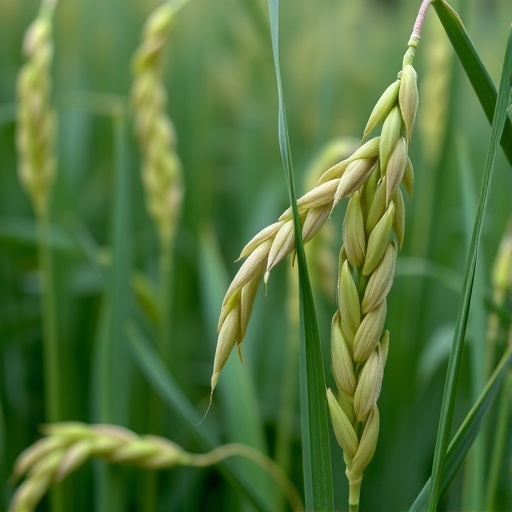
Rice, a staple food for more than half the world’s population, has long posed a challenge to agricultural scientists due to the complex trait known as grain chalkiness. This phenomenon significantly impairs the aesthetic quality, milling efficiency, and overall market value of rice. In an illuminating new study published in Science China Life Sciences, a team led by Zheng-Yi Xu at Northeast Normal University unveils a sophisticated genetic regulatory framework underlying rice grain chalkiness. Their findings center on a transcriptional module involving OsMADS18 and OsbZIP60, providing fresh insights into the intricate molecular mechanisms controlling this agronomically critical trait.
Grain chalkiness in rice manifests as opaque, white patches in the endosperm, attributed to loosely packed starch granules and air spaces. Despite its widespread impact, the precise genetic basis of chalkiness has remained elusive. The researchers embarked on an ambitious high-throughput screen using activation tagging-based T-DNA insertion mutagenesis in the model rice cultivar Kitaake, a powerful genetic tool allowing for gene disruption and activation. A striking discovery emerged when loss-of-function mutations in the MADS-box transcription factor gene OsMADS18 significantly intensified grain chalkiness while also causing reduced plant stature and delayed flowering phenotypes.
Delving deeper into the molecular interactions of OsMADS18, the study leveraged yeast two-hybrid screening—a method that detects protein-protein interactions—to identify OsbZIP60 as a key binding partner. OsbZIP60 belongs to the bZIP family of transcription factors, known for their roles in stress response pathways, suggesting a functional crossroad between developmental signals and stress mitigation mechanisms. Chromatin immunoprecipitation assays confirmed that OsMADS18 directly binds regulatory regions of several chalkiness-associated genes, including Chalk5, FLO7, OsPK2, and OsNF-YB1, which intriguingly are also targets of OsbZIP60, highlighting a complex co-regulatory network.
Genetic analyses further unraveled the hierarchy within this pathway. The osbzip60-1 osmads18-1 double mutants recapitulated the pronounced chalkiness phenotype observed in osbzip60-1 single mutants, which was more severe than in osmads18-1 mutants alone. This indicates that OsbZIP60 functions downstream of OsMADS18, positioning the OsMADS18–OsbZIP60 complex as a master regulator of grain chalkiness. These results underscore a novel mechanistic model wherein OsMADS18 may prime the transcriptional landscape that OsbZIP60 modulates during grain development.
Beyond chalkiness, the study explored physiological traits impacted by OsMADS18, particularly under high-temperature conditions—commonly encountered abiotic stress affecting rice yield. The results revealed that OsMADS18 positively influences grain weight, starch composition, amylose content, and protein accumulation. The underlying mechanism appears linked to OsMADS18’s regulation of unfolded protein response (UPR) genes such as OsbZIP50 and a suite of OsBiP chaperones (OsBiP1-5), which help maintain cellular protein homeostasis during heat stress. This finding introduces a fascinating convergence of developmental regulation and stress adaptation orchestrated by OsMADS18.
Heat stress is known to exacerbate chalkiness by impairing proper protein folding and starch biosynthesis in the endosperm. By promoting UPR gene expression, OsMADS18 effectively enhances the rice grain’s resilience to such adverse environmental conditions. The interplay between OsMADS18 and OsbZIP60 bolsters this protective response, mitigating chalkiness and ensuring grain quality is preserved even in suboptimal growth environments. Such insights have profound implications for breeding rice varieties resilient to climate change-associated stressors.
This research reveals a pivotal molecular node integrating developmental cues and stress-signaling pathways to regulate grain chalkiness. It reframes our understanding of chalkiness not merely as a structural anomaly but as the consequence of disrupted genetic networks involving key transcription factors and their downstream effectors. By deciphering this module, the study sets the stage for precision breeding and genetic engineering strategies aimed at producing higher quality rice with reduced chalkiness, increased yield, and improved nutritional profiles.
The authors propose a refined model in which OsMADS18, as an upstream transcription factor, governs the expression of UPR-related genes and interacts with OsbZIP60, which then synergizes the transcriptional regulation of chalkiness-associated genes. This coordinated regulation enhances rice grain endosperm development and ensures robust responses to environmental stress, ultimately reducing grain chalkiness. These findings highlight the sophisticated genetic and biochemical interplay required to fine-tune rice grain quality traits.
By uncovering the intricate OsMADS18–OsbZIP60 axis, this study opens new avenues for molecular interventions. Potential gene editing techniques such as CRISPR/Cas9 could target these key regulators to modulate chalkiness traits without compromising growth or yield. Furthermore, understanding how these factors interact with other signaling pathways may unveil additional targets to enhance grain quality under diverse agroecological contexts.
As climate change accelerates and global food demand rises, ensuring stable, high-quality rice production becomes increasingly urgent. This study’s revelations about the genetic control of chalkiness provide a vital foundation for developing rice varieties better adapted to environmental stresses while meeting consumer preferences for appearance and nutritional content. The OsMADS18–OsbZIP60 transcriptional module emerges as a critical nexus for future functional genomics and crop improvement efforts.
In summary, the groundbreaking discovery by Zheng-Yi Xu’s group advances our comprehension of rice grain chalkiness by delineating a novel regulatory pathway centered on OsMADS18 and OsbZIP60. Their work elucidates how these transcription factors cooperate to regulate chalkiness-related genes and the unfolded protein response under stress conditions, ultimately safeguarding grain quality. This insight paves the way for innovative breeding approaches aimed at mitigating a persistent challenge in global rice cultivation.
Subject of Research: Genetic and molecular mechanisms regulating grain chalkiness in rice through the OsMADS18–OsbZIP60 transcriptional module.
Article Title: OsMADS18 has a critical effect in regulating chalkiness of rice grains.
Web References: DOI: 10.1007/s11427-025-3129-3
Image Credits: ©Science China Press
Keywords: Rice, grain chalkiness, OsMADS18, OsbZIP60, transcriptional regulation, unfolded protein response, heat stress, starch biosynthesis, genetic mutation, T-DNA insertion, protein-protein interaction, crop improvement
Tags: genetic basis of delayed flowering in ricegenetic mechanisms of starch granule packinghigh-throughput screening in crop geneticsimpact of grain chalkiness on rice market valueMADS-box genes in crop qualitymolecular regulation of rice endosperm qualityOsbZIP60 role in rice developmentOsMADS18 transcription factor in ricerice grain chalkiness geneticsrice milling efficiency improvementT-DNA insertion mutagenesis in ricetranscriptional modules controlling grain traits