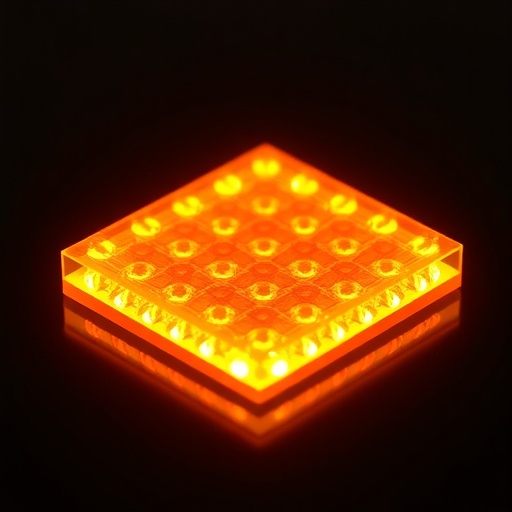
In the ever-evolving landscape of photonics and optoelectronics, a groundbreaking advancement in micro-scale light-emitting diode technology heralds a transformative future for data communication and display technology. Researchers from the University of California, Santa Barbara, led in part by doctoral student Roark Chao, have unveiled a novel design in InGaN/GaN microLEDs that dramatically enhances emission efficiency and beam directionality. This leap forward not only positions microLEDs as a viable replacement for traditional lasers in specific applications but also signifies a paradigm shift in the way light sources are engineered for high-performance technological environments.
MicroLEDs, typically measuring no wider than a human hair at around 100 microns or less, have long held promise for revolutionizing short-range optical links. Their diminutive size and inherent material advantages offer compelling benefits over conventional laser technologies, especially in contexts where thermal management and energy efficiency are paramount. However, until now, challenges related to emission efficiency and controlled light directionality have limited their practical deployment. The study led by Chao and colleagues addresses these constraints by employing distributed Bragg reflector (DBR) structures laterally surrounding the emitting regions in the microLEDs, meticulously engineered to manipulate the propagation of light at the nanoscale.
This strategic implementation of lateral DBR confinement significantly elevates optical output, with researchers recording a 20 percent increase in emission through the air side of the devices and an extraordinary 130 percent enhancement via the substrate side compared to baseline microLED architectures. Beyond simply amplifying brightness, the incorporation of DBRs curtails beam divergence by approximately 30 percent, enabling a more collimated and precisely directed light emission. This aspect is critical for communications technologies, where the fidelity of optical signals directly impacts data transfer rates and reliability.
In addition to these optical improvements, the redesigned microLED structures exhibit remarkable gains in electrical performance. The team observed a roughly 35 percent uplift in electrical efficiency, paired with a 46 percent surge in wall-plug efficiency—an metric indicating the proportion of electrical power converted into usable light. This synergy of heightened optical and electrical efficiencies marks a significant stride in device engineering, offering a pathway to scalable production of microLEDs that operate with reduced energy consumption and heat dissipation.
One of the most compelling aspects of these microLEDs lies in their thermal robustness. Unlike traditional lasers that rapidly encounter thermal issues at moderate operating temperatures, microLEDs can function efficiently at substantially higher thermal loads without necessitating intricate cooling systems. This intrinsic advantage translates to greater device longevity, simplified system designs, and decreased operational costs, particularly advantageous in the demanding environments of data centers where thermal management poses a persistent challenge.
Driven by escalating demands for faster, more efficient data communication in the era of cloud computing and artificial intelligence, data centers require optical links capable of handling massive information volumes with minimal latency and power consumption. The advanced microLEDs presented in this research hold the promise to redefine short-range optical interconnects within these facilities, offering a robust alternative to laser modules that are traditionally bulky, costly, and energy-intensive.
Beyond communication, the multifaceted utility of these improved microLEDs extends into next-generation display technology, including augmented reality (AR) and virtual reality (VR) platforms. Their ability to deliver brighter, thinner, and more energy-efficient light sources could lead to displays with unparalleled clarity, immersive color capabilities, and lower power requirements. This convergence of communication and display applications underscores the versatility and expansive potential of microLED technology as a foundational pillar in emerging digital ecosystems.
Roark Chao’s journey from undergraduate student to doctoral researcher at UCSB reflects the university’s pioneering integrated research infrastructure. Spanning from gallium nitride crystal growth to nanoscale device fabrication and photonic characterization, this comprehensive environment fosters rapid innovation cycles—from conceptual design through experimental validation—all achieved within a single institution. This seamless integration of multidisciplinary expertise has accelerated the development of the enhanced microLEDs now poised to disrupt multiple technology sectors.
The research draws upon UCSB’s deep legacy in gallium nitride-based materials and devices, a field notably advanced by Nobel laureate Shuji Nakamura. By leveraging decades of foundational work alongside contemporary nanoscale photonics insights from leaders like Steven P. DenBaars and Jon A. Schuller, the team has crafted a microLED platform that marries sophisticated material science with precision photonic engineering. Their collaborative effort exemplifies how academic synergy can drive practical solutions with global industrial relevance.
Published in the prestigious journal Optica Express, the study meticulously details both the theoretical framework and experimental validations underpinning the novel microLED design. The use of distributed Bragg reflectors as lateral barriers to light diffusion not only enhances directional emission but also mitigates optical losses inherent in earlier devices. This investigation lays critical groundwork for future research focused on optimizing microLEDs for scalable manufacturing and integration into complex photonic systems.
As technology trends continue escalating toward miniaturization and energy efficiency, innovations like this open exciting avenues for the optical communications and display industries. MicroLEDs that can efficiently channel light with high directionality and thermal stability represent a confluence of scientific ingenuity and practical utility. Looking ahead, these advances promise not only to improve the performance and reduce the costs of data center interconnects but also to facilitate novel applications across communications, computing, and visualization technologies worldwide.
Subject of Research: Enhanced emission efficiency and beam directionality in InGaN/GaN microLEDs through lateral distributed Bragg reflectors.
Article Title: Enhanced emission efficiency and directionality in InGaN/GaN microLEDs laterally enclosed by distributed Bragg reflectors.
News Publication Date: 15-Jan-2026
Web References:
https://opg.optica.org/oe/fulltext.cfm?uri=oe-34-2-2037
References:
Chao, R., Gee, S., Quevedo, A. M., Mills, W. K., Tak, T., Larson, H. S., Nitta, K. N., Nakamura, S., Schuller, J. A., DenBaars, S. P. (2026). Enhanced emission efficiency and directionality in InGaN/GaN microLEDs laterally enclosed by distributed Bragg reflectors. Optica Express.
Image Credits: Matt Perko / University of California, Santa Barbara
Keywords: Electrical engineering, MicroLED, InGaN/GaN materials, Distributed Bragg reflectors, Optoelectronics, Photonics, Data communication, Display technology, Thermal management, Nanoscale fabrication, GaN research, Optical efficiency
Tags: beam directionality in microLEDsdistributed Bragg reflector microLEDsenergy-efficient light sourceshigh-performance optical communicationInGaN/GaN microLED efficiencymicro-scale LED display technologymicroLEDs replacing lasersnanoscale light manipulationphotonics and optoelectronics advancementsshort-range optical data linksthermal management in microLEDsultra-thin microLED technology