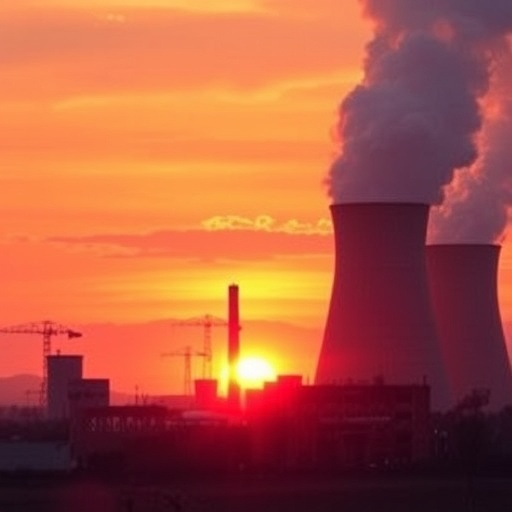
In a comprehensive, nationwide study led by researchers at the Harvard T.H. Chan School of Public Health, a previously underexplored correlation has emerged between proximity to operational nuclear power plants (NPPs) and elevated cancer mortality rates in U.S. counties. This groundbreaking research, slated for publication in the prestigious journal Nature Communications on February 23, 2026, represents the first extensive analysis of its kind undertaken in the 21st century to investigate whether living near these nuclear facilities correlates with increased cancer-related death rates on a broad geographic scale encompassing all U.S. counties and nuclear sites.
The study innovatively expands upon prior research by employing a sophisticated approach known as “continuous proximity,” which accounts for cumulative exposure potential by considering distances to multiple nearby NPPs rather than focusing narrowly on a single plant vicinity. This methodology is a significant advancement, as historic studies generally confined their analyses to isolated nuclear plants and their immediate surrounding communities. By integrating advanced statistical modeling and controlling for a wide spectrum of sociodemographic, environmental, and healthcare-related factors, the researchers were able to isolate the effect of proximity to nuclear power plants on cancer mortality with unprecedented rigor and scope.
Data for nuclear power plant operations, including geographic coordinates and operational timelines extending from 2000 to 2018, were meticulously sourced from the U.S. Energy Information Administration, complemented by cancer mortality statistics extracted from the Centers for Disease Control and Prevention (CDC) on a county-level basis. The study also controlled for confounding variables such as median household income, educational attainment, racial and ethnic demographic composition, average temperature and humidity, smoking prevalence, body mass index (BMI), and proximity to healthcare facilities, thereby minimizing potential bias that could arise from these commonly intertwined determinants of population health.
The findings unveiled a statistically significant association: counties in closer physical proximity to operating NPPs showed substantially higher cancer mortality rates even after considering all aforementioned confounding factors. Quantitatively, the study estimated that approximately 115,000 cancer deaths over the 18-year study period—equating to around 6,400 excess deaths per year—could be attributable to living nearer to nuclear power plants. Notably, this elevated risk was most prominent among older adults, a group potentially more susceptible to the cumulative effects of low-level radiation exposure and other environmental hazards related to nuclear energy production.
Senior author Petros Koutrakis, Akira Yamaguchi Professor of Environmental Health and Human Habitation, emphasized that while their findings outline a concerning correlation, they stop short of declaring causal relationships. The complex interplay of radiation exposure, environmental pollutants, and other health determinants necessitates further in-depth investigation to unravel precise mechanisms and confirm causality. Nonetheless, the evidence underscores the urgency for targeted research especially given the resurging global interest in nuclear energy as a purportedly clean and sustainable solution to escalating climate change challenges.
Intriguingly, these national findings resonate with earlier localized studies, including one by the same Harvard research team conducted in Massachusetts that identified increased cancer incidence among communities living near NPPs. Together, these studies add weight to longstanding concerns within the scientific community about the potential health ramifications of nuclear power facilities, suggesting that even low-dose exposure scenarios associated with plant operations may carry previously underestimated risks.
The study’s limitations, candidly acknowledged by the authors, include the absence of direct radiation measurements at the county or individual level. Instead, the analysis used proximity as a proxy for exposure, implicitly assuming uniform impact among all NPPs regardless of design variations, operational practices, incident histories, or safety record. These factors could differentially influence radiation release and environmental contamination, thus influencing cancer risk heterogeneously across regions.
From a policy perspective, the research calls for a paradigm shift in how nuclear energy’s public health footprint is assessed. It advocates for incorporating continuous, real-time environmental radiation monitoring alongside demographic health surveillance to ensure early detection of risk patterns. Additionally, given nuclear energy’s pivotal role in many countries’ decarbonization agendas, these findings prompt careful reconsideration of site selection, safety protocols, and long-term population health monitoring strategies.
The broader implications extend into epidemiological modeling frameworks—highlighting the necessity for multi-exposure cumulative risk assessments rather than simplistic binary proximity measures. Future research incorporating biomarkers of radiation exposure and genetic susceptibility analyses could clarify differential vulnerabilities among populations living near NPPs. Such granular insights are critical for constructing robust risk mitigation and public health intervention frameworks.
Moreover, these findings intersect with broader environmental justice concerns. Communities adjacent to NPPs often exhibit socioeconomically vulnerable profiles, amplifying the intersectionality between environmental exposures and systemic health disparities. Strategically addressing this nexus demands inclusive research designs and health equity-focused policymaking, ensuring all populations receive equitable protection commitments.
Ultimately, as global energy systems undergo transformative shifts, integrating environmental health considerations with sustainability goals is paramount. This study represents a pivotal step toward discerning nuclear power’s true health impact footprint, inviting multidisciplinary collaboration across public health, environmental science, engineering, and policy domains to forge safer, cleaner energy futures.
In conclusion, the Harvard-led investigation presents compelling evidence that living near nuclear power plants in the United States correlates with heightened cancer mortality rates, highlighting a critical yet underexplored public health dimension of nuclear energy infrastructure. While causality remains to be firmly established, the study amplifies calls for expansive research to better understand and mitigate potential health risks as nuclear power continues to be advocated in climate change mitigation strategies. This landmark analysis underscores the delicate balance between advancing energy innovation and safeguarding community health on a national scale.
Subject of Research: Not applicable
Article Title: National Analysis of Cancer Mortality and Proximity to Nuclear Power Plants in the United States
News Publication Date: February 23, 2026
Web References:
Nature Communications Article DOI
Harvard Chan School Latest News
Harvard Chan Studio Events
References:
Alwadi Y, Alahmad B, Vieira CLZ, Landrigan PJ, Christiani DC, Garshick E, Kaltofen M, Coull B, Schwartz J, Evans JS, Koutrakis P. National Analysis of Cancer Mortality and Proximity to Nuclear Power Plants in the United States. Nature Communications. 2026 Feb 23. doi: 10.1038/s41467-026-69285-4.
Keywords:
Nuclear power, nuclear power plants, nuclear energy, cancer, cancer mortality, environmental health, epidemiology, radiation exposure, public health, climate change, statistical modeling, environmental justice
Tags: advanced statistical modeling in environmental healthcancer epidemiology and nuclear powercancer mortality near nuclear power plantscontinuous proximity exposure to radiationcumulative cancer risk from multiple nuclear plantsenvironmental exposure to nuclear radiationgeographic analysis of cancer deathshealth risks of living close to NPPsimpact of nuclear facilities on public healthnationwide cancer study in the USpublic health implications of nuclear energysociodemographic factors in cancer mortality