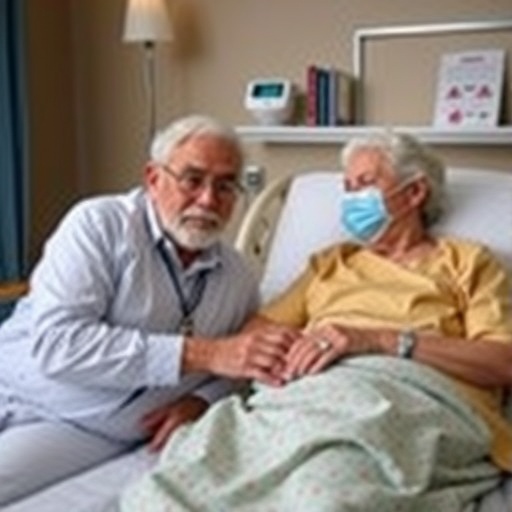
In the ever-evolving landscape of geriatric medicine, the transition from hospital to home represents a critical juncture that can profoundly impact patient outcomes. New research spearheaded by Brefka, Adamo, Leinert, and their colleagues delves into a subtle yet powerful influence on the health trajectory of older adults: companionship at the moment of hospital discharge and its relationship to the onset of delirium. This groundbreaking observational study, published in BMC Geriatrics, offers a nuanced understanding of how social factors, often overlooked in clinical practice, might play a pivotal role in mitigating cognitive decline during a vulnerable phase of recovery.
Delirium, a sudden and severe confusion that can arise in the aftermath of acute illness or surgery, remains a significant challenge in geriatric care. It not only exacerbates morbidity and prolongs hospitalization but also portends a cascade of adverse health consequences, including increased risks of institutionalization and mortality. Despite advances in medical interventions, delirium prevention continues to be elusive, largely due to its multifactorial nature. While physiological and pharmacological contributors have been extensively studied, the psychosocial domain—namely, the presence or absence of a companion during vulnerable transitional periods—has received comparatively scant attention.
The TRADE (Transitions and Delirium) observational study embarked on a systematic exploration to bridge this knowledge gap. Recruiting a substantial cohort of older adults poised to be discharged from hospital settings, the researchers meticulously documented the nature of companionship during discharge and monitored subsequent delirium occurrences in the ensuing weeks. The meticulous design accounted for a myriad of confounders, including baseline cognitive status, comorbidities, medication regimens, and functional abilities, enabling a comprehensive analysis of companionship as an independent variable.
The findings reveal a compelling association between the presence of a companion at discharge and a significantly reduced incidence of delirium. Individuals discharged unaccompanied exhibited higher rates of delirium onset, suggesting that social support during the critical handoff from hospital care to home or community settings acts as a protective buffer against cognitive destabilization. This relationship underscores the complex interplay between social context and neurocognitive health, challenging healthcare systems to rethink discharge protocols from a more holistic perspective.
From a neurobiological standpoint, the presence of a trusted companion may alleviate stress and anxiety inherent in the discharge process, stabilizing neurochemical imbalances that predispose patients to delirium. The reassurance, practical assistance, and cognitive engagement provided by companions can mitigate sensory deprivation and disorientation—key precipitants of delirium. This psychosocial enrichment during discharge might foster a smoother cognitive transition, safeguarding against the acute brain dysfunction that delirium embodies.
Moreover, the study’s observational nature provides rich clinical insights without the interference of experimental manipulation, reflecting real-world conditions. By capturing naturalistic variations in social support, the research offers pragmatic implications: hospital policies encouraging or facilitating companionship could become integral components of delirium prevention strategies. Potential interventions might include scheduling discharge times to align with family availability or deploying volunteer companions when family presence is lacking, thereby institutionalizing social support as a therapeutic modality.
Notably, the TRADE study contributes to a broader paradigm shift that recognizes social determinants as vital components of health. Aging populations often face loneliness and isolation, factors independently linked to poorer cognitive outcomes. Thus, the synergy between social connectedness and neurocognitive resilience emerges as an avenue ripe for expanded investigation and intervention, extending beyond the hospital discharge context to encompass community health programs.
Critics might posit that companionship is merely a surrogate marker for overall health or existing social resources, yet the TRADE researchers’ rigorous adjustment for confounders lends robustness to their conclusions. Additionally, the temporal proximity between discharge and delirium assessment strengthens causal inference, highlighting companionship during discharge, rather than prior social status alone, as a critical factor.
This study also reignites discussions on healthcare equity. Patients lacking familial or social networks may be disproportionately vulnerable, introducing ethical imperatives to develop inclusive support systems. Hospitals and policymakers must confront disparities in discharge support and devise mechanisms to ensure that all older adults receive equitable cognitive safeguarding during transitions.
From a practical standpoint, the implications ripple across healthcare delivery models. Incorporating social support assessments into discharge planning, training staff to recognize psychosocial vulnerabilities, and integrating interdisciplinary teams—social workers, nurses, geriatricians—can collectively fortify the discharge process. Digital innovations, such as telepresence companions or virtual visitation programs, might complement traditional in-person support, especially in contexts constrained by geographic or pandemic-related challenges.
The TRADE study also stimulates further research questions. What are the specific elements of companionship—a calming presence, assistance with medication management, or cognitive engagement—that most effectively reduce delirium risk? Could targeted interventions aimed at enhancing these elements produce even more substantial benefits? Similarly, longitudinal studies exploring the durability of companionship’s protective effects over extended recovery periods would deepen understanding.
In the realm of public health, the findings resonate with the imperative to integrate age-friendly practices across systems. Encouraging social participation and community integration may serve preventive roles in cognitive health, aligning with broader strategies to combat dementia and related syndromes. Thus, hospitalization and discharge represent critical touchpoints within a continuum of social-health interfaces demanding attention.
The study’s methodology, combining quantitative rigor with clinical applicability, exemplifies the advancing science of geriatric medicine. Employing validated delirium assessment tools and robust statistical modeling, the authors provide a template for future investigations seeking to unravel complex biopsychosocial interactions in aging populations.
As we look toward reshaping healthcare for an aging society, the TRADE observational study serves as a clarion call: companionship is not a mere convenience but a potent neuroprotective element. It invites healthcare practitioners, administrators, families, and communities to reimagine discharge planning, extending care far beyond pharmacological or procedural interventions into the nurturing realms of human connection.
In conclusion, the nuanced insights from Brefka and colleagues illuminate the profound impact of social environment on geriatric neurocognitive outcomes. Recognizing and operationalizing companionship during hospital discharge can pivotally diminish delirium onset, enhancing recovery trajectories and quality of life for older adults. As healthcare systems grapple with the complexities of aging, integrating compassionate, socially attuned strategies will undoubtedly become imperative for optimizing clinical outcomes and fostering holistic well-being.
Subject of Research: Companionship during hospital discharge and its association with delirium onset in older adults.
Article Title: Companionship at hospital discharge and its association with subsequent delirium onset in older adults – the TRADE observational study.
Article References:
Brefka, S., Adamo, J., Leinert, C. et al. Companionship at hospital discharge and its association with subsequent delirium onset in older adults – the TRADE observational study. BMC Geriatr (2026). https://doi.org/10.1186/s12877-026-07194-3
Image Credits: AI Generated
Tags: cognitive impairment after hospitalizationdelirium risk factors in older adultselderly patient recovery and social factorsgeriatric delirium prevention strategieshospital discharge companionship in elderlyhospital to home transition challenges in elderlyimpact of companionship on delirium incidencemultifactorial causes of delirium in geriatricsobservational studies on hospital dischargepsychosocial influences on elder health outcomessocial support impact on cognitive declinetransitional care and delirium in seniors