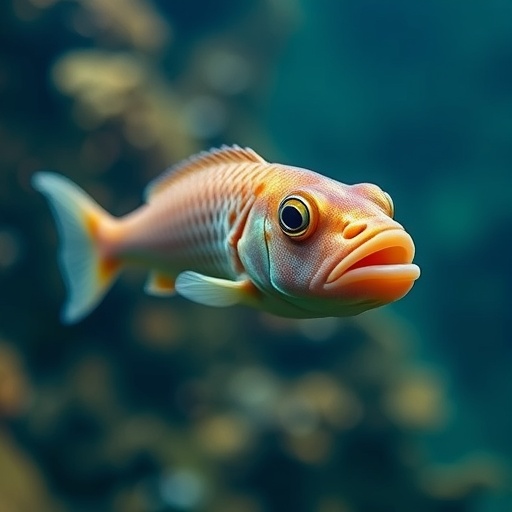
A groundbreaking discovery from Osaka Metropolitan University in Japan has unveiled intriguing cognitive abilities in cleaner wrasse fish (Labroides dimidiatus), challenging long-held assumptions about self-awareness in the animal kingdom. In a series of innovative mirror test experiments, researchers observed that these diminutive fish not only recognize their reflections but engage in sophisticated behaviors that hint at a form of self-recognition and higher intelligence previously attributed mostly to mammals.
Traditional mirror tests have been pivotal in exploring animal cognition, typically assessing an animal’s ability to recognize itself rather than perceiving the mirror image as another entity. Cleaner wrasse had been shown in past studies to recognize themselves in photographs, yet the latest experiments reveal an even more rapid and complex interaction with mirrors. This novel study reversed the conventional approach by marking the fish before exposing them to mirrors, unlike earlier experiments where mirrors were introduced first to habituate the fish.
The researchers applied parasite-like marks on the cleaner wrasse’s bodies and then introduced the mirror. Observations revealed that the fish, even those unfamiliar with reflections, quickly used the mirror to investigate and remove the marks, indicating a recognition of the image as self rather than another fish. Remarkably, this mark-directed behavior emerged on average within just 82 minutes—a stark contrast to the several days reported in prior studies—signaling an impressive capacity for rapid self-recognition.
Dr. Shumpei Sogawa explains the significance of the reversed testing order: by marking the fish first, the individuals likely felt an irregular sensation without immediate visual confirmation. The sudden presence of the mirror offered immediate visual feedback aligning with their bodily expectations, accelerating their response. This methodological innovation sheds light on the neurological underpinnings of bodily self-awareness and sensory integration in these fish.
Beyond immediate mirror-directed self-scraping, the study unveiled an even more compelling behavior: some cleaner wrasse were observed conducting what scientists call “contingency testing.” After days of mirror exposure, these fish picked up small pieces of shrimp, manipulated their position near the mirror, and attentively tracked the shrimp’s reflected movements. By doing so, they appeared to be exploring the relationship between objects and their reflections, probing the mirror’s properties beyond mere self-recognition.
Contingency testing is understood as a sophisticated cognitive strategy where an animal assesses whether mirrored movements correspond to reality by manipulating external objects rather than relying solely on their own bodies. Such behavior has been documented in highly intelligent marine mammals like dolphins and manta rays, but observing it in cleaner wrasse profoundly extends the known distribution of this ability among vertebrates.
These behaviors suggest that the self-recognition demonstrated by cleaner wrasse is not a mere reflex or conditioned response but involves higher-order cognitive processes indicative of flexible, self-referential awareness. This challenges the paradigm that self-awareness and mirror recognition evolved exclusively in mammals, implying a more widespread evolutionary origin across diverse taxa including fish.
The implications of this study are far-reaching. It challenges entrenched views on animal intelligence and encourages a re-evaluation of cognitive capacities across the animal kingdom. By demonstrating that even small, social fish are capable of rapid and complex self-recognition and environmental exploration, it highlights the sophistication of fish cognition and the potential underestimation of their mental lives.
Looking forward, the research team at Osaka Metropolitan University anticipates that ongoing studies will broaden the scope of self-awareness research to include a wider array of species, potentially extending to invertebrates. Such expanded investigations will not only deepen scientific understanding of consciousness and cognition but could also have important ramifications for animal welfare standards, conservation efforts, medical research, and the development of biologically inspired artificial intelligence systems.
Professor Masanori Kohda points out that these findings are likely to influence theoretical frameworks in evolutionary biology, spotlighting the adaptive significance of self-awareness across diverse ecological niches. This underscores a crucial need for interdisciplinary research merging behavioral neuroscience, evolutionary theory, and ecological contexts to fully elucidate the origins and functions of self-recognition.
From a methodological standpoint, this study introduces innovative approaches to behavioral testing by manipulating sensory experiences and sequence of stimuli exposure. Such approaches open new avenues in experimental design, improving the precision with which animal cognition can be studied and understood.
Finally, this research emphasizes a fundamental reconsideration of what it means to be self-aware. By pushing the boundaries of recognized cognitive capabilities in animals traditionally considered simple, it invites a profound reflection on the evolutionary pathways that led to the emergence of consciousness, and it holds promise for unraveling the complex tapestry of cognition that connects all living beings.
Subject of Research: Animals
Article Title: Rapid self-recognition ability in the cleaner fish
News Publication Date: 25-Nov-2025
Web References: http://dx.doi.org/10.1038/s41598-025-25837-0
References: Scientific Reports
Image Credits: Osaka Metropolitan University
Keywords: cleaner wrasse, self-recognition, mirror test, contingency testing, fish cognition, animal intelligence, evolutionary biology, behavioral neuroscience, Osaka Metropolitan University
Tags: animal cognition research Japananimal self-awareness studiescleaner wrasse cognitive abilitiesevolutionary implications of fish intelligencefish problem-solving behaviorfish self-recognition experimentsinnovative mirror test methodologyLabroides dimidiatus intelligencemirror test in fishnon-mammalian self-awarenessparasite mark recognition in fishself-recognition beyond mammals