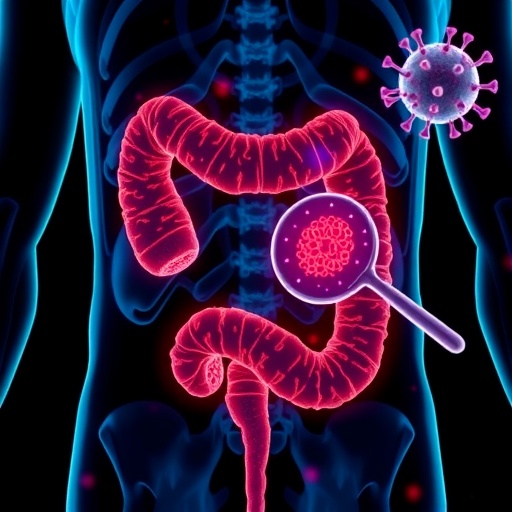
Colorectal cancer remains one of the most prevalent malignancies in the Western world, ranking high among the leading causes of cancer-associated mortality. While it is well-established that age, lifestyle, and dietary habits contribute to disease risk, the precise molecular and microbial triggers remain enigmatic. This evolving puzzle has recently gained a new dimension with the burgeoning exploration of the gut microbiome, an intricate and dynamic ecosystem teeming with bacteria, viruses, and other microscopic life forms.
In a groundbreaking study conducted by scientists at the University of Southern Denmark and Odense University Hospital, a novel virus inhabiting a well-known gut bacterium has been identified, revealing a compelling correlation with colorectal cancer. This virus is characterized as a bacteriophage — a type of virus that infects bacteria — and appears more frequently in colorectal cancer patients, suggesting a possible microbial link to tumorigenesis that goes beyond bacterial presence alone.
For years, the bacterium Bacteroides fragilis has been under scrutiny for its ambiguous connection to colorectal cancer. Despite its frequent detection in cancer patients, this bacterium also constitutes a significant portion of the gut flora in healthy individuals, creating a paradox. Traditional microbiological assessments lacked the resolution to differentiate between benign and potentially pathogenic strains. This led the researchers to hypothesize that intra-species variations, particularly those induced by viral infections within the bacteria, might hold the key to unraveling this mystery.
Through meticulous genomic analyses of bacteria isolated from patients who developed colorectal cancer and those who remained cancer-free, the team identified a distinctive viral genetic signature in the bacteria associated with the disease. This previously undescribed prophage, integrated within the Bacteroides fragilis genome, was absent or minimally present in samples from healthy individuals, indicating a statistically significant association with colorectal carcinogenesis.
While the research establishes a strong epidemiological link between the prophage-carrying bacteria and colorectal cancer, causality remains to be definitively demonstrated. Whether the virus acts as a driver of oncogenic transformation or simply serves as a biomarker of altered gut microbial ecosystems is an open question that the field must address through mechanistic studies.
This landmark discovery emerged from an extensive Danish population study encompassing data on approximately two million citizens. The study initially focused on patients who experienced serious bloodstream infections caused by Bacteroides fragilis. Among these, a subset subsequently developed colorectal cancer, offering a unique cohort for comparative genomic investigation. The virus’s presence was markedly higher in the bacterial isolates from these cancer patients, prompting further international validation efforts.
Expanding their investigation, the researchers curated and analyzed stool samples from nearly 900 individuals across Europe, the United States, and Asia. The international cohorts confirmed the initial findings, demonstrating that the presence of this bacteriophage within gut bacteria doubles the likelihood of colorectal cancer diagnosis. This robust cross-population association underscores the potential global relevance of viral-bacterial interactions in colorectal carcinogenesis.
The human gut microbiome’s complexity, comprising thousands of bacterial species and an even broader spectrum of genetic variations, has historically hindered pinpointing specific disease-associated elements. Traditional approaches focusing solely on bacterial presence failed to capture the subtle yet potentially critical influence of viral components that dwell within these bacteria. By shifting the investigative lens toward bacteriophages, this study introduces a novel framework with transformative potential for understanding microbial contributions to cancer.
If the identified prophage alters the pathogenicity or behavior of Bacteroides fragilis, it could lead to microenvironmental changes favorable to colorectal cancer development. Prophages are known to modulate bacterial gene expression, virulence factors, and interactions with the host immune system. Therefore, dissecting these virus-bacteria-host interface mechanisms is a high priority for future research aimed at elucidating the pathophysiological role of this viral agent.
From a clinical perspective, the detection of these specific bacteriophages in stool samples might evolve into a non-invasive biomarker for colorectal cancer risk stratification. Existing screening methods primarily rely on fecal occult blood tests or colonoscopy, both of which have limitations. Viral signatures could complement these tools by identifying individuals at elevated risk, potentially leading to earlier diagnosis and improved patient outcomes.
Preliminary sensitivity analyses indicate that viral sequences associated with Bacteroides fragilis infection accurately identified roughly 40 percent of cancer cases, with minimal presence in healthy controls. This sensitivity, while requiring enhancement, lays the groundwork for integrating microbial viral detection into future colorectal cancer screening programs and personalized medicine approaches.
The research methodology employed a combination of observational clinical studies and advanced metagenomic sequencing technologies. Beginning with bacteremia cases in Denmark, the team mapped prophage genomes within isolated bacteria, subsequently validating their occurrence and correlation with cancer in diverse, multinational cohorts. This integrative approach maximizes epidemiological breadth and molecular specificity, establishing a rigorous foundation for subsequent mechanistic and translational studies.
Ongoing studies aim to cultivate Bacteroides fragilis strains harboring the prophage within advanced artificial gut systems to elucidate virus-bacterium-host tissue interactions. Parallel initiatives involve detecting these bacteria and viruses directly in colorectal tumor tissues and analyzing cancer progression in genetically predisposed murine models colonized with infected bacteria. These projects, sponsored by prominent foundations, aim to clarify the prophage’s functional impact on cancer biology.
In summary, the identification of previously unknown bacteriophages within a familiar gut bacterium marks a paradigm shift in colorectal cancer research. This innovative viral-centered perspective paves the way for novel diagnostic, preventive, and therapeutic strategies. By venturing beyond bacterial taxonomy to explore viral genetic elements embedded in the microbiome, scientists are unraveling hidden layers of disease complexity with profound implications for public health.
Subject of Research: Cells
Article Title: Distinct prophage infections in colorectal cancer-associated Bacteroides fragilis
News Publication Date: 7-Feb-2026
Web References: http://dx.doi.org/10.1038/s43856-026-01403-1
References: Damgaard F. et al.: Distinct prophage infections in colorectal cancer-associated Bacteroides fragilis. Communications Medicine (2026).
Keywords: Colorectal cancer, Bacteroides fragilis, bacteriophage, gut microbiome, prophage, viral-bacterial interactions, metagenomics, cancer screening, microbiota, tumor microenvironment
Tags: bacteriophage impact on gut healthbacteriophage role in tumorigenesisBacteroides fragilis virus discoverycolorectal cancer and gut microbiomecolorectal cancer molecular mechanismsgut bacteria and cancer riskgut microbiome cancer researchmicrobial ecology in cancer developmentmicrobial triggers of colorectal cancernew viral biomarkers for colorectal cancernovel bacteriophage linked to cancervirus-bacteria interactions in gut