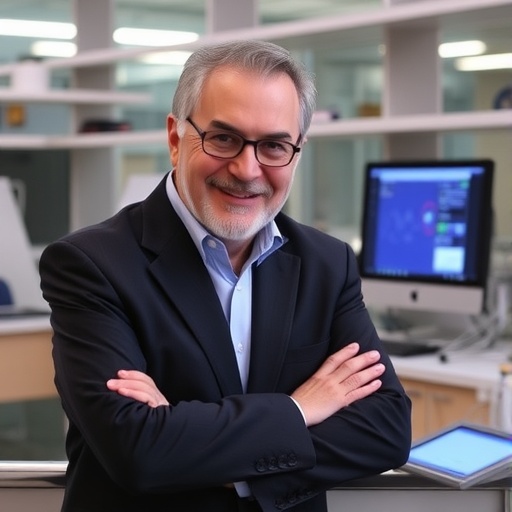
Professor Roberto Morandotti has been honored with the Max Born Award, marking a historic achievement as the first Canadian recipient of this distinguished international accolade. This recognition, presented by Optica (formerly the Optical Society of America), celebrates his groundbreaking contributions to the fields of physical optics and quantum photonics. The award immortalizes the legacy of Max Born, a foundational figure whose pioneering work established the bedrock of modern quantum mechanics, and whose influence continues to resonate throughout contemporary science.
Morandotti’s research has dramatically transformed the landscape of integrated quantum photonics, nonlinear optics, ultrafast laser technology, and terahertz science. His career epitomizes the fusion of profound quantum theoretical insights with experimental prowess, leading to innovations that push the boundaries of what is technologically feasible. His efforts have created new avenues toward the development of next-generation quantum and optical systems, standing at the frontier of scientific discovery and practical application.
A professor at the Institut national de la recherche scientifique (INRS) in Québec, Canada, Morandotti holds prominent leadership roles, including co-director positions at the Ultrahigh Speed Light Manipulation Laboratory and the QUALITY facility. These institutions focus on the manipulation and control of light at the fastest scales, harnessing quantum phenomena to unlock transformative capabilities in photonic technologies.
One of Morandotti’s most notable achievements is the first on-chip generation of complex quantum states of light. This milestone is pivotal because it enhances the quantum information capacity carried by individual photons, an essential step for advancing quantum communication and secure data transmission technologies. His experimental realization brings these concepts from theoretical constructs closer to real-world utility, potentially revolutionizing how information is encoded and transmitted.
Earlier in his career, Morandotti experimentally demonstrated optical solitons within discrete, engineered waveguide structures. Optical solitons are self-stabilizing light waves that preserve their shape and speed over vast distances, counteracting the typical dispersion and loss encountered in optical systems. This work not only provided empirical validation of complex nonlinear behaviors but also created a versatile platform for simulating phenomena from quantum mechanics and solid-state physics in optical settings.
Studying these photonic analogs, Morandotti replicated intricate physical phenomena traditionally observed only in condensed matter and quantum systems. These include Anderson localization, the halting of wave propagation due to disorder; Bloch oscillations, the oscillatory motion of particles in a periodic potential; and quantum walks, which describe quantum-mechanical counterparts of classical random walks. By manifesting these phenomena optically, Morandotti’s work bridges the divide between abstract quantum theory and practical optical engineering.
In addition to quantum photonics, Morandotti has propelled advances in ultrafast laser science. He engineered novel laser architectures that produce exceptionally stable, tunable pulses of light with ultrahigh precision and temporal resolution. These advancements are fundamental to emerging technologies like optical processors and photonic neural networks, which exploit light’s speed and coherence to achieve feats of computation beyond the reach of traditional electronic circuits.
Terahertz (THz) science is another domain enriched by Morandotti’s innovations. He has developed robust THz sources and novel waveguide structures to enable the effective generation and control of THz frequency waves. Among these contributions stands the pioneering creation of the first THz Faraday isolator—a device that enforces one-way propagation of THz waves, critical for preventing feedback in sensitive systems.
Morandotti also introduced single-shot THz imaging, an ultrafast technique capable of capturing transient phenomena occurring in trillionths of a second. Such imaging methods have profound implications for real-time analysis in materials science, sensing applications, and explorations of fundamental physical processes that unfold at previously unresolvable timescales.
With a citation count exceeding 64,000, Morandotti is widely recognized as a luminary in the physics community. He holds a Tier I Canada Research Chair and is a fellow of numerous esteemed societies, including the Royal Society of Canada, Optica, the American Physical Society (APS), IEEE, the American Association for the Advancement of Science (AAAS), SPIE, and the Institute of Physics (IoP). These honors reflect the broad and deep impact of his work across multiple disciplines.
Beyond his scientific achievements, Morandotti has shaped the next generation of researchers, mentoring over 220 students and postdoctoral fellows from more than 30 countries. Many of his mentees have ascended to leadership roles in academia, government laboratories, and industry, including influential positions in emerging quantum photonics companies like Ki3 Photonics and Hyperlight. His mentorship is a testament to his dedication to fostering innovation and collaboration worldwide.
Throughout his career, Morandotti’s excellence has been recognized through numerous prestigious awards, including the IEEE Quantum Electronics Award, the E.W.R. Steacie Memorial Fellowship, the NSERC Synergy Award, and the NSERC Brockhouse Prize. He has also been honored with significant provincial awards such as the Acfas Urgel-Archambault Award and the Prix du Québec Marie-Victorin. Moreover, his exemplary role as a mentor earned him recognition from the Canadian Association for Graduate Students and INRS.
The Max Born Award itself, established in 1982, serves to celebrate outstanding achievements in physical optics, commemorating Max Born’s foundational influence on quantum mechanics and optical science. By awarding Professor Morandotti, the scientific community acknowledges not only his exceptional technical contributions but also his role in advancing a visionary future where quantum photonics plays a pivotal role in global technology.
This landmark recognition underscores the remarkable breadth and depth of Morandotti’s impact on modern physics. From innovative experimental methods to the development of practical optical devices, his work exemplifies the power of integrating rigorous theory with cutting-edge experimentation. As quantum technologies continue to evolve, Morandotti’s pioneering spirit and discoveries will no doubt inspire ongoing progress and new paradigms in optics and photonics research.
Subject of Research: Quantum photonics, nonlinear optics, ultrafast lasers, terahertz science
Article Title: Roberto Morandotti Wins Max Born Award for Pioneering Advances in Quantum Photonics
News Publication Date: Not specified
Web References: https://inrs.ca/en/research/professors/roberto-morandotti/ https://inrs.ca/en/inrs/research-centres/energie-materiaux-telecommunications-research-centre/ https://inrs.ca/en/research/research-facilities/find-a-research-facilitie/ultrahigh-speed-light-manipulation-laboratory/
Image Credits: Josée Lecompte
Keywords
Quantum photonics, nonlinear optics, ultrafast lasers, terahertz science, Max Born Award, integrated photonics, optical solitons, quantum communication, terahertz imaging, photonic neural networks, waveguides, optical processors
Tags: groundbreaking quantum photonics researchintegrated quantum photonics innovationsnext-generation quantum optical systemsnonlinear optics advancementsOptica international recognitionphysical optics contributionsQUALITY facility leadership in photonicsquantum theoretical insights experimental fusionRoberto Morandotti Max Born Awardterahertz science developmentsultrafast laser technology applicationsUltrahigh Speed Light Manipulation Laboratory