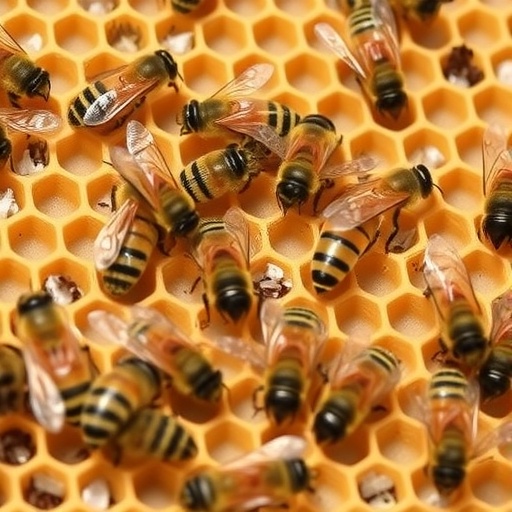
Honey bees have long fascinated scientists and nature enthusiasts alike for their complex communication behaviors, particularly the waggle dance—a sophisticated and symbolic performance through which forager bees convey precise information about the location of resources. Recent advances in data-driven analytical methods now offer unprecedented insight into how these dancers select specific hive locales, dubbed “dance floors,” where their intricate signaling transpires. A groundbreaking study conducted by researchers from Canada and the United States has ushered in a novel, quantitative framework to rigorously identify, define, and compare these waggle dance regions within the hive environment, unveiling new dimensions of spatial organization in honey bee colonies.
The study harnesses a unique experimental setup comprising an eight-frame observation hive, meticulously designed with a grid painted on the glass to facilitate precise spatial measurements of dance activities. This configuration enables scientists to capture high-resolution data on the distribution and density of waggle dances across the hive’s internal landscape. By implementing advanced statistical models and machine learning algorithms tailored for spatial clustering, the researchers were able to move beyond traditional qualitative descriptions, providing a powerful quantitative lens through which to examine dance floor dynamics.
Fundamentally, the waggle dance is not randomly performed but exhibits a patterned spatial preference linked to the hive’s structural and functional organization. The identification of distinct dance floor zones challenges prior assumptions that dance activities might be evenly distributed spatially and instead supports the idea of specialized regions optimized for efficient communication and recruitment. These findings suggest a level of behavioral compartmentalization within the hive that parallels other social insect phenomena, reinforcing the view of the hive as a highly structured superorganism.
The methodology relies heavily on synthesizing spatial coordinates of individual waggle dances over extensive observation periods, enabling the construction of detailed heat maps representing intensity gradients of dance occurrences. This approach facilitates direct comparisons not only within single colonies but also across different colonies and environmental contexts, providing a robust comparative framework to assess how dance floor configurations may vary based on ecological factors or genetic backgrounds.
Moreover, the clarity gained from these spatial analyses has ramifications extending beyond basic ethology. By pinpointing the dance floor locations, researchers can better interpret how environmental variables, such as resource availability or hive microclimate, influence recruitment strategies. This spatial precision allows a refined understanding of the decision-making processes underlying forager behaviors, offering deeper insights into how information flow is orchestrated within the hive to maximize foraging efficiency.
Critically, this study bridges a gap between behavioral ecology and computational science, illustrating the power of integrative approaches in unraveling biological complexity. The adoption of data-driven techniques heralds a new epoch in entomological research, wherein quantitative metrics can substantiate or refute long-standing hypotheses about animal communication and social organization within insect societies.
The observation hive’s grid-based design played an instrumental role in data acquisition, allowing researchers to capture waggle dance trajectories with unprecedented spatial resolution. This precision is paramount as it permits the modeling of dance clustering patterns with statistical rigor, moving beyond anecdotal or subjective characterizations toward empirically validated spatial delineations of dance floors.
Additionally, the research emphasizes the ecological significance of the waggle dance by linking spatial behaviors inside the hive to foraging outcomes in the external environment. The ability of bees to effectively communicate locations of pollen and nectar sources hinges on these dance floors’ design and utilization, suggesting an evolutionary optimization of communication sites to enhance colony-level resource acquisition.
Interestingly, the data revealed that waggle dances tend to concentrate in specific hive regions that may correlate with structural hive features or social interactions that facilitate audience attention and recruitment success. These dance floor ‘hotspots’ appear to serve as focal hubs for information exchange, maximizing the likelihood that foragers return with recruits to advantageous foraging sites.
Furthermore, the analytical framework developed is scalable and adaptable; it opens avenues for future research to investigate how perturbations such as hive stressors, disease, or environmental disruptions can alter dance floor usage and, consequently, colony foraging dynamics. Understanding these effects could prove vital for honey bee conservation efforts amid growing concerns about pollinator declines worldwide.
The implications of this study transcend entomology, exemplifying how big data and spatial analytics can unlock hidden patterns in collective animal behaviors. By advancing tools to dissect the spatial choreography of the waggle dance, the research paves the way for interdisciplinary exploration of communication networks in other social organisms.
Importantly, the collaborative nature of this project, funded by major Canadian and U.S. scientific grants, underscores the global interest in pollinator health and social insect behavior. It also highlights the necessity of sustained investment in foundational research that marries field observations with cutting-edge computational methods.
In conclusion, this pioneering research into honey bee dance floors redefines our understanding of how these insects spatially coordinate their remarkable communicative dances. The integration of data-driven spatial mapping techniques provides a compelling glimpse into the nuanced architecture of bee social communication, with broad-reaching implications for ecology, behavior, and conservation biology.
Subject of Research: Honey bee waggle dance spatial organization; identification and quantification of waggle dance regions (“dance floors”) within observation hives.
Article Title: Quantifying the honey bee dance floor: A data-driven method for defining and comparing waggle dance regions
News Publication Date: 18-Feb-2026
Web References:
NSERC Discovery Grant: https://www.nserc-crsng.gc.ca/Professors-Professeurs/Grants-Subs/index_eng.asp
NSF Division of Mathematical Sciences: https://www.nsf.gov/mps/dms
DOI: http://dx.doi.org/10.1371/journal.pone.0341456
Image Credits: Byron N. Van Nest, CC-BY 4.0
Keywords: Honey bee communication, waggle dance, dance floor mapping, spatial analysis, social insects, forager recruitment, data-driven ecology, observation hive, behavioral clustering, pollinator behavior
Tags: bee colony communication patternsforager bee signaling behaviorhigh-resolution bee dance datahoney bee waggle dance communicationmachine learning in animal behaviormapping honey bee dance floorsnovel methods in entomology researchobservation hive grid systemquantitative analysis of bee dancesspatial clustering of animal signalsspatial organization in bee hivesstatistical modeling of waggle dances