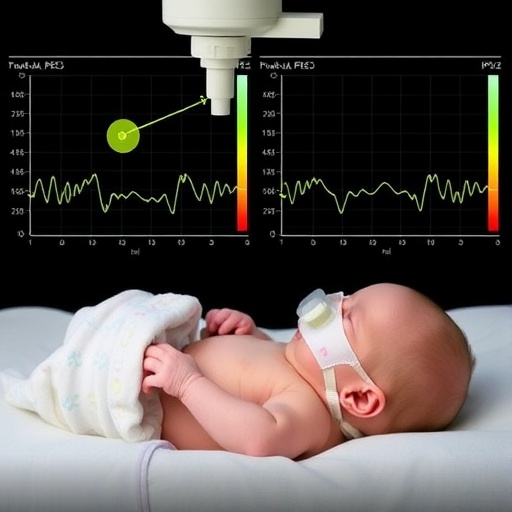
In a significant stride towards improving neonatal intensive care, researchers have unveiled a groundbreaking, non-invasive diagnostic tool designed to assess the optimal positive-end expiratory pressure (PEEP_OPT) in infants undergoing prolonged invasive ventilation. This novel development has the potential to revolutionize respiratory management in neonates, offering a more precise and less intrusive method to tailor ventilatory support, which is a critical factor in preventing chronic lung injury and promoting recovery.
Mechanical ventilation, especially in the fragile lungs of neonates, necessitates a delicate balance. Positive-end expiratory pressure plays a pivotal role in maintaining alveolar stability and improving gas exchange, yet inappropriate settings can lead to detrimental effects such as volutrauma or atelectotrauma. Traditionally, determining the optimal PEEP involves invasive measurements or trial-and-error adjustments guided by clinical judgment and intermittent imaging. These methods, while somewhat effective, are fraught with challenges including risks of infection, radiation exposure, and potential delays in achieving the ideal ventilatory parameters.
Addressing these challenges, the research team, led by Darwish et al., centered their study on developing a modality that bypasses the need for invasive procedures without compromising diagnostic accuracy. Their approach hinges on sophisticated monitoring techniques integrated with computational algorithms capable of interpreting respiratory mechanics and lung compliance in real-time. The integration of advanced signal processing and modeling techniques allows clinicians to glean vital data dynamically, streamlining the decision-making process for ventilator settings.
One of the core innovations of this tool lies in its ability to non-invasively monitor lung recruitment and derecruitment phenomena, which are essential in identifying the PEEP level that optimizes alveolar ventilation while minimizing overdistension. By capturing subtle physiological signals, the device can detect changes in lung volume and compliance, facilitating a patient-specific adjustment paradigm. This aspect is particularly vital for neonates, whose pulmonary physiology differs significantly from adults and is highly susceptible to injury.
The methodology incorporates the use of impedance pneumography combined with advanced mathematical modeling to interpret lung mechanics. This technique capitalizes on measuring electrical impedance changes across the thorax, which correlate with lung volume fluctuations during the respiratory cycle. When processed through their proprietary algorithm, these impedance signals provide actionable insights into the lung’s responsiveness to varying PEEP levels. The non-invasive nature ensures continuous monitoring without the risk associated with direct airway measurements.
Clinical validation of this tool was conducted across multiple neonatal intensive care units, involving infants with diverse pulmonary pathologies requiring prolonged mechanical ventilation. The findings demonstrated a high concordance between the non-invasive assessments of PEEP_OPT and those obtained via conventional invasive methods. Moreover, the tool facilitated more rapid titration of ventilatory pressures, contributing to improved oxygenation indices and reduced duration of ventilation support in several cases.
Beyond its immediate clinical applications, this diagnostic advancement promises to enhance our understanding of neonatal respiratory physiology under mechanical ventilation. By providing continuous, real-time data, it opens new avenues for research into lung mechanics and the effects of varying ventilator strategies in this vulnerable population. The tool could also serve as a platform for integrating artificial intelligence-driven predictive analytics, potentially forecasting adverse events or complications associated with suboptimal ventilation.
Importantly, the implementation of this technology has implications for healthcare resource utilization. The reduction in invasive procedures translates to decreased procedural risks and lower healthcare costs associated with complications management. Furthermore, the improved efficiency in ventilator management can shorten ICU stays, thereby alleviating the burden on overstretched neonatal intensive care units worldwide.
The study’s multidisciplinary approach, blending clinical expertise with engineering and computational sciences, exemplifies the growing trend towards precision medicine in neonatology. By tailoring treatment parameters to the unique physiologic responses of each infant, the approach ensures a higher standard of care that is both patient-centered and evidence-based. This customized ventilation strategy may reduce the incidence of ventilator-associated lung injury, a leading cause of morbidity and mortality in this demographic.
Looking ahead, the research team envisions integrating this diagnostic tool with existing ventilatory hardware, creating a seamless interface for clinicians. Such integration would enable automated adjustments to ventilator settings based on continuous feedback from the lung mechanics monitor, moving closer to an era of closed-loop ventilation in neonatology. This evolution holds promise in minimizing human error and optimizing therapeutic outcomes.
The dissemination of this technology will likely necessitate robust training programs to familiarize neonatal teams with its operation and data interpretation. However, the intuitive design and real-time feedback mechanisms embedded in the system are expected to facilitate rapid adoption. As neonatal critical care continues to embrace technological innovation, such tools represent the nexus of improved patient safety and enhanced clinical efficacy.
While the initial focus remains on neonates requiring prolonged invasive ventilation, the principles underlying this non-invasive diagnostic tool may extend to other at-risk populations, including pediatric patients with acute respiratory distress syndrome or adults with complex ventilatory needs. Adaptations to the algorithm and hardware could tailor the technology’s utility across broader clinical settings, underscoring its versatility and transformative potential.
In conclusion, the development of a non-invasive diagnostic tool to determine optimal PEEP in ventilated infants marks a watershed moment in neonatal respiratory care. By combining non-invasive monitoring techniques with sophisticated computational analyses, this innovation not only refines current clinical practices but also propels the field towards more personalized, effective, and safer ventilatory support. As neonatal intensive care units worldwide strive to reduce ventilator-associated complications and improve survival outcomes, this tool offers a beacon of hope and a template for future technological advances.
The study, published in the Journal of Perinatology, aligns with the ongoing imperative to innovate respiratory support strategies in neonatology, focusing on minimizing harm while maximizing therapeutic benefit. The collaboration between clinicians and engineers embodied in this work showcases the future direction of medical device development—grounded in patient-centric solutions and empowered by interdisciplinary synergy. With such advancements, the vision of precision ventilation guided by real-time, non-invasive diagnostics moves from aspiration to reality.
Subject of Research: Non-invasive assessment of optimal positive-end expiratory pressure (PEEP_OPT) in neonates under prolonged invasive mechanical ventilation.
Article Title: A non-invasive diagnostic tool for the assessment of optimal positive-end expiratory pressure (PEEP_OPT) in infants receiving prolonged invasive ventilation.
Article References:
Darwish, N., Donnelly, A., Erkinger, J. et al. A non-invasive diagnostic tool for the assessment of optimal positive-end expiratory pressure (PEEP_OPT) in infants receiving prolonged invasive ventilation. Journal of Perinatology (2026). https://doi.org/10.1038/s41372-026-02579-z
Image Credits: AI Generated
DOI: 16 February 2026
Tags: advanced neonatal intensive care diagnosticsavoiding volutrauma and atelectotraumacomputational algorithms for ventilator settingsimproving gas exchange in neonatesmechanical ventilation in fragile neonatal lungsneonatal respiratory management toolsnon-invasive lung compliance measurementnon-invasive neonatal ventilation monitoringoptimal positive-end expiratory pressure in infantsPEEP optimization in ventilated neonatespreventing chronic lung injury in newbornsreal-time respiratory mechanics assessment