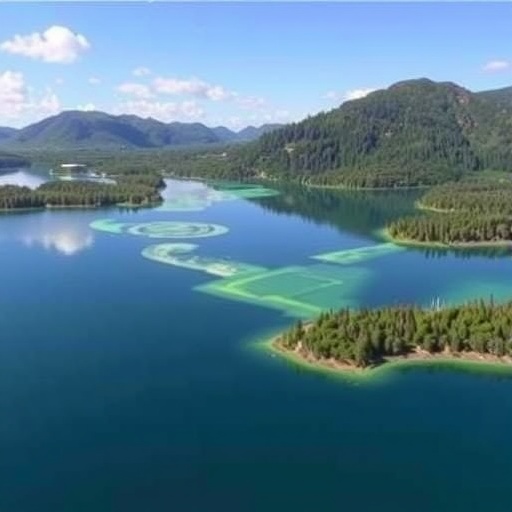
The Erhai Lake Basin, a jewel of the Yunnan-Guizhou Plateau and a cornerstone of Southwest China’s ecological heritage, has long been celebrated for its sapphire waters and misty peaks, yet a groundbreaking new study reveals that this serene landscape is masking a volatile chemical secret that ripples far across the continent. Researchers have discovered that the basin has transformed into a high-octane atmospheric nitrogen exporter, pumping thousands of metric tons of reactive compounds into the sky every year and effectively acting as a massive chimney for pollutants rather than the ecosystem sink many scientists had previously assumed. This revelation, published in the prestigious journal Nitrogen Cycling, exposes a critical imbalance in the regional nitrogen budget that threatens to destabilize local air quality and accelerate the degradation of fragile high-altitude freshwater systems while simultaneously fueling smog and haze in distant urban centers.
Reactive nitrogen is a broad term for a group of chemically active species, including ammonia and nitrogen oxides, that play a pivotal role in the chemistry of our atmosphere by serving as the essential building blocks for fine particulate matter and ground-level ozone. While nitrogen is a fundamental nutrient for life on Earth, its overabundance in the atmosphere triggers a cascading series of environmental disasters, ranging from the formation of toxic smog that penetrates deep into human lungs to the acidification of soils and the rapid eutrophication of lakes. For an ecologically sensitive region like Erhai, which serves as both a cultural landmark and a vital resource for agriculture and tourism, the presence of these compounds represents a ticking time bomb that requires immediate scientific intervention and sophisticated monitoring strategies to prevent irreversible ecological collapse.
In one of the most exhaustive and technically ambitious environmental surveys ever conducted in the region, a multidisciplinary team of scientists utilized a sophisticated blend of high-resolution emission inventories and real-time field monitoring stations scattered across the diverse watershed to map the invisible flow of nitrogen. Their results provide a startling quantified look at the basin’s chemical metabolism, revealing that the total annual emissions of atmospheric reactive nitrogen have peaked at a staggering 10,700 metric tons. This data highlights a massive disparity when compared to the natural deposition rates, which see only a tiny fraction of that nitrogen returning to the earth through rain or dry settling, leaving a net atmospheric surplus of over 8,200 metric tons that must inevitably drift elsewhere.
The chemical fingerprint of this pollution points directly to the rapid modernization and intensive land use that have come to define the Erhai region, with agricultural practices emerging as the undisputed heavyweight champion of ammonia emissions. According to the study, farming activities are responsible for more than 90 percent of the ammonia released into the air, with livestock operations and synthetic fertilizer application sharing the blame almost equally in a demonstration of the hidden environmental costs of food production. As livestock manure decomposes and fertilizers volatilize under the subtropical sun, they release clouds of ammonia that interact with other pollutants to form secondary aerosols, illustrating how even traditional rural activities can become major drivers of modern atmospheric crises.
While agriculture dominates the ammonia profile, the researchers identified a different but equally potent culprit for the surge in nitrogen oxide emissions, pinning the blame almost entirely on the transportation sector and the burning of fossil fuels. As tourism in Southwest China explodes and regional logistics networks expand, the influx of heavy-duty trucks and passenger vehicles has turned once-quiet mountain roads into significant sources of combustion-related pollution. This shift highlights a complex transition where rural landscapes are no longer just carbon-absorbing wilderness areas but are instead becoming active nodes of industrial-scale emissions, complicating the efforts of policymakers who must now balance economic growth with the preservation of the very natural beauty that attracts visitors.
One of the most concerning aspects of the research is the discovery that even though atmospheric deposition levels in the Erhai Lake Basin are considered moderate when compared to the heavily industrialized megacities of eastern China, they are still more than enough to push the lake’s ecosystem over the edge. High-altitude plateau lakes are inherently sensitive to nutrient loading because their unique biological communities have evolved in relatively low-nutrient environments, meaning that even a slight increase in nitrogen falling from the sky can trigger catastrophic algal blooms. These blooms not only deplete oxygen in the water and kill off fish populations but also produce toxins that threaten the safety of drinking water for millions of people, making nitrogen management a matter of public health rather than just environmental aesthetics.
The geographical architecture of the Erhai Lake Basin further exacerbates the pollution problem, as the dramatic mountain-and-valley topography creates a natural trap for rogue chemical compounds. The study describes how localized wind patterns and thermal inversions can effectively pin pollutants against the mountain slopes, extending their atmospheric lifetime and allowing them to undergo complex chemical transformations before they are eventually swept out of the basin. This “funnel effect” means that the nitrogen emitted by a single farm or highway can stay concentrated for long periods, increasing the likelihood of health impacts for local residents and ensuring that when the pollutants finally do escape, they are more likely to contribute to regional haze across broader swaths of Southwest China.
Beyond the local impacts, the study emphasizes that the Erhai Lake Basin is functioning as a “source” rather than a “sink,” a distinction that has massive implications for international climate and environmental agreements. When an ecosystem is a net exporter of pollution, it exports its environmental footprint to its neighbors, contributing to long-range transboundary air pollution that can affect regions hundreds of miles away. This atmospheric connectivity means that the failure to manage nitrogen in one specific watershed can undermine air quality targets in distant provinces, proving that environmental protection must be integrated across political and geographical boundaries if it is to be truly effective in the long term.
To combat this rising tide of invisible pollution, the research team advocates for a specialized, multifaceted approach that targets the root causes of nitrogen leakage through precision technology and modernized management practices. This includes the implementation of advanced manure processing systems that capture ammonia before it reaches the atmosphere, as well as the adoption of “precision agriculture” techniques that use satellite data and soil sensors to apply fertilizers only where and when they are truly needed. Simultaneously, the study calls for a radical transition in the regional transport sector toward electric vehicles and cleaner combustion technologies to mitigate the nitrogen oxides that are currently choking the valleys and contributing to the formation of secondary particulate matter.
The scientific community is praising this study as a vital framework that can be applied to other vulnerable plateau lakes around the globe, from the Andes to the Himalayas, where similar pressures of development and climate change are mounting. By providing a clear, quantified budget of how nitrogen moves through the sky and water, the researchers have moved beyond simple observations to provide a roadmap for ecological restoration. The ability to track these chemical pathways allows scientists to predict how the environment will respond to different policy interventions, turning the abstract threat of “pollution” into a manageable series of engineering and agricultural challenges that can be systematically addressed.
Ultimately, the findings from the Erhai Lake Basin serve as a powerful reminder of how human activity can fundamentally reshape even the most remote and seemingly pristine natural nutrient cycles. The researchers argue that the era of treating air, water, and land as separate silos of environmental management must end, as the nitrogen cycle links them all in a complex, overlapping web. If we are to protect the world’s remaining freshwater gems, we must look upward to the atmosphere just as much as we look down at the water, recognizing that the health of our lakes is inextricably tied to the quality of the air that flows over them and the activities of the people living in their shadows.
This study stands as a clarion call for the next generation of environmental science, where big data and field monitoring converge to reveal the hidden stresses on our planet’s life-support systems. As the scientists conclude, only by addressing multiple emission sources simultaneously and understanding the unique geographical hurdles of each basin can we hope to reverse the current trend of nitrogen saturation. The future of Erhai Lake, and many others like it, depends on our ability to transform these findings into action, ensuring that the sapphire waters of the plateau continue to reflect a clean sky rather than a haze of human-induced chemicals.
Subject of Research: Atmospheric reactive nitrogen budget and its environmental impact on the Erhai Lake Basin.
Article Title: A large net source revealed by the atmospheric reactive nitrogen budget in a subtropical plateau lake basin, southwest China.
News Publication Date: May 22, 2024.
Web References: https://www.maxapress.com/nc
References: Shen Q, Tang B, Wu X, Kang J, Li J, et al. 2026. A large net source revealed by the atmospheric reactive nitrogen budget in a subtropical plateau lake basin, southwest China. Nitrogen Cycling 2: e006 doi: 10.48130/nc-0025-0018
Keywords: Nitrogen cycle, Ammonia, Atmospheric Pollution, Erhai Lake, Reactive Nitrogen, Eutrophication, Emission Inventories, Southwest China.
Tags: air quality degradation causesatmospheric nitrogen exportationecological heritage of Yunnan-Guizhou PlateauErhai Lake Basin environmental studyfragile ecosystems in Southwest Chinahigh-altitude lake pollutionnitrogen cycling research findingsnitrogen oxides and ammonia effectsNitrogen pollution in freshwater systemsreactive nitrogen compoundsregional nitrogen budget imbalanceurban smog and haze contributors