Freshwater ecosystems in the United States are increasingly facing an insidious threat: rising salinity levels in streams, ponds, and lakes. While the impacts of salt pollution on aquatic life have been recognized for some time, emerging research from the University of Missouri illuminates a far more complex and dire scenario than previously understood. Their findings suggest that the usually separate pressures of chemical pollution and predation risk act synergistically to exacerbate mortality rates among freshwater organisms, especially gastropods such as freshwater snails.
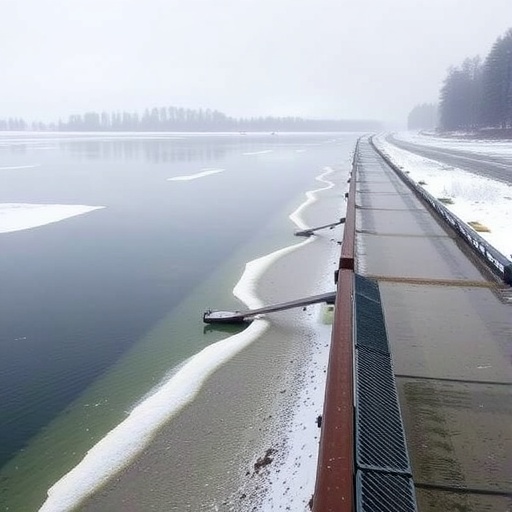
At the heart of this new research is the pervasive use of road salt for winter deicing. As snow and ice accumulate, vast quantities of sodium chloride are spread on roads to improve safety. However, much of this salt eventually washes off into adjacent waterways through road runoff, incrementally raising salinity levels in freshwater habitats that traditionally maintain low ionic concentrations. Freshwater organisms have evolved over millions of years in low-salinity conditions, rendering them particularly vulnerable to even moderate increases in salt concentrations.
Previous ecotoxicological assessments have largely focused on the direct toxic effects of elevated salinity on aquatic animals in isolation. This approach overlooks the intricate interplay of multiple stressors occurring simultaneously in natural settings. Predators and the perceived risk of predation impose significant physiological and behavioral stresses on prey species, and the University of Missouri team hypothesized that such biotic stresses could intensify the lethal effects of salt. To explore this, they designed semi-outdoor experiments that incorporated varied salt concentrations alongside the presence or absence of natural predators, thus emulating more realistic ecological dynamics.
Rick Relyea, the director of the Johnny Morris Institute of Fisheries, Wetlands, and Aquatic Systems at Mizzou, highlights the evolutionary predicament faced by freshwater snails. “Freshwater organisms have developed their physiology to thrive under low salinity,” he explains. The introduction of road salt challenges their osmoregulatory processes, demanding increased metabolic energy to maintain cellular homeostasis. When combined with the fear-induced behavioral changes caused by nearby predators, these physiological demands drive snails to a critical energetic deficit.
Observations from the study revealed that freshwater snails exposed to predator cues exhibited marked reductions in foraging and locomotion, behavioral adaptations aimed at reducing detection risk. While these anti-predator behaviors enhance survival chances under normal conditions, they inadvertently diminish energy intake. Concurrently, the elevated salinity environment imposes a continuous physiological strain as snails expend more energy to regulate internal ion balance. This dual burden significantly compromises survival, resulting in mortality rates up to 60% higher than exposure to salt alone.
Such nuanced stress interactions are typically hidden in conventional laboratory settings, where organisms are studied under simplified, single-stressor conditions. Scott Goeppner, a postdoctoral fellow and co-author of the study, emphasizes this limitation: “Standard lab studies can underestimate the real danger common pollutants like road salt pose when natural ecological conditions are not replicated.” The real-world synergism between chemical pollution and predation pressure underscores an urgent need to reevaluate environmental risk assessments and water quality standards.
Though freshwater snails may seem inconspicuous, they hold outsized ecological importance. These mollusks contribute to the regulation of algal populations by grazing, facilitate nutrient cycling by breaking down organic matter, and serve as a fundamental food source for higher trophic levels including fish and avian species. Their decline threatens to destabilize aquatic ecosystems, and unchecked algal blooms may degrade water clarity and quality, impairing the very resources communities depend on.
The implications extend beyond ecological balance to encompass economic and human health concerns. Degraded water quality resulting from disrupted food webs can increase costs related to water treatment and reduce recreational and commercial fisheries productivity. This research thus highlights a critical intersection of environmental science, public health, and infrastructure management.
Crucially, the team advocates for practical mitigation strategies that local governments can implement to limit salt runoff without compromising road safety. Techniques such as pre-treating roads before storms, precise calibration of salt-spreading equipment, and targeted application protocols can potentially halve salt usage. These measures not only protect aquatic ecosystems but also yield financial savings, emphasizing a win-win outcome for environmental stewardship and fiscal responsibility.
The University of Missouri scientists call on policymakers and environmental regulators to integrate these findings into water-quality criteria frameworks. Considering the interactive effects of chemical stressors with predator presence is necessary to avoid underestimating pollutant risks. A more holistic environmental approach grounded in realistic ecological scenarios is essential for safeguarding freshwater biodiversity and ecosystem function.
The study, titled “How do freshwater prey respond to combinations of predation risk and salinity?”, was published in the journal OIKOS. This research represents a landmark contribution to understanding multifactorial environmental stress and its consequences on aquatic invertebrates, shedding new light on how seemingly routine anthropogenic practices ripple through complex natural systems.
By revealing the exacerbated vulnerability of freshwater snails under combined chemical and predation stress, this research underscores a broader ecological principle: the sum of environmental stressors can be far greater than their individual parts. As climate change and human activities continue to alter freshwater habitats globally, incorporating such multifaceted perspectives into environmental management will be indispensable for fostering resilient ecosystems into the future.
Subject of Research: Effects of combined predation risk and elevated salinity on freshwater snails
Article Title: How do freshwater prey respond to combinations of predation risk and salinity?
News Publication Date: 9-Jan-2026
Web References:
DOI: 10.1002/oik.12034
Keywords: Freshwater biology, Predation risk, Salinity, Road salt pollution, Ecotoxicology, Aquatic ecosystems, Physiological stress, Behavioral ecology, Water quality, Environmental management, Osmoregulation, Multi-stressor interactions
Tags: aquatic life predation riskchemical pollution in freshwaterecological research on salinityfreshwater biodiversity and conservationfreshwater ecosystem healthfreshwater organism mortality ratesgastropods vulnerability to pollutionroad salt environmental impactsalinity levels in freshwater habitatssodium chloride pollution effectssynergistic stressors on aquatic lifewinter deicing practices