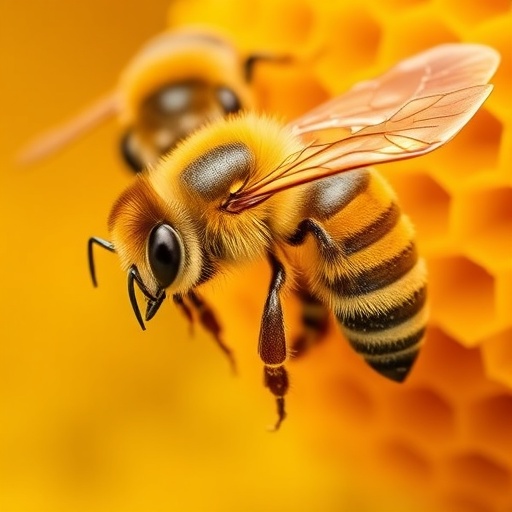
In a groundbreaking study spearheaded by researchers at Virginia Tech’s Fralin Biomedical Research Institute at VTC in collaboration with Arizona State University, scientists have unveiled pioneering insights into the neurochemical dynamics underpinning individual learning rates in honey bees. By meticulously observing the minute fluctuations in neurotransmitters within the bees’ brains as they formed new associations between odors and rewards, the team successfully identified distinct chemical patterns that can predict how swiftly or slowly a bee acquires new information. This discovery marks the first time such neurochemical processes have been mapped in real-time within honey bees during associative conditioning, dramatically advancing our understanding of the biological substrates of learning and decision-making.
This inquiry delves into the delicate interplay between two neurotransmitters—octopamine and tyramine—and their role in modulating learning sensitivity in bees. The research demonstrates that the relative balance and timing of signals these chemicals produce are potent predictors of whether a bee will rapidly form associations, dilly-dally in learning, or fail to learn altogether. Such findings resonate far beyond entomology, illuminating conserved neurochemical pathways that pervade the animal kingdom, including humans. Because octopamine and tyramine bear evolutionary kinship to neurochemicals critical in mammalian brain functions, these results could catalyze new approaches to comprehending and treating cognitive variability and neurological disorders in humans.
The intricate measurement of neurotransmitter release in live bee brains required employing advanced machine-learning algorithms capable of parsing concurrent changes in multiple monoamines—dopamine, serotonin, octopamine, and tyramine—within milliseconds. This method represents a phenomenal leap from previous work, which largely relied on inferring chemical activity from behavioral outcomes or post-mortem tissue analysis. By implementing this real-time chemical monitoring, the scientists captured an unprecedented portrait of neural signaling as bees performed the proboscis extension response—a classic behavioral assay wherein a bee extends its feeding organ upon recognizing a scent linked to a sugar reward.
Building upon decades of foundational research, including prior computational modeling of bee foraging behaviors developed by the team’s lead neuroscientist, Read Montague, this study integrates cutting-edge neurochemical sensing with predictive analytics. Montague’s earlier models illustrated how bees can navigate complex environments by learning which stimuli predict beneficial outcomes. The recent empirical data now ground those theoretical frameworks in biochemical reality, revealing how octopamine and tyramine signals set the threshold for learning and shape decision-making strategies, from cautious exploration to risk-taking.
The biological significance of these findings is immense, especially given the compact nature of the honey bee brain, which orchestrates highly sophisticated learning and memory functions within just a few milligrams of neural tissue. Brian Smith, a behavioral neuroscientist at Arizona State University and collaborator on the project, eloquently emphasizes that the tiny brain of a foraging bee covers a vast ecological landscape, learning dynamically to adapt to constantly changing floral environments. This research reinforces the notion that despite their diminutive size, bees embody remarkably advanced cognitive machinery, worthy of study not only for biological curiosity but also for insights into fundamental principles of nervous system function.
An intriguing aspect of the study is the demonstration that chemical signatures predictive of learning capabilities manifest even before explicit conditioning begins; that is, the neurotransmitter dynamics appear prior to odor-reward pairing. This pre-conditioning neurochemical activity might reflect innate predispositions or baseline neural states that prime bees’ learning systems. Contrastingly, dopamine and serotonin, two other prominent neuromodulators, did not exhibit a comparable predictive pattern during learning, underscoring the specialized roles of octopamine and tyramine in the appetitive learning domain of olfactory conditioning.
Real-time neurotransmitter monitoring further unveiled distinctive temporal profiles as learning progresses: learners exhibited pronounced shifts in octopamine and tyramine release correlating with emergence and consolidation of conditioned behaviors, while dopamine and serotonin levels diminished gradually. Non-learners, in contrast, showed negligible changes across all measured chemicals, highlighting the critical role of these antagonistic neurotransmitter pairs in not only initiating but sustaining learned responses. This nuanced neurochemical choreography advances an understanding of how neural circuits encode salience and reinforce behavioral plasticity.
Beyond basic science, the study carries substantial implications for biomedicine and agriculture alike. Understanding how neurotransmitter networks govern learning at a fundamental level may inform interventions for neurological conditions wherein these ancient monoaminergic systems go awry, such as addiction, major depressive disorder, and attention deficit hyperactivity disorder. Furthermore, because bees serve as essential pollinators in global ecosystems and agriculture, insights into factors influencing their learning and behavior stand to impact efforts to protect bee populations and enhance pollination services critical to food security.
The innovative convergence of sophisticated brain chemistry measurements with machine learning analytics underscores a new frontier in neuroscience, where dynamic, multiplexed chemical data can elucidate complex cognitive phenomena. This technical feat, achieved by fitting minuscule electrodes into the antenna lobe structure of bee brains, exemplifies how scaled-down yet precise instrumentation can bridge molecular neuroscience and ethology. It is a testament to the interdisciplinary collaboration across biology, engineering, and computational science that drives modern advances.
Montague reflects on the evolutionary continuity of these neuromodulatory systems, noting that the biochemical circuits active in honey bees trace back over 130 million years and remain integral components of human neural architecture. This evolutionary conservation validates the bee as a powerful model organism to probe universal principles of learning, memory, and behavior at both the cellular and systems level. By conditioning bees on stimuli relevant to human contexts, the research opens channels for translational insights, perpetuating a virtuous cycle from insect neurobiology to human health.
In essence, this transformative study decodes the chemical language of the bee brain, charting how the push-and-pull of octopamine and tyramine orchestrates rapid learning and flexible decision-making. It heralds a new epoch in understanding cognition, revealing that beneath the buzz lies a dynamic neurochemical interplay that could inform our grasp of brain function across species. As neurotechnologies evolve and interdisciplinary approaches deepen, such revelations ripple outward, promising profound impacts on science, medicine, and ecology.
Subject of Research: Animals
Article Title: Octopamine and tyramine dynamics predict learning rate phenotypes during associative conditioning in honey bees
News Publication Date: 11-Feb-2026
Web References:
https://doi.org/10.1126/sciadv.aea8433
Image Credits: Seth Batten/Virginia Tech
Keywords
Learning, Cognition, Bees, Dopamine, Neurotransmitters, Serotonin, Machine learning
Tags: associative conditioning in insectsbiological substrates of learningdecision-making in animalsentomology and neuroscienceevolutionary neurochemistryhoney bee brain chemistryimplications for human learninginsights into animal behaviorlearning rates in honey beesneurochemical dynamics in learningneurotransmitters in beesoctopamine and tyramine roles