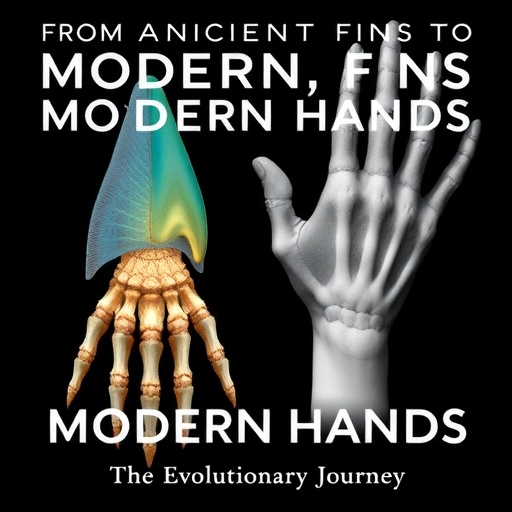
The remarkable complexity observed in the anatomy of modern organisms is a product of millions of years of evolutionary refinement, tracing back to simpler ancestral body structures. One of the quintessential examples of this evolutionary marvel is the human hand, a finely tuned instrument capable of intricate movements and dexterous manipulation. Our hands, with their clearly differentiated dorsal (back) and ventral (palm) surfaces, epitomize the sophisticated adaptations that enabled terrestrial life to thrive. The ventral side, primarily used for grasping and sensing, contrasts sharply with the dorsal side, which is protected by structures such as fingernails. Understanding how this specific anatomical polarity—the dorsal-ventral axis—evolved genetically from primitive ancestors has long been a pivotal question in developmental and evolutionary biology.
Recent groundbreaking research conducted by an international collaboration headed by Joost Woltering at the University of Konstanz has illuminated fundamental aspects of this evolutionary transition. Their findings, published in Molecular Biology and Evolution, dissect the genetic orchestration behind the emergence of the dorsal-ventral limb patterning from the ancient fins of fish. By focusing on the gene Lmx1b, a pivotal determinant of dorsal identity in vertebrate limbs, the team uncovered how ancestral gene functions were repurposed to create new developmental patterns critical for limb evolution.
Approximately 500 million years ago, vertebrate ancestors possessed midline fins—paired structures situated along the body’s dorsal surface such as in sharks and other cartilaginous fish. Around this era, a crucial genetic duplication and redeployment took place when the genetic module responsible for midline fin development was co-opted and activated on the side of the body. This innovation gave rise to paired lateral fins, which represent the evolutionary precursors of tetrapod limbs. Around 350 million years ago, these paired fins underwent further evolutionary modification, culminating in the formation of the limbs that characterize land vertebrates. Despite these broad strokes of anatomical evolution, the molecular underpinnings guiding the emergence of limb-specific features such as dorsal-ventral identity remained elusive until now.
What is especially compelling is that while paired fins and terrestrial limbs share notable genetic signatures, the midline fins from which paired fins originated display symmetrical left and right sides without a defined dorsal or ventral polarity akin to the human hand. This begs a deeper investigation into how the genetic pathways responsible for limb development diversified and specialized to acquire novel functions. The gene Lmx1b, already known in vertebrate developmental biology as a crucial player in defining dorsal limb structures, became the research focus for uncovering these evolutionary changes.
In extant tetrapods, Lmx1b expression is tightly localized to dorsal limb mesenchyme, effectively instructing cells to adopt characteristics of the back of the hand or foot. Cells lacking Lmx1b activity default to ventral fates, contributing to palm and sole structures. Applying advanced molecular techniques, the researchers tracked Lmx1b activation patterns in a variety of fish species, encompassing both sharks with midline fins and cichlids bearing paired fins. These investigations revealed a striking divergence: in paired fins, the Lmx1b gene exhibits a dorsal expression pattern analogous to that in human limbs. In contrast, in midline fins, Lmx1b activity was localized toward the posterior side, facing away from the anterior (head region). This was a profound and unexpected discovery revealing that Lmx1b’s ancestral roles were unrelated to delineating top and bottom surfaces.
Seeking to unravel the developmental regulation responsible for this difference, the team delved into the upstream signaling pathways controlling Lmx1b expression. They found that in paired fins, Lmx1b activation is governed by Wnt signaling pathways—well-established molecular cues essential for dorsal patterning in vertebrate limbs. Conversely, in midline fins, Lmx1b expression was controlled through Hedgehog signaling, a distinct signaling cascade often involved in patterning and morphogen gradients during embryogenesis. Experimental inhibition of Wnt signaling in developing fish embryos abolished Lmx1b expression in paired fins but had no effect on its expression in midline fins. This evidence underscores the complexity of gene regulatory evolution, demonstrating that the mere presence of Lmx1b was insufficient for dorsal-ventral patterning without novel cis-regulatory elements responsive to new signaling inputs.
Perhaps the most fascinating facet of this research lies in the ancestral functional role of Lmx1b within midline fins. While its dorsal-ventral patterning role is a vertebrate limb innovation, Lmx1b originally functioned to facilitate proper neuronal wiring. Specifically, it directs the expression of receptor molecules that guide motor neurons to their muscle targets in the posterior fin musculature, ensuring coordinated muscle innervation. Motor neural circuits are fundamental for controlled movement, and this ancestral function likely provided a selective advantage by refining locomotion and fin control in early vertebrates. This insight reflects a broader evolutionary principle whereby existing gene networks are co-opted and elaborated upon to generate new morphological and functional traits.
This study by Woltering and colleagues exemplifies how evolutionary novelty can arise through regulatory repurposing—a process by which genes acquire new expression domains and functions while retaining older ones. It challenges the simplistic notion of gene gain or loss, instead highlighting the plasticity and modularity of gene regulatory elements that enable profound morphological transitions. The evolution of limb dorsal-ventral polarity is thus not merely a matter of new genes emerging, but of ancient genetic circuits being rewired to serve novel developmental roles.
Moreover, this work has broad implications for understanding congenital limb malformations and axial patterning defects in humans. As Lmx1b mutations are known to cause developmental syndromes such as Nail-Patella Syndrome, dissecting its evolutionary history enriches medical genetics by offering a deeper context for gene function and regulatory control. The conservation and divergence of developmental signaling pathways further emphasize the intertwined fates of evolution and embryology.
Technologically, this research leveraged sophisticated gene expression analyses and functional perturbations in multiple fish species, illustrating the power of comparative developmental biology. By bridging paleobiological timelines with modern molecular tools, the study reveals how ancient fin structures embodied latent genetic potentials later realized in limbs, transforming our understanding of vertebrate appendage evolution.
In summary, the emergence of the dorsal-ventral axis in vertebrate limbs represents a key evolutionary innovation accomplished through the redeployment of the Lmx1b gene regulated by novel signaling inputs. Originally involved in neuronal guidance within midline fins, Lmx1b was co-opted and reprogrammed via Wnt signaling pathways to establish limb dorsality. This regulatory shift underpinned the morphological differentiation essential for terrestrial locomotion and object manipulation, reflecting the elegant genetic architecture through which nature sculpts complexity from simplicity.
As evolution marches forward, the re-engineering of ancient genetic pathways continues to fuel the diversity of life forms, showing that the origins of complex structures can often be traced back to surprising developmental legacies. The human hand, a masterful evolutionary achievement, thus holds within its intricate design the echoes of primordial fish fins and the molecular whispers of genes like Lmx1b that have been repurposed time and time again to forge new biological frontiers.
Subject of Research: Evolutionary developmental biology focusing on genetic mechanisms underlying dorsal-ventral patterning in vertebrate fins and limbs.
Article Title: Dorsoventral limb patterning in paired appendages emerged via regulatory repurposing of an ancestral posterior fin module.
News Publication Date: 2026
Web References: https://doi.org/10.1093/molbev/msaf331
References: S. Zdral, S.G. Bordignon, A. Meyer, M.A. Ros, J.M. Woltering (2026) Molecular Biology and Evolution.
Image Credits: Joost Woltering
Keywords: Molecular biology, Evolutionary biology, Molecular evolution, Molecular genetics, Cell biology
Tags: adaptations in terrestrial lifeancestral fish fins to human handsdorsal-ventral axis in anatomyevolution of human handsevolutionary biology of hand developmentevolutionary refinement of anatomygenetic evolution of limb structuresintricate movements of human handsJoost Woltering evolutionary studyLmx1b gene and limb evolutionMolecular Biology and Evolution findingsresearch on limb patterning genes