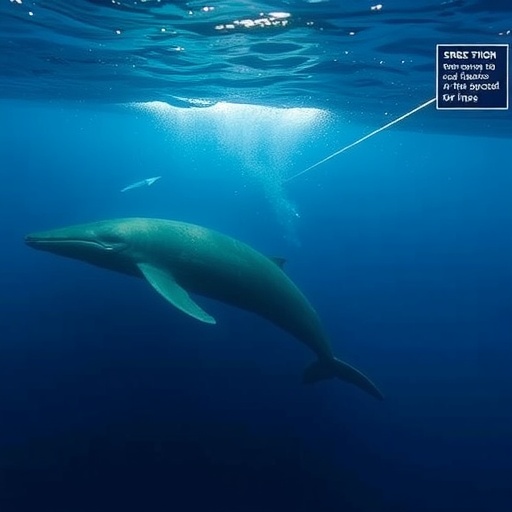
In the vast expanses of the world’s oceans, the sperm whale, Physeter macrocephalus, stands as a giant not only in size but in its remarkable ability to traverse great distances. These marine mammals exhibit an extraordinary potential for dispersal, voyaging across thousands of miles. Yet, despite their capacities for long-distance movement, researchers have found that gene flow among sperm whale populations is not as unrestricted as one might expect. A new study published in Heredity unravels the complex genetic signature underlying sperm whale populations inhabiting the U.S. Gulf of Mexico and the western North Atlantic Ocean, revealing how sex-specific behaviors influence genetic structure and what this means for conservation efforts.
For decades, scientists have grappled with understanding how migratory species such as the sperm whale maintain genetic connectivity across the globe. While earlier genetic studies using mitochondrial DNA pointed to significant population structure, analyses with nuclear DNA markers suggested weaker differentiation. These conflicting results have puzzled marine biologists as they attempt to decipher the true dynamics of connectivity and dispersal. Mitochondrial DNA, inherited maternally, often reflects female lineage and site fidelity, whereas nuclear DNA encompasses genetic contributions from both parents, highlighting patterns shaped by both sexes’ movements.
The innovative study by Brennan, Wilcox Talbot, Martinez, and colleagues deploys a genomic approach to delve deeper into these patterns, utilizing reduced representation genomic sequencing alongside mitochondrial control region analysis. Their sample comprises 73 sperm whales, a robust number given the challenges of marine mammal sampling, collected from two geographically distinct but connected regions—the U.S. Gulf of Mexico and the broader western North Atlantic Ocean. This dual-region focus allows for examination of both fine- and broad-scale population dynamics and their impacts on genetic diversity.
Upon analyzing nuclear markers, the team observed an almost panmictic pattern of gene flow, with pairwise FST values ranging from a negligible 0.001 to 0.008, suggesting little genetic structuring at this level. Nuclear panmixia implies that males, which often undertake extensive migrations, contribute genes broadly across populations, homogenizing the nuclear genetic landscape. This finding is consistent with expectations based on male-biased dispersal, a behavior where males are more likely to leave natal groups and mate across populations, promoting genetic mixing.
Contrastingly, mitochondrial DNA revealed marked population structure, with FST values a striking 0.36 to 0.65 between the two regions. This profound differentiation underscores female philopatry—the tendency of females to remain or return to their natal regions, maintaining population-specific mitochondrial lineages. The divergence shown in mitochondrial genomes starkly contrasts with nuclear findings, illustrating how sex-specific dispersal behaviors sculpt the genetic architecture of sperm whales.
Further refining their analyses, the researchers isolated data sets to examine sex-specific patterns explicitly. Female-only mitochondrial DNA analyses reinforced the strong regional mitochondrial structure, while female nuclear DNA did not show similar differentiation. Male-only analyses for both nuclear and mitochondrial markers revealed no significant genetic structure, supporting the hypothesis that males disperse widely and interbreed among regional groups, acting as agents of nuclear gene flow across ocean basins.
Another fascinating dimension emerged when they investigated relatedness within populations, detecting a decline in relatedness as geographic distance increased. This pattern likely reflects the social organization of sperm whales—matrilineal social units where related females and their offspring cluster closely, creating familial structure that diminishes with spatial separation. Such social fidelity intensifies mitochondrial population structure by restricting female movement and gene flow.
The genomic data also exposed concerning levels of genetic diversity and effective population size. Nuclear diversity was measured at 0.0014 and mitochondrial at 0.0017, both considered low, signaling reduced heterozygosity that can limit adaptive potential. The effective population size (Ne) was estimated at just 460 individuals, a figure that highlights vulnerability due to population declines from historic whaling and ongoing anthropogenic pressures like ship strikes, noise pollution, and habitat degradation.
These findings hold significant implications for conservation strategies. The clear partitioning of genetic variation, particularly in mitochondrial DNA, underscores the importance of recognizing these two regions—the U.S. Gulf of Mexico and the western North Atlantic Ocean—as distinct management units. Treating them separately allows for targeted conservation actions that preserve unique mitochondrial lineages, helping maintain overall species resilience against environmental changes and human impacts.
Moreover, this study illustrates the indispensable value of integrating both mitochondrial and nuclear genomic data in investigating complex population structures. Relying solely on one genetic marker could conceal critical sex-specific dispersal patterns fundamental to understanding the natural history and connectivity of threatened species. Applying such comprehensive genomic frameworks can revolutionize conservation genetics, ensuring policies are informed by nuanced biological realities.
Interestingly, the sperm whale’s life history imparts layers of complexity to these patterns. Females’ tendency for philopatry may enhance social cohesion and cooperative behaviors within matrilineal groups, beneficial for nurturing calves and survival. Meanwhile, males’ role in dispersal ensures genetic exchange and reduces the risk of inbreeding. This sexually dimorphic dispersal strategy emphasizes evolutionary trade-offs that balance local adaptation with genetic diversity across populations.
The low genetic diversity and small effective population size uncovered by this study signal an urgent need for continuous monitoring. Assessing how these genetic metrics fluctuate in response to environmental disturbances or changing ocean conditions could provide early warnings of population declines or shifts in connectivity patterns. Such proactive data gathering is imperative to crafting adaptive management plans to safeguard these iconic marine giants.
Importantly, this research reinforces that even species capable of extraordinary dispersal are not immune to population differentiation driven by behavior and geography. Marine mammals like sperm whales, despite roaming vast oceanic territories, exhibit genetic landscapes shaped by the intricate interplay of sex-specific movement behaviors and social structures. This complexity demands sophisticated genetic tools and integrative approaches to unravel.
The integration of advanced genomic techniques in this study represents a leap forward in marine mammal conservation genetics. It highlights how reduced representation sequencing can yield high-resolution insights into population connectivity, relatedness, and effective population size—crucial parameters previously difficult to obtain. Such technological progress enables the detection of subtle genetic patterns that might otherwise evade classical genetic studies.
Going forward, expanding similar genomic analyses across additional ocean basins and incorporating environmental variables could elucidate how global climatic shifts and human activities influence sperm whale population structure on a broader scale. Understanding such dynamics is vital as the species faces mounting threats from increasing ocean noise, prey depletion, and climate change-induced habitat alterations.
Ultimately, this research by Brennan and colleagues offers a compelling case study at the intersection of genomics, behavior, and conservation biology. It underscores that preserving biological diversity in the ocean requires acknowledging the deep evolutionary and behavioral roots shaping genetic connectivity, rather than relying solely on simplistic models of dispersal. By embracing such complexity, scientists and managers can design more effective strategies to protect sperm whales and ocean biodiversity writ large.
This profound genomic dissection of sperm whale populations not only enriches our understanding of their biology but also reinforces the urgent call for region-specific conservation initiatives. As we strive to secure a future for these majestic creatures, such detailed knowledge forms the cornerstone of informed decisions that can safeguard their genetic legacy in an increasingly uncertain oceanic environment.
Subject of Research: Population genetics and connectivity of sperm whales (Physeter macrocephalus) in the U.S. Gulf of Mexico and western North Atlantic Ocean regions.
Article Title: Mitochondrial structure despite nuclear panmixia: sex-specific dispersal dictates population structure in sperm whales.
Article References:
Brennan, R.S., Wilcox Talbot, L.A., Martinez, A. et al. Mitochondrial structure despite nuclear panmixia: sex-specific dispersal dictates population structure in sperm whales. Heredity (2026). https://doi.org/10.1038/s41437-026-00824-x
Image Credits: AI Generated
DOI: 06 February 2026
Tags: conservation implications for sperm whalesgenetic connectivity in marine mammalsgenetic structure of marine speciesGulf of Mexico sperm whale studyimpact of sex on gene flowlong-distance migration patternsmarine biology researchmitochondrial DNA vs nuclear DNANorth Atlantic sperm whale populationssex-specific dispersal behaviorssperm whale conservation strategiessperm whale populations