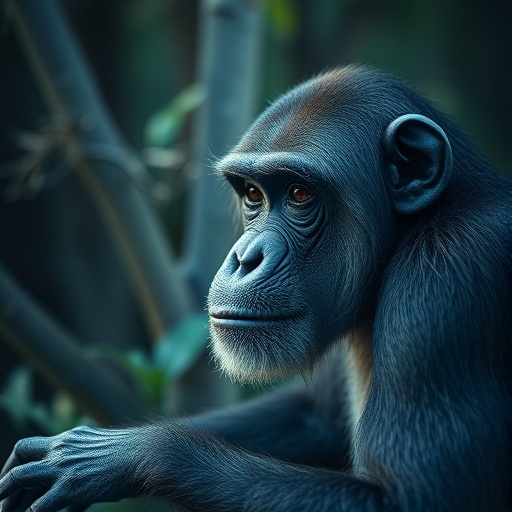
In a groundbreaking discovery that challenges long-standing beliefs about animal cognition, researchers at Johns Hopkins University have demonstrated that apes possess the remarkable ability to imagine and engage in pretend play, a cognitive trait previously believed to be uniquely human. This revelation emerged from a series of meticulously designed experiments reminiscent of children’s tea parties, showing that apes, specifically a bonobo known as Kanzi, can mentally represent objects that do not physically exist—a cognitive feat indicative of imagination.
Traditionally, the capacity for imagination and pretense has been considered a defining characteristic of humans, thought to emerge early in childhood and integral to complex social behaviors and problem-solving. However, the Johns Hopkins research undermines this assumption by providing empirical evidence that an enculturated bonobo can track and interact with objects that are purely imaginary, thereby expanding our understanding of the evolutionary roots of imagination. These insights suggest that such cognitive abilities likely trace back 6 to 9 million years to our last common ancestors with apes.
At the center of this research was Kanzi, a 43-year-old bonobo who has been extensively studied for his language comprehension and interaction capabilities. In controlled settings, Kanzi participated in a series of tasks designed to simulate human pretense, such as pretending to pour juice into empty cups or placing invisible grapes inside containers during a mock tea party. Remarkably, Kanzi not only responded appropriately to these pretend scenarios but reliably identified the location of these imaginary objects, highlighting a sophisticated understanding of symbolic representation.
The primary experiment involved transparent cups and a pitcher, where an experimenter pretended to pour juice into the cups before asking Kanzi to indicate which contained juice. Despite no actual liquid being present, Kanzi correctly pointed to the imagined “filled” cup, a response that remained consistent even when the location of the cup was changed. This demonstrated that Kanzi was not relying solely on perceptual cues but was engaging in cognitive processes involving mental representation and inference.
To rule out the possibility that Kanzi simply expected real juice to be hidden in the cups, a second experiment introduced both a real cup of juice and an empty cup “filled” with pretend juice. When asked to choose what he wanted, Kanzi predominantly selected the real juice, indicating a clear differentiation in his cognitive processing between real and imaginary objects. This discriminative behavior strengthens the argument that Kanzi was genuinely engaging with the concept of pretense rather than reacting to stimuli based on expectation or habit.
The researchers extended this line of inquiry by involving pretend grapes and similar scenarios where physical evidence was absent, yet Kanzi successfully tracked the pretend items’ locations. Although Kanzi was not flawless in every trial, his consistent accuracy provides compelling evidence that the ape could maintain and manipulate mental representations of objects that do not exist in the immediate environment. This finding refutes the previously held notion that such cognitive processes are an exclusive hallmark of human minds.
This study’s implications are profound, posing a significant paradigm shift in cognitive science and animal psychology. The ability to conceive of objects not present challenges simplistic views of animal intelligence as purely reactive or immediate. Instead, it suggests a complex mental life wherein apes can conceive narratives, scenarios, and possibly anticipate future events by simulating possibilities mentally—a capacity critical for planning and social behavior.
Moreover, the methodology employed—drawing from naturalistic pretend play scenarios that mirror early childhood behavior—adds a novel dimension to comparative psychology. Unlike anecdotal observations of animal play in the wild or captivity, these controlled experiments provide replicable data supporting the conceptualization of shared cognitive traits across species. This could pave the way for broader research investigating the extent and limits of imagination in other nonhuman animals.
Co-author Amalia Bastos emphasized the significance of Kanzi’s ability, highlighting how it reflects a mental capacity to generate abstract ideas while simultaneously understanding their unreality. This dual cognitive process is a cornerstone of imaginative thought and suggests a level of self-awareness and executive function that may have been underestimated in nonhuman primates. The researchers hope future studies will explore related aspects, such as theory of mind and future-oriented cognition in apes.
Christopher Krupenye, the assistant professor leading the study, contextualizes these findings within a historical framework akin to Jane Goodall’s discovery of tool use in chimpanzees. Just as Goodall’s work shifted perceptions of what distinguishes humans from other primates, so too could this new evidence reshape our understanding of the mental lives of other creatures. It urges a reconsideration of the ethical and conservation imperatives that stem from recognizing cognitive complexity in apes.
This research also represents a call to action, with Krupenye advocating for increased protection of apes whose sophisticated minds deserve respect and preservation. Given the threats these animals face due to habitat loss and human activity, acknowledging their rich cognitive lives underscores the urgency of conservation efforts. The study not only advances scientific knowledge but also frames an ethical dialogue about human responsibilities toward intelligent nonhuman species.
Published in the prestigious journal Science, these research findings mark a milestone in the interdisciplinary examination of animal minds—bridging psychology, evolutionary biology, and anthropology. Moving forward, the team envisions expanding their experimental framework to include other species, testing whether imaginative capacities manifest beyond apes, and what evolutionary advantages such cognitive traits confer in the natural world.
In sum, the Johns Hopkins study illuminates the mental sophistication of apes through compelling evidence that they can engage in pretend play, a cognitive domain long held as a uniquely human province. This discovery not only enriches our understanding of animal psychology but also invites a profound reconsideration of humanity’s place on the continuum of intelligence, imagination, and consciousness.
Subject of Research: Animal Psychology, Cognitive Psychology, Imagination in Apes
Article Title: Evidence for representation of pretend objects by Kanzi, a language trained bonobo
News Publication Date: 5-Feb-2026
Web References: DOI link
Image Credits: Johns Hopkins University
Keywords: Animal psychology, Cognitive psychology
Tags: animal behavior experimentsanimal cognition researchapes imagination abilitybonobo cognitive skillscognitive abilities of primatesenculturated bonobo researchevolutionary roots of imaginationhuman-like traits in animalsimplications for understanding human evolutionKanzi the bonobo studypretend play in apessocial behaviors in non-human animals