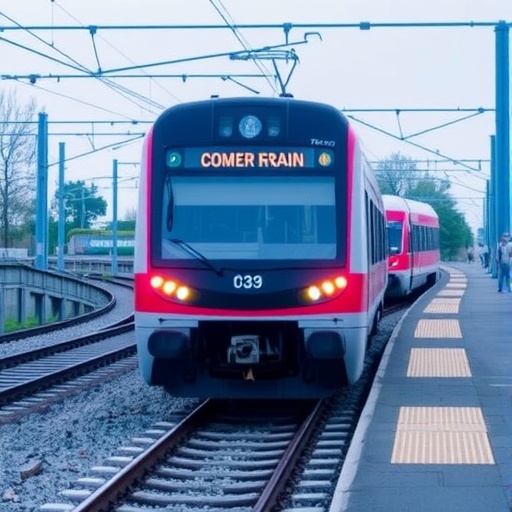
Insulated joints are often overlooked components of railway infrastructure, yet their crucial role enables safe and efficient train operations across vast networks. These joints effectively divide railway lines into distinct electrically separated segments, allowing for reliable communication within the rail system. They play a critical part in ensuring that trains can safely navigate from one segment to another, only granting passage when a section is vacant. Presently, Austria boasts around 33,000 insulated joints, but these essential components frequently deteriorate rapidly, particularly on heavily trafficked routes. In an innovative collaboration, Graz University of Technology (TU Graz), in conjunction with ÖBB and Martin Schienentechnik, has embarked on a mission to enhance the durability and performance of insulated joints through advanced materials and design methodologies.
In this groundbreaking initiative, researchers prioritized a comprehensive view that encompassed not only individual component durability but also efficiency across the entire railway system. Ferdinand Pospischil, associated with TU Graz’s Institute of Railway Infrastructure Design, articulated the importance of assessing all the forces exerted on the system, from the weights and dynamics of trains to the various structural interactions involved. The approach taken by the TU Graz team emphasizes collaboration among disparate fields of expertise, which is essential in tackling the multifaceted challenges of railway design. This interdisciplinary teamwork informed the creation of a new prototype that has shown substantial improvements in longevity without adversely affecting other components of the railway infrastructure.
To arrive at a suitable design, the research team first identified vulnerabilities within the existing insulated joint network. They utilized data collected from specialized track measurement vehicles, which provided invaluable insights into the condition of current joints and the stresses they endure. Following data acquisition, members of the team conducted on-site assessments of worn-out insulated joints to examine the mechanical forces experienced in real-world conditions. This systematic research and analysis led to the development of a digital twin—a virtual model that simulates the behavior of insulated joints under various loads and conditions. This innovative tool allowed the researchers to optimize design configurations and test hypothetical prototypes while minimizing real-world risks.
The transition from theoretical design to practical application led to the construction of a new insulated joint prototype, which underwent rigorous testing back on the tracks. Initial evaluation results indicate that this prototype exhibits significantly lower material stress, largely due to a more effective distribution of forces throughout its structure. These enhancements not only promise to extend the life expectancy of new insulated joints but also contribute to improved overall system reliability. As a consequence of these advancements, stakeholders can expect reduced delays, diminished maintenance burdens, and an ultimately more resilient railway network.
Considerations surrounding operational efficiency were paramount during the development process, as emphasized by Stefan Marschnig, another expert from TU Graz’s Institute of Railway Engineering and Transport Economics. He noted that the wear and tear on insulated joints from frequent train operations can be dramatic; trains exert significant stress on these components with each passing axle. Therefore, the team aimed to develop a joint system that would outperform existing options in terms of both durability and reduced wear on adjacent track components. The researchers have expressed optimism that, with these developments, not only will they achieve longer-lasting insulated joints, but they will also manage to keep production costs within reasonable limits.
The anticipated benefits of the new insulated joint design go beyond simple longevity. With robust structural integrity and reduced failure rates, the advancements could lead to a paradigm shift in how railway operators manage maintenance schedules and operational reliability. Consequently, these innovations have the potential to contribute meaningfully to the safety and efficiency of rail transport, which is vital in today’s fast-paced transportation landscape.
As the railway industry moves towards increased automation and technological adoption, enhancing the infrastructure supporting these advancements becomes even more essential. The development of long-lasting insulated joints aligns perfectly with this trend, promising to not only improve the current rail network but also to pave the way for smart, future-oriented rail systems. Researchers at TU Graz see their work as a stepping stone towards fully integrating innovative materials and engineering practices into the greater railway infrastructure framework.
In summary, the collaborative effort between TU Graz, ÖBB, and Martin Schienentechnik has yielded a noteworthy advancement in the design and performance of insulated joints. As the prototype continues to undergo testing and optimization, stakeholders eagerly await the final implementation phase. This project exemplifies the importance of comprehensive research approaches and the potential technological advancements can bring to critical infrastructure sectors.
Ultimately, the project signifies a crucial step forward in enhancing the longevity and reliability of railway systems, benefiting passengers and freight alike. Improved infrastructure resilience not only supports the demands of modern society but also aligns with sustainable transport goals through increased efficiency and reduced operational disruptions.
As the world continues to grapple with transportation challenges in the face of increased urbanization and climate change, innovations such as these remind us of the ongoing need for research-based solutions to ensure the safety and efficiency of public transport systems. The collaborative nature of the project serves as a model for future initiatives, urging continued investment in research and development within railway infrastructure.
The importance of this work cannot be overstated, as it seeks to address both current challenges and future scalability of rail systems globally. In a time where public transportation is vital to reducing carbon footprints and enhancing sustainable practices, the findings and advancements presented by TU Graz could mark a significant turning point in railway engineering.
By bridging gaps in knowledge and application, this pioneering project sets the stage for further exploration into enhancing railway components, ensuring that the future of public transportation is not only reliable but also resilient.
Subject of Research:
Article Title:
News Publication Date:
Web References:
References:
Image Credits:
Keywords
Tags: advanced design methodologies in railwayscollaboration in railway engineeringdurable materials for railway componentselectrical separation in rail systemsimproving railway network efficiencyinsulated joints in railwaysminimizing railway disruptionsperformance enhancement of railway jointsrailway infrastructure innovationsrailway safety and communicationrailway system dynamics and interactionsTU Graz railway research