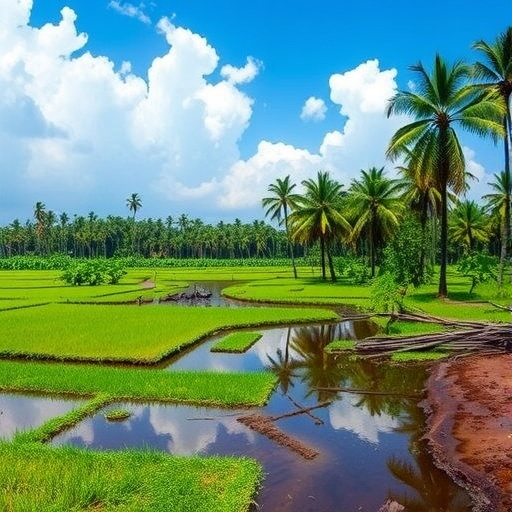
In recent years, tropical peat swamp forests in Southeast Asia have gained increasing attention due to their critical role in the global carbon cycle. These ecosystems, spanning across Indonesia, Malaysia, and beyond, constitute a significant natural resource. They have formed over millennia, with plants thriving in these unique waterlogged conditions. The decomposition of organic material in such low-oxygen environments allows for substantial carbon storage in the soil. However, recent findings from a research team at Hokkaido University have drastically altered our understanding of these peatlands, proposing that their climate impact may be far more pronounced than previously recognized.
Peatlands are extraordinary biomes characterized by their waterlogged conditions and anoxic environments. Over thousands of years, the decay of plant material has resulted in layers of peat that can accumulate to significant depths. The continuous process of plant growth, death, and decay has led to the preservation of vast quantities of carbon, which would otherwise be released into the atmosphere if the peat was not saturated with water. These ecosystems not only act as carbon sinks but also help in regulating water flow within their respective regions, providing critical ecosystem services to both local wildlife and surrounding human populations.
Nevertheless, in the last few decades, the rapid expansion of agricultural activities across Southeast Asia has led to the extensive draining of these peatlands. The practice of draining peatlands allows for the conversion of these areas into productive agricultural land, primarily for palm oil plantations. Unfortunately, this land conversion represents a severe disruption of the natural carbon storage process. The draining process reduces groundwater levels, exposing the carbon-rich peat to air, which significantly accelerates its decomposition. While reducing methane emissions, this alteration simultaneously leads to a marked increase in carbon dioxide emissions.
Emerging research by Professor Takashi Hirano and his team sheds new light on the complexity of greenhouse gas emissions from tropical peatlands. They highlight that while tropical peatlands have been known as significant sources of CO2 emissions, there remain considerable uncertainties regarding their overall greenhouse gas output. The challenges of measuring emissions stem from the region’s variable climatic patterns. Seasonal fluctuations in rainfall and the corresponding variations in groundwater levels result in oscillating greenhouse gas emissions, complicating measurement efforts.
To address these challenges, the researchers developed an innovative methodology to map groundwater levels across extensive peatland areas, estimating associated greenhouse gas emissions with unprecedented accuracy. This advancement facilitates a more comprehensive understanding of how hydrological changes influence the emissions landscape of these ecosystems. By employing satellite data from the Japan Aerospace Exploration Agency (JAXA), they meticulously analyzed rainfall variations throughout Southeast Asia, combining these findings with on-the-ground measurements from multiple monitoring locations.
The results of the study, which covered approximately 180,000 square kilometers of peatlands, revealed surprising emissions patterns; even under natural hydrological conditions, tropical peat swamp forests release more greenhouse gases in total than they sequester. This startling revelation contradicts the previous assumption that these ecosystems function primarily as carbon sinks. Instead, it appears that their contribution to atmospheric greenhouse gases is fundamentally destabilizing, exacerbating climate change.
Further examination of the results indicates that human activities, combined with extreme climate events, significantly magnify emissions from these peatlands. The study quantified that draining these swamp forests can nearly triple greenhouse gas emissions when compared to their natural state. Even more alarming, the conversion of peatlands into agricultural land raises emissions by more than six times. Given that emissions from these peatlands account for roughly 30% of Japan’s annual greenhouse gas output, the implications for global climate policy are substantial.
Regional climatic phenomena, particularly those linked to El Niño, introduce additional unpredictability. During droughts associated with this climate pattern, emissions can escalate dramatically, increasing annual greenhouse gas outputs by around 16%. This factor underscores the urgency of understanding the correlation between climate variability and peatland emissions to develop effective climate strategies and regulatory measures.
Looking toward the future, shifting rainfall patterns predicted by climate models raise significant questions regarding peatland management and their role in the global climate system. Projections indicate that precipitation in Southeast Asia may increase by the mid-21st century. This change could potentially enhance groundwater levels, potentially resulting in a decrease in peat decomposition, provided that other environmental factors align favorably.
Despite covering merely 3% of the planet’s surface, peatlands contain more carbon than all of the world’s forests combined, as reported by the United Nations Environment Programme. The dual challenge of climate change and human-driven land-use alterations posits a precarious outlook for these ecosystems. Understanding how to manage them effectively and observing how shifting weather patterns will affect them will be paramount in determining their future function within our warming planet’s carbon cycle.
The trajectory of peatland ecosystems will be crucial not only for Indonesia and Malaysia but for the broader global context of climate change. Recognizing the net emissions from these regions rather than their potential as carbon sinks provides a more nuanced basis for environmental policymaking. As we strive towards sustainable development and climate resilience, these findings underscore the necessity of a more comprehensive approach to managing peatlands and protecting their invaluable ecosystem services.
In sum, the intricate interplay of hydrology, emissions, and climate dynamics within tropical peat swamp forests has revealed a complex new reality that demands rigorous scientific research and informed public policy. The implications of this study extend beyond academia, impacting conservation strategies, agricultural practices, and climate action initiatives around the world. Future efforts must be directed towards preserving these critical ecosystems to mitigate climate change and foster sustainable land use practices that benefit both local communities and the global environment.
Subject of Research:
Article Title: Impact of Land Use Change and Drought on the Net Emissions of Carbon Dioxide and Methane from Tropical Peatlands in Southeast Asia
News Publication Date: 16-Dec-2025
Web References:
References:
Image Credits: Takashi Hirano
Keywords
Tags: anoxic environments peat ecosystemsbiodiversity in peat swamp forestscarbon storage in peat soilsclimate change impact tropical peatlandsecological importance of peatlandsgreenhouse gas contributions peatlandsHokkaido University peatland researchpeatland conservation strategiesSoutheast Asia peat swamp forestssustainable management of peat ecosystemstropical peatlands carbon emissionswater regulation by peatlands