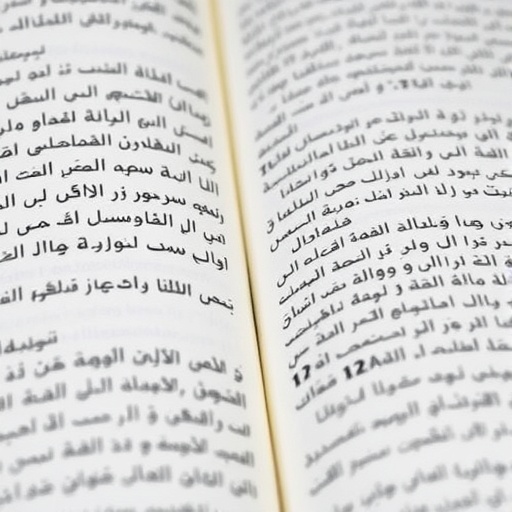
A new era in Arabic language processing is upon us, with groundbreaking advancements in the field of diacritization. Researchers from the University of Sharjah have unveiled a machine-learning system that promises to revolutionize how Arabic script is read and understood. This development is particularly significant given the challenges faced by both native speakers and learners of Arabic, especially when engaging with text that lacks the vowel markers critical for correct pronunciation and comprehension.
Arabic, a language characterized by its reliance on consonantal roots, often presents a formidable challenge. The absence of diacritics, which denote short vowels, can obscure meanings, making it difficult even for proficient speakers to navigate texts. This lack of clarity is problematic not only for native speakers but also for those learning Arabic as a second language, as the nuances of meaning and pronunciation become increasingly lost.
The machine-learning model created by these researchers specifically addresses the difficulties associated with interacting with undiacritized Arabic script. Known as SukounBERT.v2, this system is designed to accurately diacritize Arabic texts. The researchers highlight that this process is not merely about adding marks; it is essential for preserving the semantic integrity of the language. In Arabic, a single word can have radically different meanings depending on its diacritical markings, underscoring the importance of proper diacritization.
SukounBERT.v2 stands out due to its innovative approach to addressing the prevalent issues of diacritization in Arabic. Traditional models often struggle to generalize across the various dialects of Arabic and tend to perform inadequately in noisy and error-prone environments. The new model attempts to bridge this gap by enabling existing AI frameworks to provide accurate vowel markings, thereby enhancing readability and comprehension for users across proficiency levels.
One of the most notable features of SukounBERT.v2 is its heavy reliance on contextual clues, which helps to resolve ambiguities in both meaning and pronunciation. This contextual awareness is achieved through a multi-phase training methodology that enhances the robustness of the diacritization process. By incorporating dataset improvements and noise injection—such as intentionally introducing spelling errors and transliterations—the researchers created a much more resilient model capable of better handling the vast array of Arabic text available.
The development process also included the compilation of the Sukoun Corpus, a vast dataset that contains over 5.2 million lines of text from a variety of sources, such as dictionaries and poetry. This corpus serves as the foundation for training and refining the model, ensuring that it has access to a rich tapestry of linguistic data. Furthermore, the model introduces a unique token-level mapping dictionary designed to facilitate minimal diacritization—an approach that maintains a balance between accuracy and readability.
What sets minimal diacritization apart from full diacritization is its focus on providing essential phonetic cues without overwhelming the reader with excessive markings. This strategy is especially beneficial in modern publishing, where readability is paramount, especially for texts that will be consumed by a diverse audience. By minimizing the diacritic load, the model aims to aid both native and non-native speakers in navigating authentic, undiacritized texts—those frequently encountered in newspapers, literature, and other daily contexts.
Despite the advancements represented by SukounBERT.v2, the researchers acknowledge that challenges remain. One significant barrier is the scarcity of contemporary diacritized datasets, which hinders further progress in automating diacritization processes. This limitation underscores a broader need for the creation of large-scale, open-source datasets that can support ongoing research and improve the performance of diacritization models across various Arabic dialects. Moreover, while the system boasts high accuracy, its “black box” nature poses a hurdle, as it affects transparency in how decisions are made by the model.
The implications of this research are far-reaching. With over 400 million native Arabic speakers and a growing population of learners worldwide, the demand for effective diacritization solutions has never been higher. Manual diacritization is often time-consuming and labor-intensive, making it an impractical solution for the vast amounts of digital text being generated today. Automated approaches like SukounBERT.v2 offer a promising alternative, presenting the potential for significant improvements in reading comprehension and textual analysis in the Arabic language sphere.
In summary, the advent of SukounBERT.v2 marks a pivotal moment in the evolution of Arabic language technology. By successfully integrating machine learning methodologies with an understanding of linguistic principles, researchers are poised to enhance diacritization processes in ways that could fundamentally change the reading experience for Arabic speakers and learners alike. As these innovations continue to evolve, they hold the potential to not only boost Arabic literacy but also bridge cultural divides by making Arabic texts more accessible to diverse audiences.
In conclusion, the quest for perfect diacritization in Arabic continues, driven by technological innovation, a vast corpus of data, and a commitment to refining and enhancing the reading experience for all. The challenges are significant, but the rewards—greater clarity, improved literacy, and a deeper understanding of the Arabic language—are more than worth the effort.
Subject of Research: Arabic Diacritization
Article Title: Empowering Arabic diacritic restoration models with robustness, generalization, and minimal diacritization
News Publication Date: 1-Jan-2026
Web References: Information Processing & Management
References: Not available
Image Credits: Credit: Information Processing & Management (2026). DOI: Link
Keywords
Arabic, diacritization, machine learning, SukounBERT.v2, natural language processing, reading comprehension, linguistic models, Arabic script, contextual training, digital texts.
Tags: advancements in Arabic linguisticsArabic language processingchallenges for native Arabic speakersenhancing Arabic fluencymachine learning for diacritizationpreserving semantic integrity in Arabicreading undiacritized Arabic textsrevolutionizing Arabic text comprehensionsecond language Arabic learnersSukounBERT.v2 modelunderstanding consonantal roots in Arabicvowel markers in Arabic script