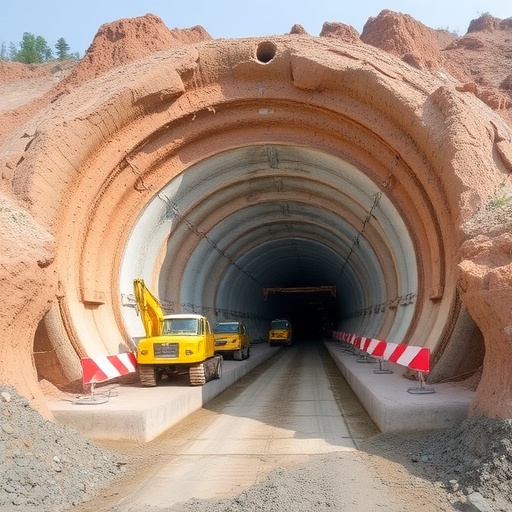
The construction of tunnels has become a pivotal aspect of modern infrastructure, particularly given the growing necessity for efficient transportation systems. Among these projects, the Hankou Tunnel, situated amid the challenging geological conditions of the Xinjin Expressway spiral tunnel group, has garnered significant attention. Recent research led by a distinguished team from Beijing University of Technology has emerged, utilizing advanced computational simulation models to enhance our understanding of tunnel excavation processes and the support systems required to ensure safety and structural integrity.
The research team, spearheaded by Professor Dechun Lu, harnessed sophisticated simulation technology, specifically the ABAQUS platform, to create intricate digital models that replicate the tunnel’s construction from inception to completion. This groundbreaking approach not only serves to model the physical realities of tunneling but also provides an invaluable resource for tunneling engineers looking to improve existing methods of ground support in difficult terrains.
In the dynamic field of engineering, the application of computational simulations has revolutionized the way engineers approach tunnel construction. The findings from this extensive research offer substantial insights into the interaction between various support methods, particularly when working with Grade V surrounding rock. Through the comparative analysis of ground anchors and pre-support pipes, the study provides evidence to optimize support strategies in tunnels like Hankou, which are characterized by soft and fractured rock formations.
As mountain tunnels continue to proliferate worldwide, ensuring their stability is of paramount importance. The Hankou Tunnel serves as a case study in identifying effective reinforcement methods amidst ongoing debates regarding the efficiency of standard ground anchors. While these anchors are a routine component of tunnel construction, their efficacy when paired with other methods remains an area ripe for exploration. This research addresses that gap through rigorous computer simulations, effectively validating their approach with real-world data.
The research findings provide crucial indicators regarding deformation and mechanical responses observed during the excavation process. By evaluating factors such as the settlement of the tunnel crown, the inward movement of surrounding rocks, and corresponding stress fields, the team was able to map out potential failure zones. This comprehensive approach is crucial for predicting how geological variances will affect construction outcomes, thereby allowing for better preparation and planning.
The validated models directly reflect the engineering challenges faced in situ, offering a more precise understanding of the forces at play during tunneling operations. Graduate researcher Xiaoyu Liu highlighted that the analysis not only concentrated on final stress and deformation post-excavation but also provided insights into how these factors evolve through various stages of the construction process. This historical perspective enriches the understanding of how to manage and mitigate risks inherent in tunnel excavation.
Central to the study’s findings is the combination of primary and secondary linings along with ground anchors as a robust support system sufficient to control rock stress and deformation. The introduction of pre-support pipes into this equation allows for additional stabilization, especially in zones where rock can be particularly weak or fractured, ultimately creating a multi-layered support strategy that adapts to the challenges presented by the geological environment.
This research encourages engineers to employ a flexible strategy that standardizes the combination of linings and anchor systems while also permitting the integration of pre-support pipes in areas identified as having the weakest ground conditions. Such adaptability is essential for the success of tunnel constructions in geographically complex areas, increasing both safety and efficiency.
While acknowledging that certain details of their simulation models could be refined further, the team asserts that their study represents a significant step forward in developing more reliable reinforcement techniques for mountainous tunnels. Their insights reflect an ongoing commitment to research excellence in an industry where innovation and safety are paramount.
In light of these findings, this research paper, titled “Comparison and selection of support schemes for deep buried soft broken section of Xinjin expressway spiral tunnel—a case study of Hankou tunnel,” signifies a substantial contribution to the field of tunnel engineering. Published in the peer-reviewed journal Smart Construction, the study is not only a testament to effective research practices but also a reflection of the growing importance of interdisciplinary approaches to solving complex engineering problems.
Furthermore, the implications of these research findings extend beyond the immediate context of the Hankou Tunnel. The methodologies and strategies developed here can be applied to a vast range of tunnel projects confronted with similar challenges, thereby helping to set new standards for tunnel design and construction globally. Such advancements could significantly enhance efficiency and safety in tunneling operations, aligning with broader trends in infrastructure development focused on sustainability and resilience.
In conclusion, the efforts invested by Professor Lu and his research team illustrate a compelling narrative of innovation in tunnel engineering. Through the strategic use of computational models, the research paves the way for improved safety and efficiency in one of modern construction’s most challenging arenas. As we look to the future, continued research in this domain will undoubtedly yield even greater advancements, ensuring that the tunnels of tomorrow can withstand the test of time.
Subject of Research: Supports in Tunnel Excavation
Article Title: Comparison and selection of support schemes for deep buried soft broken section of Xinjin expressway spiral tunnel—a case study of Hankou tunnel
News Publication Date: 26-Jan-2026
Web References: https://doi.org/10.55092/sc20260002
References: Smart Construction, ISSN: 2960-2033
Image Credits: Credit: Dechun Lu, Xiaoyu Liu, Caixia Guo, Xiuli Du/ Beijing University of Technology, Haining Xu/China Construction Road and Bridge Group Fourth Engineering Co., Ltd.
Keywords
Applied sciences and engineering, Geological engineering
Tags: ABAQUS simulation technologycomputational simulation in engineeringengineering research advancementsexcavation process modelinggeological challenges in tunnel constructionGrade V surrounding rock analysisground support methods in tunnelingHankou Tunnel case studyinteraction of support systems in tunnelingsupport strategies for soft groundtunnel construction techniquesXinjin Expressway infrastructure