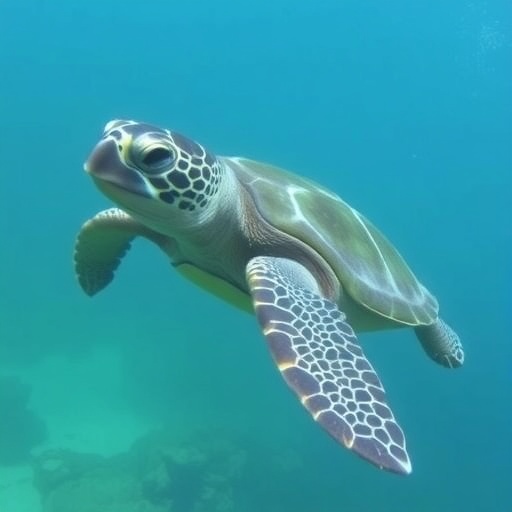
Kemp’s Ridley Sea Turtles Face Acoustic Threats Amidst Human Coastal Activity
Kemp’s ridley sea turtles (Lepidochelys kempii) are recognized as one of the most imperiled sea turtle species on the planet, largely confined to the eastern and Gulf coasts of North America, regions that coexist with some of the busiest maritime routes globally. While the perils posed by traditional anthropogenic factors such as fishing bycatch, habitat degradation, vessel collisions, and pollution are well documented, an emerging concern in marine conservation circles relates to the impact of human-generated underwater noise on these endangered reptiles. New multidisciplinary research spearheaded by teams from Duke University Marine Laboratory, NOAA, and North Carolina State University provides fresh insights into the auditory capabilities of Kemp’s ridley turtles, signaling the potential significance of noise pollution in their survival dynamics.
Sound in the marine environment serves as a critical sensory modality for many aquatic organisms, enabling navigation, foraging, and social communication. Unlike light, which dissipates rapidly underwater, low-frequency sound waves traverse vast distances, often permeating the entire habitat. For Kemp’s ridley turtles inhabiting nearshore coastal and shelf waters—areas heavily trafficked by commercial vessels, dredging operations, and oil exploration platforms—this acoustic landscape is increasingly dominated by anthropogenic noise falling within frequency bands crucial to their cardiac and behavioral cues. Despite this, until now, the auditory sensitivity of these turtles had been poorly characterized, particularly in controlled experimental contexts.
Utilizing a novel approach involving the placement of noninvasive electrophysiological sensors on the turtles’ cranial region, researchers were able to directly measure neural responses along the auditory pathways when exposed to a systematic range of sound stimuli between 50 and 1,600 Hz. This frequency range encapsulates the lower spectrum of frequencies audible to humans and overlaps with most industrial underwater noise. The findings reveal a distinct auditory peak sensitivity of Kemp’s ridleys at approximately 300 Hz, with sensitivity diminishing at higher frequencies. This low-frequency auditory tuning aligns closely with the dominant frequencies emitted by large vessels, maritime construction equipment, and other prevalent coastal anthropogenic sources.
The implications of these findings ripple through the conservation and management frameworks. The acoustic overlap means that these turtles may experience sensory masking, distraction, or even stress responses when exposed to continuous or high-intensity industrial noise. Such disturbances could compromise their ability to detect biologically relevant sounds, complicate navigation across migratory routes, or interfere with their communication, all of which may cumulatively affect reproductive success and survival. The study’s lead author, Charles Muirhead, underscores that these results do not conclusively demonstrate harm but rather establish a baseline for prioritizing further field investigations into behavioral and physiological responses under real-world ocean conditions.
The study’s methodology marks a significant advancement in sea turtle bioacoustics research. Conventional attempts at assessing marine turtle hearing often relied on behavioral assays or less precise indirect measures. By recording auditory-evoked potentials—a direct neural correlate—inside the auditory nerve pathways, the approach furnishes objective, high-resolution data on auditory thresholds and frequency ranges that can inform species-specific acoustic risk assessments. This technical refinement opens pathways for rigorous evaluations of noise mitigation techniques and regulated vessel operations to safeguard sensitive habitats.
Recognizing that the acoustic environment in coastal waters is dynamic and compounded by multiple concurrent stressors, the research team emphasizes the necessity for integrative ecosystem monitoring frameworks. Such frameworks would not only quantify noise levels and sources in turtle habitats but also evaluate the intersection of noise with chemical pollution, prey abundance, and physical habitat quality. Targeted conservation strategies could then be tailored to spatially and temporally minimize noise exposure during critical life stages, such as nesting migrations or juvenile dispersal.
Looking forward, the researchers aim to extend their investigations beyond laboratory conditions by employing acoustic playback experiments and telemetry in natural habitats. Understanding the behavioral modifications or avoidance patterns exhibited by Kemp’s ridley turtles in response to specific anthropogenic noise profiles will be instrumental in quantifying the actual ecological impact. Furthermore, correlating stress biomarkers and reproductive indicators with sound exposure data may offer vital clues on sublethal effects that threaten long-term population viability.
These research efforts coincide with growing global recognition of noise pollution as a major threat to marine biodiversity. Regulatory bodies and marine spatial planners are increasingly called upon to incorporate bioacoustic data into environmental impact assessments for coastal developments and shipping operations. The findings from this Kemp’s ridley study provide a scientific foundation to influence policy adjustments, such as the implementation of quieting technologies in vessels or establishing marine protected areas with noise limitations.
For Kemp’s ridleys, whose vulnerable populations number only in the tens of thousands, every increment in threat reduction is critical. Their unique ecological niche and evolutionary adaptations dependent on sensory cues highlight the urgency of understanding and mitigating anthropogenic noise. This research paves the way toward establishing concrete guidelines and conservation measures that harmonize human maritime activities with the imperatives of preserving endangered marine life.
The multidisciplinary collaboration exemplified by this work underscores the importance of bridging marine biology, acoustical engineering, and environmental management to address complex conservation challenges. By elucidating the underwater acoustic perception of Kemp’s ridley turtles, the study opens avenues for more nuanced, species-centric noise impact evaluations. This approach is vital in an era of accelerating coastal development and escalating ocean noise pollution, wherein safeguarding bioacoustic habitats remains a crucial frontier in marine conservation science.
Ultimately, advancing our knowledge of how Kemp’s ridleys interact with their acoustic environment will empower scientists and policymakers alike to devise evidence-based interventions. Through continued research and adaptive management driven by robust bioacoustic data, it may be possible to alleviate the cumulative burdens threatening this endangered species, ensuring that Kemp’s ridley sea turtles persist in the world’s oceans for generations to come.
Subject of Research: Underwater hearing sensitivity and vulnerability of Kemp’s ridley sea turtles to anthropogenic noise
Article Title: Underwater hearing sensitivity of the Kemp’s ridley sea turtle (Lepidochelys kempii)
News Publication Date: February 3, 2026
Web References: https://doi.org/10.1121/10.0041867
Image Credits: Instigator/Shanna Stawicki Photography
Keywords
Acoustics, Physics, Bioacoustics, Noise pollution
Tags: acoustic assessment in marine biologyanthropogenic threats to sea turtlesauditory capabilities of turtlescoastal habitat degradationendangered sea turtle speciesimpact of human activity on wildlifeinterdisciplinary marine researchKemp’s ridley sea turtlesmarine conservation challengesmaritime routes and wildlifenoise pollution and marine lifeunderwater noise pollution effects