In a groundbreaking study recently published in Nature Communications, researchers have unveiled the intricate epigenetic mechanisms by which counteracting FOX proteins regulate the delicate balance between lytic and latent phases in herpesvirus infection. This discovery provides significant insight into the virus’s ability to toggle between dormancy and active replication, a phenomenon central to herpesvirus pathogenesis and persistence within the human body. The findings have profound implications for developing novel therapeutic strategies that could effectively target viral latency, a major challenge in herpesvirus treatment.
Herpesviruses are infamous for their lifelong latency, during which viral genomes persist in the host cells without generating infectious particles. This quiescent state can reactivate under certain conditions, causing viral replication and disease recurrence. Understanding the molecular interplay that governs this lytic-latent switch has been a persistent challenge in virology. The latest research conducted by Xiang, Yang, Zhang, and colleagues sheds light on the critical epigenetic control exerted by members of the FOX (Forkhead box) family of transcription factors, which orchestrate this switch through a balance of opposing activities.
Central to the study is the identification of two counteracting FOX proteins acting as molecular rheostats controlling herpesvirus gene expression. These proteins exert antagonistic epigenetic influences on viral chromatin, modulating histone modifications that determine whether viral genes are transcriptionally active or repressed. Specifically, one FOX protein promotes the recruitment of histone acetyltransferases, facilitating an open chromatin conformation conducive to lytic replication. Conversely, its counterpart recruits histone deacetylases and repressive complexes, enforcing a compact chromatin state aligned with viral latency.
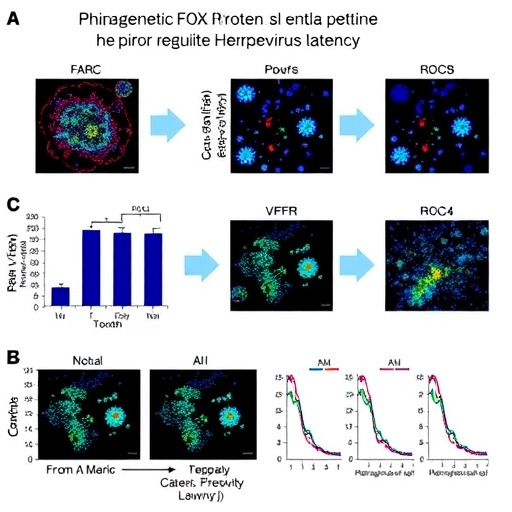
The team employed cutting-edge chromatin immunoprecipitation sequencing (ChIP-seq) to map the binding landscapes of these FOX proteins across the viral episome during different infection stages. Their data revealed dynamic occupancy patterns: during latency, the repressive FOX protein predominated, maintaining a silenced viral genome, while in lytic reactivation, the activating FOX protein relocated to promote transcription of immediate early genes essential for viral replication. This elegant regulatory mechanism underscores how herpesvirus exploits host epigenetic machinery to persist and reactivate.
Beyond chromatin occupancy, epigenome editing techniques further substantiated the functional roles of these FOX proteins. CRISPR-dCas9 fused with chromatin modifiers selectively targeted FOX-binding sites, demonstrating that tweaking this epigenetic axis could scientifically tilt the balance towards either latency or lytic replication. Such precision offers a blueprint for potential antiviral therapies that manipulate viral latency by modulating FOX protein activity or their associated chromatin modifiers.
These findings dovetail with emerging understanding of how host-virus interactions extend beyond mere genetic information to epigenetic regulation, which is reversible and exquisitely responsive to cellular and environmental signals. The presence of counteracting FOX proteins underscores a nuanced epigenetic duel at the heart of herpesvirus biology, where viral fate hinges on the balance of activating and repressive forces superimposed on the viral genome.
The broader biological roles of FOX proteins in cellular differentiation, metabolism, and immune regulation add layers of complexity to their involvement in viral control, suggesting that herpesvirus harnesses fundamental cellular regulatory pathways for its own lifecycle management. This co-option of FOX protein function could explain why herpesviruses exhibit such remarkable latency and reactivation capabilities, evading immune clearance.
Moreover, the study’s epigenetic framework provides a fresh perspective on latent viral reservoirs—particularly in neurons for herpes simplex virus and B lymphocytes for Epstein-Barr virus—where subtle shifts in chromatin architecture can unleash reactivation. By delineating the molecular underpinnings of such shifts, this research paves the way for drug development aimed at stable suppression or controlled activation strategies.
Future investigations inspired by this study may explore how external stimuli, such as cellular stress, immune signaling, or pharmacological agents, influence FOX protein expression or function. Understanding these extrinsic modulators could unlock tailored interventions that prevent herpesvirus-associated diseases by stabilizing latency or inducing safe viral reactivation for immune clearance.
Equally important is the potential for extending these mechanistic insights to other latent viruses that employ similar chromatin-dependent regulatory controls. The epigenetic control paradigm elucidated here may represent a universal viral strategy, broadening the impact of this research beyond herpesviruses and informing a new class of epigenome-targeting antivirals.
In conclusion, the work of Xiang and colleagues offers a seminal contribution to virology and epigenetics by characterizing the counterbalancing roles of FOX proteins in herpesvirus epigenetic regulation. The interplay between these proteins acts as a molecular switch dictating viral latency and lytic replication, reshaping our understanding of viral persistence and reactivation at the chromatin level. As the field moves forward, these discoveries are poised to revolutionize antiviral therapeutic approaches, ultimately improving outcomes for individuals affected by herpesvirus infections.
The convergence of molecular biology, epigenetics, and virology embodied in this study exemplifies the power of interdisciplinary research. By harnessing novel genomic tools and integrating them with classical virology, the researchers illuminate a regulatory axis that was previously obscured. Their work not only fills critical knowledge gaps but also ignites new questions about viral lifestyle regulation and host-pathogen coevolution.
The impact of this research resonates with clinicians and researchers alike, offering hope that in the future, the persistent challenge of herpesvirus latency can be effectively tackled. This could lead to therapies that eradicate latent infections or prevent reactivation without relying solely on current antiviral drugs, which primarily target active replication phases.
As herpesviruses are responsible for a wide array of human diseases, ranging from cold sores and genital herpes to cancers and neurological disorders, improving control over their life cycle is of paramount importance. The identification of epigenetic control nodes like FOX proteins promises to be a game-changer in the clinical management and understanding of these pervasive viral pathogens.
Ultimately, the elucidation of FOX protein-mediated epigenetic regulation represents a major step toward decoding the viral “switchboard” that toggles between silence and activity. Through this lens, herpesvirus latency is no longer a static state but a finely tuned dance choreographed by epigenetic regulators. This knowledge not only enriches fundamental virology but also empowers translational efforts aimed at disrupting chronic viral infections.
Subject of Research: Epigenetic control mechanisms by FOX proteins regulating herpesvirus lytic-latent balance.
Article Title: Counteracting FOX proteins epigenetically control the herpesvirus lytic-latent balance.
Article References:
Xiang, Y., Yang, X., Zhang, J. et al. Counteracting FOX proteins epigenetically control the herpesvirus lytic-latent balance. Nat Commun (2026). https://doi.org/10.1038/s41467-026-68915-1
Image Credits: AI Generated
Tags: challenges in herpesvirus latency managementchromatin modulation by FOX proteinsepigenetic regulation of herpesvirus latencyFOX proteins in viral infectionherpesvirus pathogenesis and reactivationinterplay of lytic-latent switchlytic and latent phases of herpesvirusmolecular mechanisms of viral persistencequiescent state of herpesvirusestherapeutic strategies for herpesvirus treatmenttranscription factors in virologyviral gene expression control