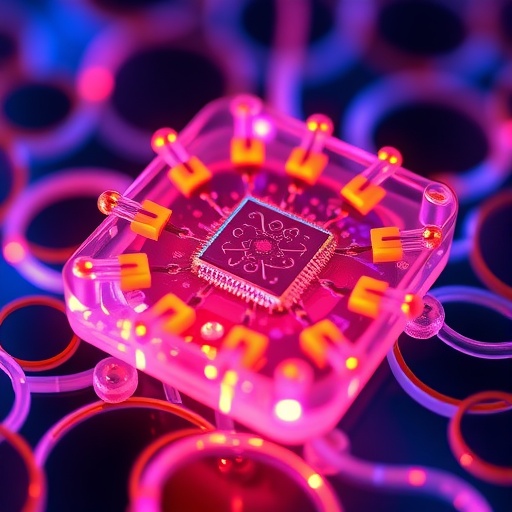
In a groundbreaking fusion of biology and electronics, recent advancements have illuminated the path toward energy-efficient computing by harnessing the intricate mechanisms found in living systems. The research spearheaded by Oren, Gupta, Habib, and their team, published in Communications Engineering in 2026, marks a pivotal moment in the evolution of synthetic biology applied to next-generation electronic devices. This novel approach draws inspiration directly from nature’s engineering prowess, specifically targeting the design and functioning of logarithmic data converters, critical components in modern signal processing.
The core of this innovation rests on understanding how biological systems perform complex computations with remarkable energy efficiency and resilience. Traditional electronic devices, while powerful, consume significant energy, particularly when performing nonlinear data transformations such as logarithmic conversions. Such transformations are essential in various fields, including audio signal processing, image compression, and telecommunications. By mimicking the molecular and cellular processes that living organisms use to handle vast amounts of data with minimal power expenditure, the researchers developed bioinspired circuits offering a transformative alternative.
Synthetic biology has long promised revolutionary advances by reprogramming living cells or designing novel biomolecules. However, its application to electronics has faced challenges related to interfacing biological materials with silicon-based technologies. The research team overcame these hurdles by engineering biomolecular components capable of functioning as fundamental electronic elements—resistors, capacitors, and transistors—inside a biological matrix. This biohybrid architecture leverages enzymatic reactions and genetic circuits to generate logarithmic responses, capturing the essence of natural signal processing pathways.
One notable aspect of these bioinspired systems is their remarkable ability to operate at ambient temperatures without the need for extensive cooling infrastructures typical in conventional electronics. Enzyme-mediated reactions that underpin the logarithmic function require orders of magnitude less energy than silicon transistors switching at high frequencies. This thermal advantage not only reduces energy consumption but also enhances device longevity and reliability—a crucial factor for applications in remote or resource-constrained environments.
The bioengineered logarithmic converters demonstrate tunability through genetic modulation and biomolecular concentration adjustments. This capacity allows for dynamic reconfiguration of device parameters, offering a level of flexibility rarely achievable in purely electronic systems. Adjusting reaction kinetics or protein expression levels reprograms the system in real time, enabling adaptive responses to varying input signals. Such adaptability mimics physiological feedback mechanisms, paving the way for self-regulating electronic circuits that optimize performance autonomously.
Furthermore, the integration of these synthetic biological components into existing electronic infrastructure was a significant focus for the researchers. By developing interfaces that transduce biochemical signals into electrical currents, the team ensured compatibility with standard microelectronic platforms. These biohybrid interfaces open possibilities for hybrid computation, where biological and electronic elements synergistically handle tasks based on their respective strengths—energy efficiency and processing speed—resulting in unparalleled system performance.
The implications of this research extend well beyond engineering. By embedding biological principles into computational hardware, new horizons in medical diagnostics, environmental monitoring, and wearable technology become accessible. Biosensors utilizing logarithmic conversion biochips could detect wide dynamic ranges of analytes with minimal power requirements, essential for continuous monitoring applications. Similarly, adaptive hearing aids and visual prosthetics could benefit from bioinspired logarithmic circuits mimicking natural sensory processing, enhancing user experience and reducing battery dependency.
Challenges remain in scaling and mass production. Biological components inherently face variability and sensitivity to environmental factors. The team addressed these concerns by devising robust genetic circuits insulated from external fluctuations and optimizing biochemical pathways to minimize noise. Encapsulation techniques and microfluidic delivery systems extend the functional lifetime of biohybrid devices, ensuring stability and reproducibility crucial for commercial viability.
In collaboration with materials scientists, the researchers also explored biocompatible substrates and biodegradable electronics, highlighting sustainability. By incorporating living cells or biomolecules into environmentally friendly materials, the end-of-life impact of electronic devices can dramatically decrease. This approach aligns with global efforts toward reducing electronic waste, merging ecological consciousness with technological advancement.
Moreover, the mathematical modeling underpinning these bioinspired logarithmic converters revealed deep insights into nonlinear biological computation. By translating enzymatic kinetics into circuit analogues, the team established design principles bridging biology and electrical engineering. These models enable predictive tuning of circuit behavior, accelerating development cycles and facilitating integration into complex electronic systems without extensive empirical iteration.
This transformative research also catalyzes new interdisciplinary collaboration, bringing together synthetic biologists, electrical engineers, computer scientists, and physicists. Such convergent efforts highlight the necessity of cross-domain expertise to tackle multifaceted challenges in modern technology. The study’s success demonstrates how merging disciplines can yield innovations unattainable within siloed approaches, setting a paradigm for future scientific inquiry.
Excitedly, this bioinspired methodology holds promise for advancing artificial intelligence hardware. Neuromorphic systems relying on analog computation could exploit logarithmic transformations executed through biocircuits, enabling faster, energy-saving computations that mimic neuronal logarithmic encoding of sensory input. This biological analog could vastly improve machine learning models running directly on specialized hardware, overcoming current constraints imposed by digital architectures.
The broader societal impact is profound. As energy consumption by data centers and personal electronics continues to surge, finding sustainable, efficient alternatives becomes imperative. This breakthrough in synthetic biology-enabled electronics offers a path toward greener computation, reducing carbon footprints associated with digital technology. Governments and industries are taking notice, exploring avenues for deploying these bioinspired devices at scale.
Educationally, this study provides a rich platform for inspiring the next generation of scientists and engineers. It showcases the thrill of innovation at the boundaries of knowledge, encouraging young researchers to explore hybrid disciplines and develop creative technological solutions. Importantly, the research presents a hopeful narrative of tapping nature’s wisdom to solve pressing human challenges, fostering a deeper respect for biological complexity.
In conclusion, the pioneering work led by Oren, Gupta, Habib, and colleagues represents a seminal leap in synthetic biology and electronics. By harnessing bioinspired designs for energy-efficient logarithmic data converters, they have unlocked new possibilities for sustainable, adaptive, and high-performance computing devices. This endeavor not only reshapes technological landscapes but also enriches our understanding of the interplay between biology and engineering, heralding a future where living systems and human-made electronics coalesce harmoniously.
Subject of Research: Synthetic biology applied to development of energy-efficient bioinspired electronic devices, specifically logarithmic data converters.
Article Title: Harnessing synthetic biology for energy-efficient bioinspired electronics: applications for logarithmic data converters.
Article References:
Oren, I., Gupta, V., Habib, M. et al. Harnessing synthetic biology for energy-efficient bioinspired electronics: applications for logarithmic data converters. Commun Eng (2026). https://doi.org/10.1038/s44172-026-00589-5
Image Credits: AI Generated
Tags: audio signal processing innovationsbioinspired synthetic biologybiological systems in computingenergy efficient electronicsimage compression techniqueslogarithmic data convertersmolecular and cellular processesnonlinear data transformationssignal processing advancementssustainable technology solutionssynthetic biology in electronicstelecommunications enhancements