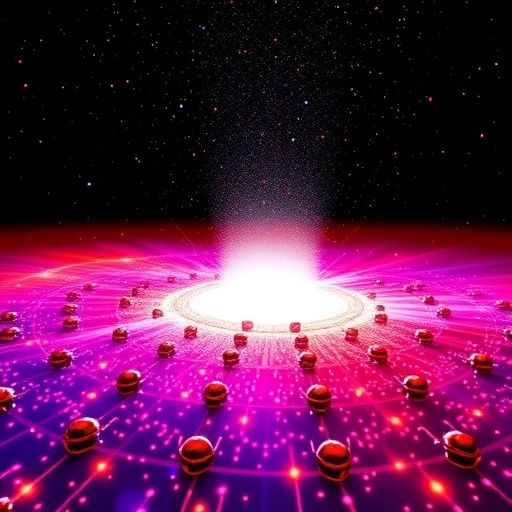
In the realm of high-energy nuclear physics, understanding the behavior of heavy quarkonium—an exotic and tightly bound state of heavy quark-antiquark pairs—uncovers vital insights into the quark-gluon plasma (QGP), a primordial state of matter that existed microseconds after the Big Bang. Recent groundbreaking research led by Professor Kai Zhou has delved into the intricate thermodynamic properties and dissociation mechanisms of heavy quarkonium under extreme conditions typical of relativistic heavy-ion collisions. This pioneering work applies advanced theoretical models, blending holographic QCD frameworks with Bayesian analysis, to unravel the complex dynamics governing quarkonium interaction with the QGP, offering a transformative lens into the quantum chromodynamic universe.
Heavy quarkonium, exemplified by particles such as the J/ψ—composed of charm quark and anticharm quark pairs—function as fundamental probes probing the QGP medium. Due to their substantial masses, these quark-antiquark pairs are predominantly generated during the very initial hard scattering phases, preceding the full formation of the QGP. As these quarkonia traverse the highly energetic QGP environment, they encounter a phenomenon known as color screening—a fundamental QCD effect whereby the medium suppresses the binding color force between the quarks, effectively destabilizing the quarkonium state. This color screening reduces the binding potential, resulting in the dissociation of the quarkonium into unbound heavy quarks, thereby encoding essential information about the screening length scales and temperature-dependent properties of the QGP.
The study guided by Professor Zhou deploys the Einstein-Maxwell-Dilaton (EMD) holographic QCD model, a sophisticated computational framework grounded in the gauge/gravity duality principle, to simulate the heavy quarkonium’s thermodynamic evolution within a dense QCD medium. By incorporating Bayesian inference, the research rigorously quantifies uncertainties and extracts probabilistic descriptions of QGP parameters influencing quarkonium dissociation. Crucially, this approach allows systematic evaluation of how temperature and baryochemical potential sculpt key physical observables such as dissociation length, entropy variation, potential and binding energies, as well as quasiparticle internal energies, thereby providing a microscopic window into the confinement-deconfinement transition.
Thermodynamic quantities are central to understanding the deconfinement process affecting heavy quarkonium. Changes in the potential energy landscape, alongside entropy and entropy forces, elucidate the destabilization pathways by which quark-antiquark pairs lose their coherence. The study demonstrates how increasing temperature and chemical potential intensify color screening effects, progressively diminishing the quarkonium binding energy until dissociation thresholds are crossed. This thermal unbinding reflects the critical temperature-dependent shift between confined hadronic matter and the deconfined QGP phase, a crossover that holds profound implications for interpreting experimental signals from facilities such as the Large Hadron Collider (LHC) and the Relativistic Heavy Ion Collider (RHIC).
One of the remarkable outcomes from the research is the enhanced ability to describe the complex interplay between microscopic quantum chromodynamics and macroscopic thermodynamic observables. By mapping quarkonium dissociation into quantifiable thermodynamic parameters within a holographic QCD construct, the team converts abstract QCD dissociation mechanisms into computationally accessible and experimentally verifiable predictions. This cross-disciplinary synthesis paves the way for refined theoretical models that encompass both equilibrium and nonequilibrium dynamics, capturing the transient but crucial moments of quark-gluon plasma evolution in heavy-ion collisions.
Beyond the theoretical novelty, the research impacts the broader understanding of QCD matter under extreme conditions, such as those found in neutron star mergers or early universe cosmology. The ability to characterize the phase structure of QCD matter under varying temperature and chemical potential is critical for constructing comprehensive equations-of-state that underpin astrophysical modeling. Heavy quarkonium dissociation emerges as a unique experimental signature linking terrestrial heavy-ion collision data with cosmological and nuclear astrophysics phenomena.
Looking ahead, Professor Zhou and the team are poised to advance their investigation into more dynamic, realistic simulations of QGP conditions. Real heavy-ion collisions unfold in evolving environments where temperature and baryochemical potential fluctuate rapidly over femtoseconds. Capturing these spatiotemporal gradients demands extending the holographic QCD models to incorporate time-dependent flows and medium expansions. Such efforts aim to bridge gaps between idealized theoretical constructs and the stochastic nature of physical experiments, ultimately refining predictive power regarding QGP properties and the fate of embedded heavy quarkonium states.
Integrating Bayesian statistical frameworks with holographic QCD not only bolsters the interpretive precision of the quarkonium dissociation but also offers a versatile analytical tool for exploring other nonperturbative QCD phenomena. The methodology transcends the specific case of charmonium, suggesting broader applicability to bottomonium and other heavy-flavor mesons, which behave differently under varying energy scales and medium conditions. This adaptability stands to enrich the palette of heavy-ion collision phenomenology and nuclear matter research.
The study concludes that the dissociation of heavy quarkonium in the QGP is governed by a delicate balance of competing thermodynamic forces shaped by the medium’s temperature and chemical potential. The resultant theoretical framework provides a coherent narrative explaining how color screening dissolves quark-antiquark bonds, translating quantum field theory into tangible thermodynamic insights. Such breakthroughs advance the foundational knowledge of QCD, underscore the importance of holographic duality in nuclear physics, and illuminate pathways to uncovering the inner workings of the strong force under extreme circumstances.
By turning complex quark dynamics into calculable physical phenomena, this research not only enriches fundamental physics but also primes the community for designing future high-energy accelerator experiments and developing innovative technologies. As Professor Kai Zhou emphasized, each theoretical advancement contributes to constructing a comprehensive bridge connecting micro-level quark interactions with macro-level experimental observations—a crucial stride toward demystifying the enigmatic physics of extreme nuclear matter.
This landmark research was formally published in the journal Nuclear Science and Techniques on January 31, 2026. The full article entitled “Thermodynamics of heavy quarkonium in a Bayesian holographic QCD model” provides detailed computational analyses and theoretical perspectives that are expected to shape the trajectory of heavy-ion collision studies for years to come.
Subject of Research: Not applicable
Article Title: Thermodynamics of heavy quarkonium in a Bayesian holographic QCD model
News Publication Date: 31-Jan-2026
Web References: DOI: 10.1007/s41365-026-01903-8
Image Credits: Zhou Kai
Keywords
Nuclear physics, Particle physics
Tags: advanced theoretical models in particle physicsBayesian holographic QCD modelcolor screening effects in QCDheavy quark-antiquark interactionsheavy quarkonium thermodynamicshigh-energy nuclear physics researchJ/ψ particle thermodynamicsprimordial state of matter studiesquantum chromodynamics insightsquark-gluon plasma dynamicsquarkonium dissociation mechanismsrelativistic heavy-ion collisions