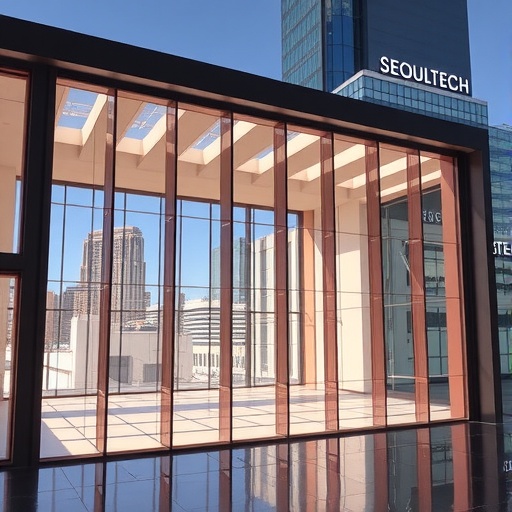
In an era marked by the increasing vulnerability of electronic infrastructure to electromagnetic disturbances, a groundbreaking development has emerged from the scientific community that promises to revolutionize the way we protect critical civilian and military facilities. Researchers hailing from South Korea and the United States have ingeniously designed transparent glass windows embedded with metal mesh films that provide ultra-wideband electromagnetic pulse (EMP) shielding. This innovation not only addresses a critical security challenge but also preserves the aesthetic and functional qualities of conventional glass, representing a major leap forward in electromagnetic defense technology.
Electromagnetic pulses, or EMPs, are intense bursts of electromagnetic energy generated by sources including nuclear detonations, specialized EMP devices, and deliberate electromagnetic interference. These pulses can wreak havoc on electronic systems by inducing currents and voltages beyond their operational capacity, leading to catastrophic failure of equipment and communication networks. The potential for such damage extends across both military command centers and civilian infrastructure, accentuating the need for effective, reliable shielding solutions.
Previous efforts to develop transparent EMP shielding have predominantly involved conductive oxide electrodes or metal mesh films combined with saline solutions. However, such approaches frequently failed to deliver comprehensive broadband protection while maintaining essential optical transparency for practical deployment in architecture. Achieving an optimal balance of these characteristics has long eluded researchers due to inherent physical and material limitations.
Addressing this gap, a multidisciplinary team led by Professor Chang Won Jung from Seoul National University of Science and Technology has unveiled a sophisticated metal mesh film architecture that delivers unprecedented EMP shielding performance without sacrificing transparency. The research, formally published in the December 1, 2025 edition of Engineering Science and Technology, an International Journal, showcases extensive experimental validation of these next-generation windows in diverse configurations tailored to EMP mitigation.
The team’s methodology involved a comparative analysis of various metal mesh topologies, including square grids, symmetric and asymmetric hexagonal patterns, cross dipoles, and double square loops. Ultimately, the asymmetric hexagonal mesh emerged as the superior design due to its synergistic properties that maximize shielding effectiveness across a wide frequency spectrum while minimally impacting visible light transmission. This strategic geometrical arrangement enhances the electromagnetic attenuation capabilities of the film without compromising the window’s clarity or light permeability.
One of the most striking features of the proposed EMP shielding system is its fully passive operational mode. Unlike prior technologies requiring external electrical inputs or dynamic components, this mesh-based solution relies solely on its intrinsic electromagnetic properties to deflect and absorb harmful pulses. This passive attribute significantly improves the technology’s feasibility for widespread architectural integration, ensuring installations can be deployed with minimal maintenance and energy overhead.
The EMP shielding effectiveness demonstrated by these asymmetric hexagonal metal mesh windows achieves attenuation levels surpassing 60 decibels, which is suitable for civilian use, and even meets stringent military-grade thresholds exceeding 80 decibels. These metrics epitomize the delicate balance between strong electromagnetic protection and high optical transparency—a combination rarely addressed simultaneously in earlier studies. Such performance is especially critical in safeguarding environments housing sensitive electronics, including government complexes, medical centers, and airports.
Beyond its military and governmental applications, the technology offers immense promise for an array of critical infrastructure settings. Data centers, research laboratories, and communication hubs that depend on uninterrupted electronic operations stand to benefit from this protective innovation. The seamless integration of EMP shielding into transparent window assemblies ensures that these vital locations retain natural lighting and external visibility, thereby enhancing both operational functionality and occupant comfort.
Electromagnetic interference and EMP threats represent escalating concerns in the context of rapidly advancing digital ecosystems and interconnected infrastructures worldwide. The solution presented by Professor Jung’s team introduces a foundational paradigm for electromagnetic safety, one that harmonizes with contemporary architectural aesthetics and usability. As smart cities and industrial complexes continue to proliferate, embedding robust shielding mechanisms within building envelopes will be indispensable for ensuring durability and resilience against electromagnetic hazards.
Fundamentally, this technology leverages the physical principles of electromagnetic wave interaction with conductive mesh structures to induce reflection, absorption, and scattering processes that mitigate pulse energy. The carefully engineered mesh dimensions and arrangement resonate across ultra-wide frequency bands, effectively neutralizing disruptive EMP waveforms. This precise engineering underlies the system’s ability to deliver broadband shielding while preserving high levels of visible transparency.
The research underscores a shifting focus in security policy and infrastructure design, wherein proactive measures against covert and electromagnetic threats are increasingly prioritized. The transparency of the shielding solution also addresses aesthetic concerns common with conventional opaque EMP protections, thereby inviting wider acceptance in civilian and urban environments. This dynamic balances rigorous defense requirements with public usability and architectural design principles.
In the broader scientific context, this breakthrough signifies a marriage of materials science, electromagnetism, optical engineering, and nanotechnology. By manipulating metal mesh films at micro- and nanoscale levels, the researchers have harnessed advanced physical phenomena to meet stringent performance criteria. This confluence of disciplines not only advances EMP shielding capabilities but also sets a precedent for future innovations in multifunctional transparent materials.
Looking ahead, continued refinement and scaling of these EMP-shielded glass windows will likely catalyze their adoption across diverse sectors. The passive, power-free nature of the system simplifies installation logistics and operational costs, factors critical for deployment across expansive architectural projects. As global concern over electromagnetic vulnerabilities grows, technologies like these are poised to become integral components of secure, resilient infrastructure worldwide.
Subject of Research: Not applicable
Article Title: Ultra-wideband EMP-shielded glass windows using metal mesh films for civilian and military infrastructure
News Publication Date: 1-Dec-2025
References: DOI: 10.1016/j.jestch.2025.102235
Image Credits: Chang Won Jung from SeoulTech
Keywords
Materials science, Physics, Electromagnetism, Security policy, Military technology, Building construction, Nanotechnology, Nanomaterials, Optics, Electronics
Tags: advancements in electromagnetic defenseaesthetic functional glass solutionscritical infrastructure security innovationselectromagnetic disturbances and electronic systemselectromagnetic pulse protection technologyEMP shielding for electronic equipmentinnovative window design for securitymilitary and civilian infrastructure protectionSouth Korea US research collaborationtransparent EMP shieldingtransparent glass with metal meshultra-wideband electromagnetic shielding