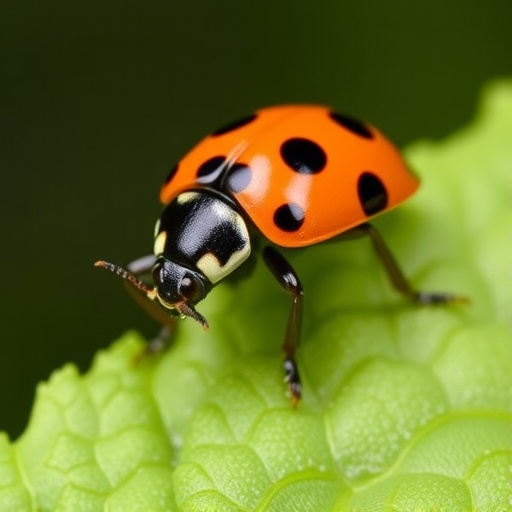
In a remarkable discovery that underscores the hidden biodiversity flourishing even in urban university campuses, researchers at Kyushu University have identified a new species of ladybird beetle living on a Japanese black pine right on their own Hakozaki Satellite campus in Fukuoka, Japan. This newly classified beetle, named Parastethorus pinicola, unveils an intricate ecological narrative overlooked due to its diminutive size and cryptic nature. The finding not only enriches the scientific understanding of the tribe Stethorini, a group of tiny ladybird beetles renowned for their role in controlling spider mite populations, but also illuminates the challenges and rewards of taxonomic precision in entomology.
Parastethorus pinicola, translating aptly to “pine dweller,” is an extraordinary example of microfauna that thrives unnoticed despite its proximity to bustling human activity. Measuring a mere one millimeter in length, the beetle’s black exoskeleton and diminutive size have historically caused it to elude entomologists and insect collectors alike. Ryōta Seki, a doctoral researcher in the Graduate School of Bioresource and Bioenvironment Sciences at Kyushu University, spearheaded the discovery during a meticulous survey of pine tree-resident ladybirds. This study, initiated partly because of the existing Japanese black pines on campus, reflects a strategic pivot from traditional insect collection sites, focusing instead on underexplored arboreal niches.
The comprehensive research, which took three years to complete and culminated in a systematic review published in Acta Entomologica Musei Nationalis Pragae, revisited the taxonomic classification of the Stethorini tribe in Japan—the first such revision in over half a century. The researchers painstakingly examined approximately 1,700 specimens, applying rigorous morphological dissection to unveil subtle but definitive reproductive organ characteristics necessary for species-level identification. Such methodology highlights the critical importance of microscopic anatomical analysis in resolving cryptic species complexes that are morphologically uniform to the naked eye.
One notable outcome of this taxonomy overhaul was the clarification that Stethorus japonicus, a widely recognized species in Japan, is in fact conspecific with Stethorus siphonulus—a species distributed broadly across China and Southeast Asia. This revelation is significant for regional ecological studies and pest management programs, ensuring accurate communication and data sharing regarding species distributions and their biological roles.
Additionally, the study led to the discovery of a second new species, named Stethorus takakoae, found in the northernmost island of Hokkaido. This naming pays homage to the first author’s grandmother, Takako Ōtsuki, symbolizing the personal dedication behind scientific inquiry. Such nomenclatural honors reflect the tradition and human dimension within taxonomy, linking generations through scientific legacy.
The significance of these findings extends beyond nomenclature and classification. The identification of species such as P. pinicola enhances the understanding of predator-prey dynamics in pine ecosystems. Stethorini ladybirds play a crucial predatory role in controlling populations of spider mites, which are notorious pests that can cause extensive damage to pine trees and other plants. Hence, defining accurate species boundaries aids in better ecological management and conservation strategies informed by precise biological identities.
Despite their ecological importance, small black ladybirds have long been underrepresented in entomological research due to the inherent difficulty in distinguishing morphologically similar species. Their minute size, comparable to a grain of sand, combined with nearly identical external features, poses formidable challenges in field identification and demands advanced microscopic work. This underscores a broader issue in biodiversity studies: numerous species likely remain undescribed or misidentified, especially among diminutive invertebrates.
Associate Professor Munetoshi Maruyama of Kyushu University Museum, the supervising researcher of this project, emphasizes the value of persistent, detailed observation of commonplace environments. His team’s success in uncovering novel species on an urban campus serves as a call to scientists and the public alike to recognize and appreciate the largely invisible ecosystems thriving in everyday surroundings. These “minor” insects, despite their size, are integral to maintaining healthy ecological networks.
Such discoveries also illustrate the synergistic potential of combining classical taxonomy with modern systematic approaches. While molecular techniques increasingly supplement species classification, the rooted tradition of morphological scrutiny remains fundamental, especially when dissecting reproductive anatomy to delineate cryptic species. This combined approach ensures robustness and reliability in species descriptions critical for subsequent biological research and conservation policy.
The researchers’ work fundamentally challenges assumptions about urban biodiversity, underscoring a paradigm that rich biological diversity can exist in seemingly mundane or highly human-impacted habitats. This holds profound implications for urban ecology, environmental monitoring, and education, encouraging a reimagined relationship with the natural world even within metropolitan and academic landscapes.
By standardizing species definitions and clarifying their geographic ranges, this research enriches the scientific discourse across Asia and beyond, facilitating more coordinated international efforts in entomology and pest control. The broad distribution of the clarified species, spanning tropical to temperate zones, highlights their ecological resilience and adaptive breadth.
Ultimately, the discovery of Parastethorus pinicola and Stethorus takakoae elevates awareness of the complexity and subtlety of life forms at small scales, inspiring further exploration and curiosity. It serves as a testament to how dedicated research, even in familiar settings, can yield transformative insights into biodiversity and ecosystem dynamics, offering valuable knowledge to combat environmental challenges in the 21st century.
Subject of Research: Animals
Article Title: Review of the genera Stethorus and Parastethorus from Japan (Coleoptera: Coccinellidae)
News Publication Date: 7-Nov-2025
Web References: Acta Entomologica Musei Nationalis Pragae – DOI: 10.37520/aemnp.2025.021
Image Credits: Munetoshi Maruyama / Kyushu University
Keywords: Parastethorus pinicola, Stethorus takakoae, ladybird beetle, taxonomy, systematic review, Stethorini tribe, pine ecosystems, biodiversity, entomology, cryptic species, Kyushu University, insect classification
Tags: biodiversity on university campusesblack pine beetle speciesecological significance of ladybird beetlesentomological surveys in urban settingsKyushu University researchmicrofauna in urban ecosystemsnew species of ladybird beetleParastethorus pinicola discoveryrole of ladybirds in pest controltaxonomic challenges in insectstiny beetles in Fukuoka Japanurban entomology research