A groundbreaking study conducted by researchers at Concordia University has unveiled a novel approach for quantifying the volume of actionable water contained within snowpacks across Canada and Alaska. This innovative framework, termed Snow Water Availability (SWA), integrates satellite remote sensing data with advanced climate reanalysis techniques to systematically measure snow depth, density, and spatial coverage. The comprehensive scope and granular nature of SWA provide unprecedented insights into regional and temporal variations in snowpack water reserves, offering crucial indications of hydrological shifts driven by climate dynamics.
Ali Nazemi, the study’s corresponding author and associate professor at Concordia’s Department of Building, Civil and Environmental Engineering, emphasizes the critical importance of accurately locating snowpacks for understanding subsequent water resource distributions. The melting of snowpacks feeds vital river systems, agricultural operations, hydroelectric generation, and community water needs; thus, mapping these reserves with high fidelity is essential to anticipating and mitigating water scarcity risks. The SWA method stands apart by capturing not only volume but also the precise geospatial context of snow water, enabling more nuanced assessments than traditional hydrological models.
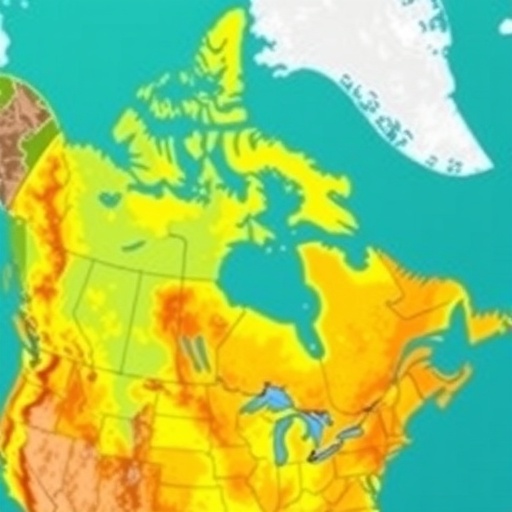
Findings from applying the SWA methodology reveal a sharp decline in usable snow water within the mid-elevation zones of the Canadian Rockies—a region accounting for a mere three percent of the nation’s landmass but responsible for sustaining multiple critical river headwaters. This localized depletion, alongside smaller but cumulative decreases dispersed across broader areas, affects 26 percent of Canadian territory and threatens water security for approximately 86 percent of the population. The pervasive nature of these trends highlights a systemic “creeping drought” phenomenon that evolves subtly yet exerts mounting pressure across diverse socio-economic sectors, including farming, energy production, transportation, leisure, and Indigenous communities.
This insidious form of drought presents a formidable challenge due to its gradual onset and spatial heterogeneity, often eluding early detection until water shortages reach crisis proportions, as historically observed in southern Ontario and Quebec in 2012 and western Canada in 2015. The study’s revelations urge a paradigm shift in water resource management strategies to incorporate predictive insights derived from innovative remote sensing analytics such as SWA, thereby enhancing preparedness and resilience to emerging climatic stresses.
Central to the spatial variability observed in SWA declines is the critical role of snow depth reduction in mid-altitude mountain environments, notably within the Okanagan–Similkameen drainage basin of British Columbia. With its dense population and high dependence on mountain snowmelt for potable and agricultural water, this region has endured significant losses in snow storage over recent decades. Compounding these effects are large basin systems such as the Assiniboine–Red River and the Saskatchewan River, where marginal decreases in snow cover dispersed over extensive territories collectively exacerbate regional water deficits, advancing the long-term risk profile of the hydrological network.
Unlike conventional assessments which often overlook rapid transitions at the snow season’s margins, SWA’s grid-based analysis using 25 km by 25 km spatial resolution captures the dynamic beginning and end of snow accumulation periods with acute sensitivity. This method accounts for fine-scale topographical heterogeneity—such as slope aspects, diverse terrain profiles, and uneven snow distribution—that influences melt timing and volume. Through multi-temporal sampling ranging from seasonal to monthly intervals, researchers can discern subtle shifts in snow hydrology that cumulatively impact the water supply chain.
Interestingly, the study discovered that despite the pronounced drought effects in southern and mid-latitude zones, total snow water availability has increased in northern Canadian regions, particularly near the Arctic coastline. This counterintuitive trend is linked to climate-induced reductions in Arctic sea ice, which culminate in higher atmospheric moisture content. Enhanced moisture transport leads to increased snowfall in cooler inland Arctic areas, paradoxically augmenting localized snow water volumes. However, this northern augmentation does not offset the declining SWA in populated and economically critical southern regions, underscoring an asymmetric hydrological impact shaped by climatic warming.
This spatially heterogeneous response to climate variability emphasizes the limitations of existing water management frameworks, which often assume uniform resource availability across territories. Nazemi argues that the disparity—where a modest three percent decline in SWA disproportionately affects over a quarter of the territory and a vast majority of the population—necessitates an urgent reassessment of allocation policies. Adopting data-informed approaches that integrate SWA metrics can enhance strategic water distribution, drought forecasting, and ecosystem conservation amid accelerating anthropogenic climate disruption.
The broader implications of declining snow water storage encompass cascading effects beyond immediate water shortages. Agricultural productivity suffers as irrigation sources dwindle, hydropower generation capacity wanes due to reduced meltwater input, freshwater ecosystems face stress from altered flow regimes, and traditional ways of life in Indigenous communities are jeopardized. The creeping snow drought thereby represents a multifaceted threat to both human and environmental systems, demanding multidisciplinary engagement to devise adaptive strategies and sustainable water governance models.
The study’s methodology, relying on satellite data fused with climate reanalysis, leverages the latest advancements in Earth observation technologies and computational modeling. This integration facilitates long-term, large-scale monitoring of snowpack conditions with a level of precision rarely attainable by ground-based surveys alone. The resultant SWA datasets offer scientists, policymakers, and stakeholders robust tools to visualize temporal trends, identify vulnerable regions, and simulate potential future scenarios under varying climate trajectories.
Contributions to this research also include collaborations with experts from the University of California, Irvine, ensuring a cross-institutional synthesis of hydrological and climatological expertise. Funded by Canada’s New Frontier Research Fund—Exploration and the Natural Sciences and Engineering Research Council Discovery program, the study exemplifies the role of federal investment in addressing critical environmental challenges through data-driven innovation.
Published in the prestigious journal Communications Earth & Environment, this research marks a significant advancement in understanding how climate change reshapes the hydrological landscape. By revealing the subtle but consequential depletion of snow water—dubbed “creeping snow drought”—the study alerts the scientific community and public alike to an emerging crisis that requires immediate attention. The integration of SWA into water resource management promises not only enhanced drought prediction but also more equitable and sustainable stewardship of Canada’s freshwater wealth in an uncertain climatic future.
Subject of Research: Not specified
Article Title: Creeping snow drought threatens Canada’s water supply
News Publication Date: 9-Jan-2026
Web References: https://www.nature.com/articles/s43247-025-03162-8
References: Nazemi, A., et al. (2026). Creeping snow drought threatens Canada’s water supply. Communications Earth & Environment. DOI: 10.1038/s43247-025-03162-8
Image Credits: Concordia University
Keywords: Climate change, Anthropogenic climate change, Range shifts, Hydrosphere, Seasonal changes, Hydrological cycle, Freshwater resources, Watersheds
Tags: agricultural water needs in Canadaclimate reanalysis techniqueshydroelectric generation and snowmelthydrological shifts due to climate dynamicsimpact of climate change on snowpacksregional variations in snow depth and densitysatellite remote sensing in hydrologysnow droughts in CanadaSnow Water Availability frameworksnowpack mapping for water scarcitysnowpack water reserveswater resource management in Canada