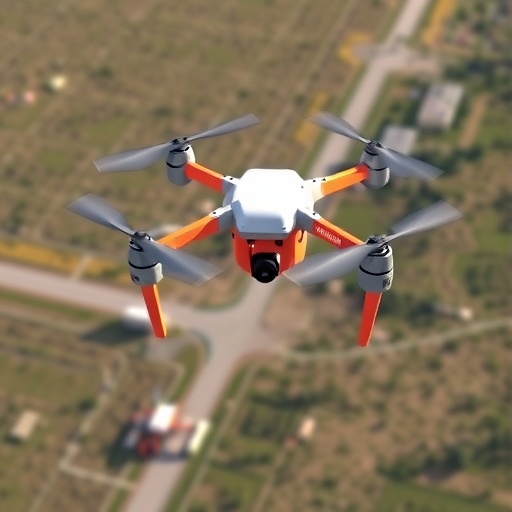
In a groundbreaking study that marries the principles of multi-agent reinforcement learning with the complexities of dynamic environment modeling, researchers Zhang, Li, and Zhao have charted a new course in unmanned aerial vehicle (UAV) path planning. Their innovative approach brings to light previously untapped potential for UAVs to navigate intricate environments effectively, a necessity in various applications such as search and rescue, environmental monitoring, and urban planning. This paper, set to be published in the prestigious journal “Discover Artificial Intelligence,” foreshadows a major leap in how UAVs operate and interact within their environments.
The authors first establish the framework within which their research operates, emphasizing the necessity for advanced path planning methodologies in scenarios where UAVs face rapidly changing environments. Traditional path planning techniques often falter in dynamic settings, leading to delays or inefficient routes that compromise UAV mission efficacy. The lack of adaptability in these older methods highlights an urgent need to incorporate machine learning techniques that can intelligently assess environmental variables and respond in real-time.
Central to their research is the application of multi-agent reinforcement learning. This approach models UAV operations as a multi-agent system, enabling each drone to communicate, share data, and collaborate towards optimal path planning. By leveraging reinforcement learning algorithms, the UAVs learn from their experiences and continuously improve their decision-making abilities. This collaborative learning model sets a clear edge over traditional approaches, as it allows for the analysis of a UAV’s strategies in conjunction with others, leading to a refined understanding of complex scenarios.
The researchers articulate the importance of dynamic environment modeling as a key component of their study. By establishing a realistic simulation of environmental conditions, the UAVs can better predict obstacles, changes in terrain, and even dynamic entities like other aircraft or moving obstacles in urban landscapes. This predictive capability is paramount to ensure safe and efficient navigation. The integration of environmental modeling with reinforcement learning affords the UAVs a capacity for foresight, allowing them to make informed decisions rather than reactive ones.
The paper presents a comprehensive description of the simulation environment created for testing the algorithms. By mirroring real-world scenarios—including weather variations, obstacle movements, and varying ground conditions—the simulations ensure that the learning model receives a robust dataset from which to train. This represents a substantial advancement from previous studies that often relied on static environments that failed to encapsulate the full scope of challenges faced during actual UAV operations.
An essential aspect of the study is the experimental design used to evaluate the performance of the proposed methodologies. The authors detail a series of tests conducted across multiple scenarios that reflect different environmental dynamics, allowing for rigorous performance assessment. The results indicated that UAVs utilizing the proposed multi-agent reinforcement learning methodology consistently outperformed those using conventional path planning methods. Improvements were observed in both efficiency and safety, showcasing substantial enhancements in how UAVs can navigate through dynamically changing landscapes.
Moreover, the researchers discuss the implications of their findings for real-world applications. The ability for UAVs to operate under unpredictable conditions opens up numerous opportunities in sectors such as logistics, emergency response, and precision agriculture. For instance, during disaster relief operations, UAVs equipped with advanced path planning capabilities could identify the safest and fastest routes to deliver supplies or assess damage in areas made inaccessible by natural calamities.
Zhang, Li, and Zhao address the inherent challenges of implementing such advanced technologies in standard UAV operations. They acknowledge that while the benefits are considerable, practical constraints—such as computational power, battery life, and regulatory concerns—must be meticulously navigated. Optimizing the algorithms to ensure they can run efficiently on a UAV’s onboard systems without overtaxing resources is crucial for practical adoption.
Moreover, the team highlights the potential for future research to expand on their foundation. There exists an opportunity to explore the extent to which these methodologies can be adapted for larger fleets of UAVs operating simultaneously. As swarms of UAVs grow increasingly common in applications such as surveillance and agricultural monitoring, the interplay among agents could yield even more advanced strategies that build on their current findings.
The intricacies of safety and regulation also demand further consideration. The authors propose that ongoing collaboration with policymakers will be essential to pave the way for widespread UAV integration into public airspace. Ensuring that both safety and operational efficiency are prioritized in developing these technologies will be key to fostering public trust and facilitating the acceptance of UAVs in everyday applications.
In conclusion, the authors invite the scientific and technological communities to recognize the magnitude of their findings. By integrating multi-agent reinforcement learning with dynamic path planning, they are not only optimizing UAV operational capabilities but also setting a precedent for future advancements in autonomous systems. As the field of UAV technology continues to evolve, this study serves as a crucial stepping stone toward sophisticated pathfinding solutions that could soon redefine how UAVs interact within our dynamically shifting environments.
Zhang, Li, and Zhao’s research epitomizes the innovative spirit of current technological exploration, pushing the boundaries of what is possible with UAV technology. As drones become increasingly prevalent in everyday life, their ability to maneuver through complex, unpredictable environments will be pivotal. It’s a thrilling time for advancements in UAV research, and the implications of this study reverberate beyond the academic realm, promising transformative changes in our industries and everyday experiences.
With an eye on the future, the authors underscore that the potential of UAVs is only just beginning to be unlocked. As more sophisticated learning algorithms develop, and as UAV technology advances, we can anticipate a new era of aerial capabilities that are responsive, intelligent, and essential for addressing the myriad challenges of our modern world.
Subject of Research: UAV path planning using multi-agent reinforcement learning
Article Title: In-station UAV path planning based on multi-agent reinforcement learning and dynamic environment modeling
Article References:
Zhang, X., Li, C. & Zhao, M. In-station UAV path planning based on multi-agent reinforcement learning and dynamic environment modeling.
Discov Artif Intell (2026). https://doi.org/10.1007/s44163-026-00882-4
Image Credits: AI Generated
DOI: 10.1007/s44163-026-00882-4
Keywords: UAV, path planning, multi-agent reinforcement learning, dynamic modeling, environmental predictions.
Tags: advanced UAV operation methodologiescollaborative drone systemsdynamic environment modelingefficient route optimizationenvironmental monitoring dronesintelligent navigation techniquesmachine learning in roboticsmulti-agent reinforcement learningreal-time adaptive algorithmssearch and rescue UAV applicationsUAV path planningurban planning UAV strategies