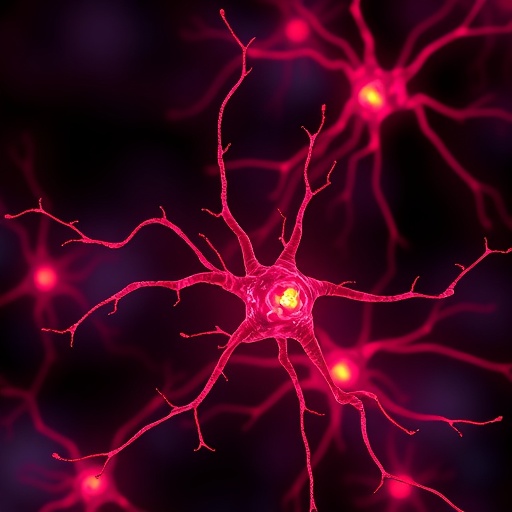
In a groundbreaking new study poised to disrupt our understanding of neuronal regulation and sensory perception, researchers have uncovered a specialized subset of microglia that intimately associate with the axon initial segment (AIS) of neurons, orchestrating both neuronal excitability and visual processing. This discovery not only challenges the prevailing view of microglia as passive immune sentinels within the central nervous system but also highlights their critical role as active contributors to the fine-tuning of neuronal circuits and sensory experience.
For decades, microglia have been recognized primarily for their immunological functions—patrolling the brain’s milieu for pathogens, clearing debris, and responding to injury. However, recent years have witnessed a paradigm shift recognizing these glial cells as dynamic players in synaptic pruning, plasticity, and homeostasis. The current research, carried out by Wang, Wang, Gao, and colleagues, expands this repertoire, identifying a unique microglial population uniquely positioned at the AIS—the neuronal structure responsible for action potential initiation and maintenance of neuronal polarity.
The axon initial segment represents a critical functional domain where neuronal output is decided. This region integrates synaptic inputs to generate the all-or-none electrical impulse that travels along the axon to communicate with downstream neurons. Until now, the cellular environment of the AIS was believed to be largely neuronal and glial in the classic astrocyte sense, yet the presence and influence of microglia at this site were not defined. Employing a multidisciplinary approach combining in vivo imaging, electrophysiology, and molecular profiling, the team revealed that these AIS-associated microglia (termed “AIS-MGLs”) interact directly with the axon segments, modulate neuronal firing, and affect sensory input processing related to vision.
Utilizing state-of-the-art two-photon microscopy in murine cortical tissue, the researchers visualized microglial processes enwrapping the AIS with remarkable specificity and persistence. These microglial processes formed stable contacts with AIS membrane domains rich in voltage-gated sodium channels, suggesting a capacity for direct influence on neuronal excitability. Intriguingly, selective ablation or functional perturbation of AIS-MGLs led to heightened spontaneous neuronal firing rates and disrupted tuning properties of neurons in the visual cortex. This hyperexcitability translated into aberrant visual perception tasks, demonstrating a profound behavioral correlate.
Delving deeper into the molecular crosstalk, the authors uncovered that AIS-MGLs express a distinct complement of receptors and signaling molecules that enable precise monitoring and tweaking of neuronal ion channel function. Among these, the purinergic receptor P2Y12 played a pivotal role in maintaining microglial contact with the AIS. When pharmacologically manipulated, alterations in P2Y12 signaling perturbed AIS-MGL distribution and consequently neuronal activity dynamics. This implies that purinergic signaling pathways are critical mediators of glia-neuron communication at the spike-initiation zone.
The notion that microglia are capable of sculpting neuronal output by direct interaction with axonal subdomains represents a conceptual leap. It provides a mechanistic framework for understanding how immune cells adaptively regulate neuronal gain and sensory processing, expanding beyond the canonical synapse-centered paradigms. This shift in perspective could help unlock mysteries surrounding neurological disorders characterized by dysfunctional neuronal excitability, such as epilepsy, autism spectrum disorders, and neurodegenerative diseases.
Remarkably, the study also provides evidence that AIS-MGLs dynamically respond to sensory experience. Exposure to visual stimuli of varying intensity modulated the morphology and motility of AIS-associated microglial processes, indicating that these glia are deeply embedded in activity-dependent circuit refinement. The ability of microglia to sense and adapt to environmental input, while directly tuning action potential generation sites, underscores their integral role in the homeostatic control of cortical function.
From a therapeutic standpoint, targeting AIS-associated microglial pathways may open new avenues for modulating neuronal excitability in disease states. By harnessing or restoring the function of AIS-MGLs, it might be possible to recalibrate aberrant neural circuits without globally suppressing neuronal activity, which often leads to cognitive or motor side effects. This cell-specific intervention strategy could herald a novel class of neuroimmunomodulatory treatments.
The implications are vast—not only does this discovery deepen fundamental insights into microglial biology and neuron-glia interactions, but it also calls for a revision of models describing how neuronal activity is regulated at the subcellular level. The concept of an “immunological microdomain” centered on the axon initial segment, governed by a bespoke microglial population, introduces a new dimension to neural circuit architecture and function.
Future investigations inspired by this work will doubtlessly explore whether AIS-MGLs exist across brain regions and species, their developmental origins, and how their dysfunction contributes to neuropsychiatric conditions. It also raises provocative questions about the interplay between microglia and other glial subtypes at the AIS, and whether similar specialized immune niches exist along other axonal compartments or dendritic segments.
This transformative research by Wang and colleagues thus sheds light on the hidden complexity of brain microenvironment architecture, revealing that the delicate balance of excitation and inhibition within cortical circuits is not a purely neuronal affair. Microglia inhabiting the axon initial segment emerge as powerful regulators of neuronal output and sensory experience, redefining our understanding of the immune system’s role within the nervous system.
As the field of neuroimmunology races forward, this discovery promises to catalyze a surge of research uncovering the precise molecular dialogues and cellular mechanisms through which microglia modulate neuronal function. By illuminating the bridge between immune surveillance and neural coding, it opens a new frontier, blurring the boundaries between classical neuroscience and immunology.
In sum, the identification of AIS-associated microglia as key arbiters of neuronal excitability and visual perception rewrites textbooks on brain physiology and offers a tantalizing glimpse into the intricate choreography that sustains cognition, perception, and behavior. This paradigm-shifting insight reveals how the brain’s “immune architects” sculpt not only responses to injury and infection but also the very signals that enable us to see and interpret the world around us.
The study, published in Cell Research, encapsulates a vital step forward in neuroscience, with profound implications for our understanding of brain function and the treatment of neurological disorders. It is a vivid demonstration that within the complexity of the brain’s cellular microcosm, novel players await discovery, challenging assumptions and expanding horizons for science and medicine alike.
Subject of Research: The role of axon initial segment-associated microglia in regulating neuronal activity and visual perception.
Article Title: The axon initial segment-associated microglia regulate neuronal activity and visual perception.
Article References:
Wang, Y., Wang, Q., Gao, C. et al. The axon initial segment-associated microglia regulate neuronal activity and visual perception. Cell Res (2026). https://doi.org/10.1038/s41422-026-01218-8
Image Credits: AI Generated
DOI: https://doi.org/10.1038/s41422-026-01218-8
Tags: action potential initiation mechanismsaxon initial segment functioncentral nervous system glial cellsimmune functions of microgliamicroglia dynamics in synaptic pruningmicroglia role in vision processingneuronal excitability regulationneuronal polarity maintenanceparadigm shift in glial cell functionsresearch on neuronal regulationsensory perception and neuronal circuitsspecialized microglia subsets