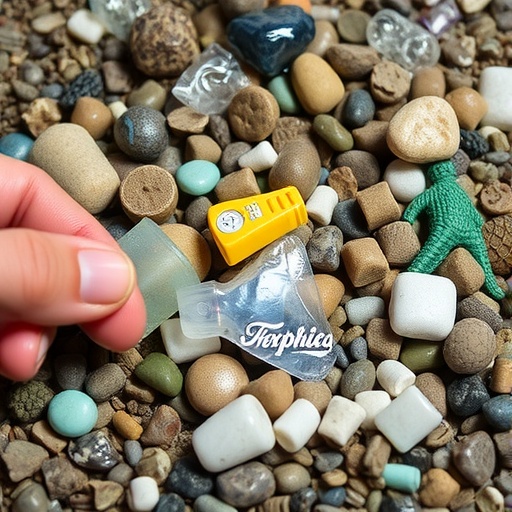
A groundbreaking advancement in environmental science has emerged from the recent study conducted by researchers Kuka, Andersone, Cirule, and their colleagues, shedding critical light on the pervasive issue of microplastic pollution. Published in an upcoming edition of Microplastics and Nanoplastics (2026), their work introduces a novel methodological approach designed to precisely quantify the release of microplastics from plastic-based materials subjected to weathering processes. This pioneering research not only deepens our understanding of microplastic generation but also sets a new precedent for environmental monitoring and policy enforcement in the global fight against plastic pollution.
Plastics have been ubiquitous in modern life for decades, yet their environmental repercussions continue to unfold, revealing complex pathways by which these materials degrade and disperse into the ecosystem. Particularly alarming is the formation and proliferation of microplastics—tiny plastic fragments typically less than 5 millimeters in diameter—that originate from the fragmentation of larger plastic debris. Until now, the scientific community has grappled with accurately measuring how much, and under what specific conditions, weathered plastics release microplastics into natural environments. This gap in measurement precision has hindered the development of comprehensive risk assessments and management strategies.
The team led by Kuka et al. has addressed this critical challenge by engineering a breakthrough quantification technique that captures the dynamics of microplastic release during the weathering lifecycle of diverse plastic materials. Unlike conventional sampling methods that often rely on approximate mass-loss measurements or indirect estimations, their method combines sophisticated surface analysis with advanced particle characterization tools. This dual-pronged approach enables the detection, enumeration, and sizing of fragmented microplastics as they are liberated from their original matrices, providing unprecedented accuracy and sensitivity.
Central to their methodology is the simulation of environmental weathering parameters—such as UV radiation exposure, temperature fluctuations, and mechanical abrasion—within controlled laboratory settings. By replicating the multifaceted stresses that plastic materials endure outdoors, the researchers ensure that the microplastic release profiles they observe mirror real-world scenarios. This fidelity to natural conditions is crucial for interpreting data that can directly inform environmental models predicting microplastic distribution across various ecosystems.
The implications of this refined quantification cascade across multiple realms of environmental research and policy. For scientists, the ability to precisely track microplastic emission rates from different types of plastics during aging facilitates more rigorous hazard identification and toxicity assessments. Specifically, it allows for comparative studies that can unravel material-specific degradation pathways and their corresponding ecological impact, thus guiding the innovation of new, more sustainable polymer formulations.
Furthermore, environmental regulators and policymakers stand to benefit immensely from this advancement. Having a standardized, reliable measurement protocol means that microplastic release can be monitored consistently across different geographical locations and ecosystems. Such data transparency empowers legislative bodies to craft targeted regulations aimed at curbing plastic pollution at the source—be it through material bans, recycling mandates, or public awareness campaigns—and to evaluate the effectiveness of these interventions over time.
Another dimension of significance stems from the technology’s potential to drive public engagement and industry accountability. By elucidating the invisible, yet omnipresent, nature of microplastic pollution, the research captures a critical narrative that resonates with global audiences increasingly concerned about environmental degradation. The clarity afforded by this method could catalyze corporate responsibility initiatives by equipping manufacturers with factual feedback on product lifecycle impacts, thus fostering material innovation that directly curtails microplastic emissions.
Beyond the scope of plastics themselves, the authors also shed light on the intricate interactions between microplastics and environmental matrices, such as soil and water systems. Their findings reveal that weathering-induced microplastic particles exhibit diverse physicochemical characteristics that influence their mobility, bioavailability, and potential toxicity. Understanding these attributes at a granular level provides a foundation for subsequent research into microplastic transport mechanisms, interactions with living organisms, and their ultimate fate within biogeochemical cycles.
The methodological clarity of the study exemplifies a blend of interdisciplinary scientific expertise. It bridges polymer chemistry, environmental science, materials engineering, and analytical chemistry through an integrated experimental design. High-resolution imaging techniques, such as electron microscopy, and particle size analyzers complement chemical fingerprinting methods, ensuring that each microplastic particle is comprehensively characterized not only by size but also by polymer composition and surface morphology.
Moreover, this research highlights the temporal complexity of microplastic release. The kinetics of particle detachment during weathering do not follow simple, linear patterns; instead, they demonstrate phases of accelerated fragmentation interspersed with periods of relative stability. These intricate kinetics underscore the importance of longitudinal monitoring programs capable of capturing the dynamic nature of plastic degradation in natural environments.
The study’s pioneering approach also accounts for environmental variability by incorporating factors such as humidity, salinity, and biological activity into their weathering simulations. This holistic perspective acknowledges that microplastic release is not dictated solely by abiotic mechanical or photochemical factors but can be modulated by microbial colonization and biochemical interactions on plastic surfaces, thereby bringing essential biological realism into experimental paradigms.
In addition to laboratory validation, the authors advocate for the adoption of this quantification technique in field studies, proposing its integration into environmental monitoring frameworks worldwide. They argue that such a standardized method could harmonize microplastic pollution data globally, a critical step given the transboundary nature of plastic debris dispersal via oceanic and atmospheric pathways. This harmonization is pivotal for constructing robust datasets that enable meta-analyses and global-scale assessments.
With the advent of their novel method, Kuka and colleagues effectively open new avenues for predictive environmental modeling. The detailed empirical data generated can inform computational simulations that estimate future scenarios of plastic pollution under varying climate change trajectories and human consumption patterns. These predictive capabilities are essential tools for policymakers and conservationists aiming to mitigate long-term environmental and health ramifications associated with microplastics.
In the broader societal context, this research arrives at a critical juncture marked by heightened public scrutiny over plastic waste management and sustainability. As awareness of microplastic contamination escalates, the demand for actionable scientific insights intensifies. By delivering a precise, replicable, and practical measurement method, this study empowers stakeholders across academia, industry, policy, and civil society to engage with microplastic pollution in an informed and solution-oriented manner.
To encapsulate, the method developed by Kuka, Andersone, Cirule, et al. stands as a significant milestone in environmental science, offering a refined lens through which the complex phenomenon of microplastic release can be systematically quantified and understood. This innovation promises to enhance scientific rigor, policy effectiveness, and public engagement in addressing one of the most pressing environmental challenges of the 21st century.
As we progress towards a future increasingly defined by sustainable development imperatives, research endeavors such as this will be instrumental in shaping humanity’s relationship with plastics, advocating for a circular economy paradigm, and safeguarding ecosystem health. The availability of robust, standardized measurement tools is a foundational pillar for these transformative efforts, positioning this breakthrough as a beacon of hope and advancement in the global endeavor to combat plastic pollution.
Subject of Research: Methodology for quantifying microplastic release from weathered plastic-based materials
Article Title: Method for quantification of microplastic release from plastic-based materials during weathering
Article References:
Kuka, E., Andersone, I., Cirule, D. et al. Method for quantification of microplastic release from plastic-based materials during weathering. Micropl.& Nanopl. (2026). https://doi.org/10.1186/s43591-026-00173-w
Image Credits: AI Generated
Tags: combating microplastic proliferationenvironmental monitoring techniquesenvironmental science advancementsmicroplastic pollution measurementmicroplastics and nanoplastics researchnovel methodologies in environmental studiesplastic debris fragmentationplastic degradation pathwaysplastic pollution policy enforcementquantifying microplastics in ecosystemsrisk assessment for microplasticsweathered plastics microplastic release