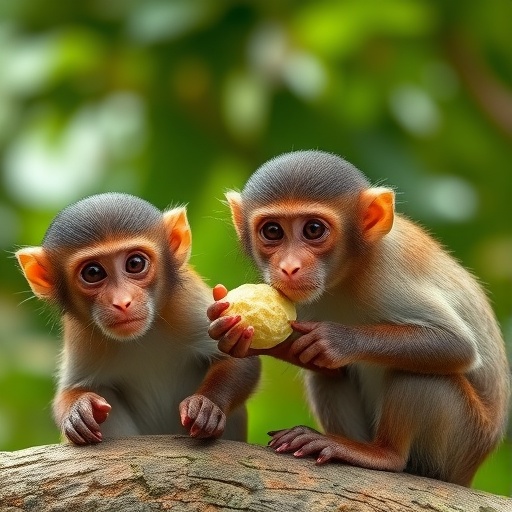
In a groundbreaking study, researchers led by E.J. Jordan have turned their attention to the remarkable information-seeking behaviors exhibited by capuchin monkeys, highlighting a fascinating interplay between cognitive abilities, social learning, and foraging strategies. This research, as published in Animal Cognition, provides a unique glimpse into the cognitive lives of these primates, revealing how they navigate their environments in pursuit of food while simultaneously engaging with the complexities of their social dynamics.
Capuchin monkeys, known for their intelligence and dexterity, have long intrigued scientists studying primate behavior. In this new research, the focus shifts to the methods these monkeys employ when seeking out food. The study employs a series of experiments designed to assess not only the monkeys’ ability to seek information but also their concurrent strategies for decision-making based on that information. The findings shed light on how cognitive processes underpin their survival in the wild.
The study’s design is both innovative and meticulous, incorporating a variety of controlled settings that allow researchers to observe the monkeys’ behaviors as they encounter food-related tasks. By presenting different scenarios that mimic real-life challenges faced by capuchin monkeys, researchers were able to analyze how these animals demonstrate problem-solving skills and adapt their behaviors according to their social contexts. This approach not only offers insights into their individual decision-making but also emphasizes the importance of social collaboration.
Alarmingly, researchers noted a pronounced tendency for capuchin monkeys to seek information about food when in the presence of peers. This behavior suggests a high level of social intelligence, as these monkeys seem to understand the advantages of gathering knowledge from one another. Such collaborative information-seeking behavior has implications for understanding the evolution of social cognition in primates, prompting researchers to reconsider how learning mechanisms may have developed across species.
The interaction between foraging strategies and social communication in capuchins reveals a rich tapestry of behavioral ecology. Monkeys not only rely on their own experiences but actively scout their companions’ actions, exhibiting an acute awareness of their peers’ movements. This raises intriguing questions about the role of observation in learning, particularly in terms of how younger monkeys may acquire foraging techniques from more experienced individuals in their troops.
One key aspect of this study lies in its examination of different types of food information. Capuchin monkeys demonstrated an ability to differentiate between various food sources, as well as the nutritional value and accessibility of those sources. Researchers meticulously cataloged the monkeys’ interactions with different food items, uncovering a nuanced understanding of their preferences and decision-making processes. From taste testing to evaluating physical effort versus reward, capuchin monkeys exhibit a complexity of thought previously underestimated in non-human primates.
Moreover, the findings suggest that situational context plays a crucial role in how monkeys approach food-related tasks. When presented with opportunities to either act independently or rely on the knowledge of others, monkeys appeared to weigh their options carefully, often opting to collaborate when the potential benefits were clear. This consideration of social factors, in tandem with individual needs, reflects a sophisticated layer of cognition that parallels human information-seeking behaviors.
The implications of this research extend beyond the realm of animal behavior. By illuminating the cognitive processes of capuchin monkeys, scientists can draw parallels to human social strategies, potentially informing areas such as education, peer learning, and information sharing. Understanding how non-human primates navigate the complexities of their environments can enrich our grasp of our own evolutionary path, particularly concerning the development of social networks and collaborative knowledge transfer.
In the wake of these findings, researchers advocate for more extensive studies on capuchin monkeys as models for exploring cognitive evolution. These intelligent primates can serve as vital indicators of the broader cognitive capabilities of primates, including humans. By unraveling the intricacies of their information-seeking behaviors, future research might unlock new insights into the cognitive underpinnings of sociality and survival mechanisms across diverse species.
Overall, the work spearheaded by Jordan and colleagues contributes significantly to our understanding of primate cognition, particularly in the field of comparative psychology. This research invites further exploration into how learning and decision-making evolve in social species, urging scientists to continue dissecting the layers of intelligence that define our closest relatives in the animal kingdom.
In conclusion, the findings from this innovative study underscore the importance of social dynamics in shaping information-seeking behaviors among capuchin monkeys. As researchers delve deeper into the cognitive world of these remarkable primates, they invite a reconsideration of what it means to be intelligent in the animal kingdom, challenging preconceived notions of knowledge acquisition, social learning, and survival strategies.
The ongoing exploration of capuchin monkeys as a lens for understanding more extensive cognitive processes serves not only to highlight the complexity of animal behavior but also to encourage a broader appreciation for the interconnectedness of cognition across species. This pivotal research not only enriches our understanding of capuchins but also paints a more comprehensive picture of social animals and their pursuit of knowledge in an ever-changing world.
As the findings ripple through the scientific community, the study paves the way for more holistic approaches to research on animal cognition. By understanding the rich tapestry of social learning and information seeking, scientists can better appreciate the multifaceted nature of intelligence and its myriad expressions in the wild. The future of cognitive research appears promising, fueled by the engaging behaviors of species like capuchin monkeys that continue to challenge our perceptions of thought, learning, and collaboration.
This research is an invitation to explore the cognitive capacities of diverse animal species further. As scientists push the boundaries of what we know, capuchin monkeys stand out as remarkable examples of how intelligence manifests in nature, drawing attention to the significance of social structures in the quest for knowledge—a journey that is as relevant for us as it is for them.
Subject of Research: Capuchin monkeys and their information-seeking behaviors regarding food.
Article Title: Peek a boo! Information seeking about food and functionality in capuchin monkeys.
Article References:
Jordan, E.J., Allritz, M., Bohn, M. et al. Peek a boo! Information seeking about food and functionality in capuchin monkeys.
Anim Cogn 28, 87 (2025). https://doi.org/10.1007/s10071-025-01999-2
Image Credits: AI Generated
DOI: 10.1007/s10071-025-01999-2
Keywords: Capuchin monkeys, information seeking, social learning, cognitive behavior, primate intelligence.
Tags: animal cognition researchCapuchin monkeys cognitive abilitiescomplexities of monkey social dynamicsdecision-making in primate behaviorenvironmental navigation by primatesfood discovery behaviorsforaging strategies of capuchin monkeysinformation-seeking behaviors in monkeysinnovative study design in primatologyproblem-solving skills in animalssocial learning in primatessurvival strategies of capuchin monkeys