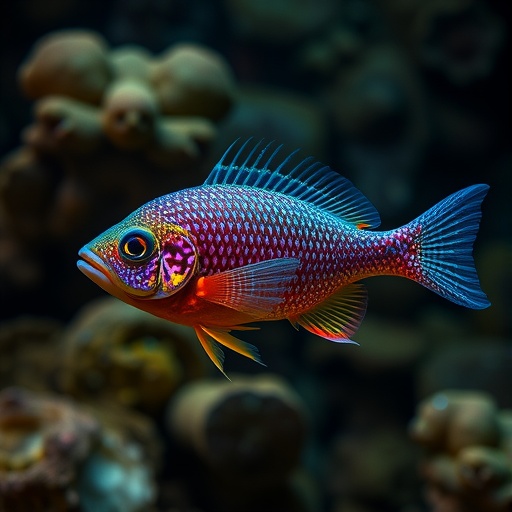
In a groundbreaking study published in Acta Parasitologica, researchers da Silva, Yamada, and Yamada reveal the discovery of a new species of monogenean parasite within the genus Gussevia, found parasitizing the gills of the popular ornamental fish Astronotus ocellatus, commonly known as the Oscar fish. This discovery emerges from the Caatinga domain in northeastern Brazil, a unique and environmentally significant biome, further emphasizing the region’s unexplored biodiversity. The revelation not only opens new avenues in parasitological research but also highlights the critical ecological interactions between parasites and freshwater fish species in South America.
The genus Gussevia is part of the family Dactylogyridae, which encompasses a diversity of monogenean flatworms widely recognized for their parasitism on the gills of freshwater fishes. These parasites are of keen scientific interest due to their direct lifecycle, high host specificity, and potential impact on fish health and aquaculture productivity. The newly described species extends the known diversity of Gussevia, providing insights into parasite-host coevolution and biogeography. The authors employed detailed morphological and morphometric analyses based on microscopic examination to delineate the distinctive characteristics that warrant the recognition of this novel species.
The site of collection for this study, the Caatinga biome, is notably characterized by its semi-arid climate and unique endemic flora and fauna. This biome has been underrepresented in parasitological surveys compared to other Brazilian ecoregions such as the Amazon or Pantanal. The discovery signals that the Caatinga might harbor many more unknown parasitic species, which play essential roles in the health and dynamics of freshwater ecosystems. Understanding parasitic diversity in such environments is critical for formulating conservation strategies and managing freshwater habitats sustainably.
Detailed morphological descriptions in the paper highlight several distinctive features that separate the new Gussevia species from its congeners. These include variations in the structure of the haptor, the organ monogeneans use to attach to their hosts, as well as differences in the shape and size of copulatory organs. Such taxonomic precision is essential for distinguishing closely related species and has implications for identifying host-parasite specificity and transmission dynamics. This level of detail is particularly valuable for parasitologists and fish health specialists monitoring disease risks in wild and cultured fish populations.
Furthermore, the discovery underscores the ecological importance of parasite diversity as a component of freshwater biodiversity. Parasites, often overlooked or considered detrimental, actually contribute significantly to the complexity and stability of aquatic ecosystems. They can influence host population dynamics, community structure, and even drive evolutionary pressures. In this context, the identification of a new monogenean species enriches our appreciation of parasitic roles in natural environments and serves as a reminder of the importance of preserving these complex biological interactions.
From an applied perspective, the findings bear significance for ornamental fish aquaculture, particularly concerning Astronotus ocellatus, which is a species traded globally for aquariums. Parasite infestations can impair fish health, leading to economic losses and the risk of spreading parasites to non-native regions. Characterizing parasites with precision aids in developing effective management strategies and biosecurity measures to mitigate such risks. This new species description thus contributes a crucial piece of knowledge for fish health monitoring and sustainable aquaculture practices.
The research methodology elegantly combined classical parasitological techniques with modern analytical tools. The team conducted thorough microscopic examinations using differential interference contrast and phase-contrast microscopy, supplemented by detailed morphometric assessments to quantify anatomical features precisely. This approach ensures robustness in taxonomic conclusions and sets a benchmark for future work on monogenean parasites in understudied fish hosts. It also highlights the continuing relevance of morphological studies in conjunction with molecular methods in modern parasitology.
Moreover, the study highlights how host specificity in monogeneans can be leveraged to understand host evolutionary relationships and historical biogeographic patterns. Astronotus ocellatus is native to South American river systems and has a distinct evolutionary trajectory. The close association of its parasitic fauna reflects this evolutionary history, suggesting co-divergence patterns that can be further investigated using molecular phylogenetics. This adds an evolutionary dimension to the ecological findings and provides a framework for in-depth studies on host-parasite evolution.
The publication also discusses potential conservation implications related to habitat degradation in the Caatinga region. Human activities such as agriculture, deforestation, and water extraction threaten the integrity of freshwater habitats. Parasites, including the newly identified Gussevia species, may serve as bioindicators of ecosystem health. Monitoring their presence and prevalence can provide crucial information about the ecological condition of water bodies and the impacts of anthropogenic pressures, ultimately informing conservation policies in these fragile environments.
Importantly, the discovery enriches the global catalog of monogenean diversity, which remains far from complete. Given the vast number of freshwater fish species worldwide, many hosting species-specific monogeneans, untapped biodiversity remains extensive. Efforts such as this study emphasize the need for comprehensive parasitological inventories, particularly in biodiverse but underexplored regions like the Caatinga. They also encourage greater integration of parasitology in broader biodiversity conservation and environmental monitoring initiatives.
The authors make a compelling case for increased research funding and capacity building in parasitology within developing regions. Such investments would enable scientists to explore parasitic communities and their ecological roles more comprehensively, ultimately enhancing our understanding of aquatic biodiversity. Enhanced parasitological knowledge contributes to fisheries management, ecosystem health assessment, and potentially new biotechnological applications. The new Gussevia species serves as a testament to the untapped scientific potential lying beneath the surface of freshwater biodiversity.
To conclude, this discovery of a new Gussevia parasite species on the gills of Astronotus ocellatus in the Caatinga biome represents a major contribution to parasitology, fish biology, and biodiversity research. It highlights the intricate and underappreciated relationships between hosts and their parasites, while reinforcing the ecological significance of parasite diversity in freshwater ecosystems. The work provides vital baseline data for further evolutionary, ecological, and conservation studies, inspiring a renewed focus on parasitic organisms as integral components of global biodiversity. As freshwater systems face escalating threats worldwide, understanding parasites’ roles will be critical for sustaining ecological balance and fishery resources alike.
Subject of Research: Monogenean parasite biodiversity in freshwater fish, specifically a newly identified species of Gussevia parasitizing the gills of Astronotus ocellatus in the Caatinga biome of northeastern Brazil.
Article Title: A New Species of Gussevia (Monopisthocotyla: Dactylogyridae) Parasitizing the Gills of Astronotus ocellatus (Cichliformes: Cichlidae) in the Caatinga Domain, Northeastern Brazil.
Article References:
da Silva, A.J.T., Yamada, P.O.F. & Yamada, F.H. A New Species of Gussevia (Monopisthocotyla: Dactylogyridae) Parasitizing the Gills of Astronotus Ocellatus (Cichliformes: Cichlidae) in the Caatinga Domain, Northeastern Brazil. Acta Parasit. 71, 25 (2026). https://doi.org/10.1007/s11686-025-01210-z
Image Credits: AI Generated
DOI: https://doi.org/10.1007/s11686-025-01210-z
Tags: Astronotus ocellatus parasitebiogeography of monogeneansCaatinga biome biodiversityDactylogyridae family characteristicsecological interactions in South Americafish health and aquaculture impactsfreshwater fish parasitesmonogenean flatworms in Brazilmorphological analysis of parasitesnew Gussevia species discoveryparasite-host coevolutionparasitology research advancements