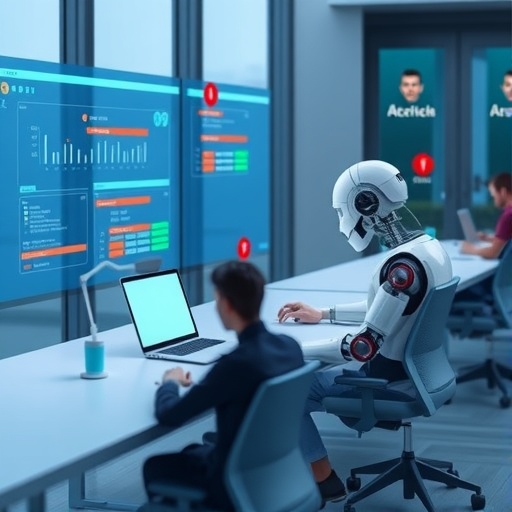
In a groundbreaking development that stands to redefine the management of co-working spaces, researcher S. Ding has introduced a dynamic scheduling framework that leverages the power of multi-agent reinforcement learning. As the demand for flexible work environments rises, this innovative approach promises not only to enhance resource allocation but also to optimize user experiences effectively. Co-working spaces are becoming essential in today’s fast-paced, remote work-centered world, making efficient management of these resources increasingly vital.
The research addresses a common challenge faced by co-working spaces—maximizing the utilization of shared resources such as desks, meeting rooms, and amenities while accommodating the diverse needs and preferences of various users. S. Ding’s framework utilizes multi-agent systems, wherein multiple intelligent agents work synergistically to evaluate and adapt scheduling protocols in real time. This approach is particularly significant given the unpredictable nature of user demands in co-working environments, where varying schedules and preferences often clash.
By employing advanced algorithms grounded in reinforcement learning, the framework can continuously learn from interactions within the environment. It identifies optimal strategies for resource allocation based on historical data and real-time feedback, ensuring that both facility managers and users benefit from the enhanced efficiency. The dynamic nature of this system means that the scheduling adjustments are instantaneous, something that traditional scheduling methods struggle to achieve as they often rely on static data input.
The theoretical underpinnings of this framework delve deep into the realms of artificial intelligence and machine learning, merging them with practical applications. In essence, multi-agent reinforcement learning facilitates a decentralized system of decision-making, where each agent is responsible for its own set of tasks while also considering the broader group’s goals. This collective intelligence fosters a responsive and adaptive environment, ideal for the ever-evolving needs of co-working spaces.
Furthermore, this framework introduces the concept of user-centric scheduling, which is pivotal in an age where personalization is key. Users often have unique requirements for their workspace, whether pertaining to quiet areas for focus or collaborative spaces for teamwork. The multi-agent system assesses these individual preferences and priorities, ensuring that every user is fully accommodated. By analyzing patterns in usage and preferences, it can also anticipate future needs, making it a proactive solution rather than a reactive one.
One of the standout features of S. Ding’s research is its emphasis on real-time feedback and adjustment. As users interact with the co-working space, the agents monitoring the environment can make instant modifications to the scheduling. For example, if a sudden influx of users occurs, the system can quickly reroute meetings to less occupied rooms or extend desk availability. Such adaptability is crucial in maintaining an organized and efficient workspace that meets user needs without compromise.
Moreover, the ecological implications of optimizing co-working spaces through this framework cannot be overlooked. By maximizing the use of existing resources, co-working spaces can reduce the need for new construction, which in turn minimizes carbon footprints associated with building expansion. This aligns with broader trends towards sustainability and efficient resource use in urban environments, addressing not only economic concerns but environmental ones as well.
The implementation of this system poses interesting implications for the future of work. As hybrid models of working emerge, where people alternate between in-office and remote work, the role of co-working spaces as versatile incubators for productivity becomes pronounced. Innovators in this environment will need flexible systems that can adapt to shifting patterns of usage, and S. Ding’s work offers just that.
Looking ahead, the research also opens the door to further innovations. Future developments could integrate IoT (Internet of Things) technologies that enhance the capabilities of the multi-agent systems by providing additional data points from smart devices within the space. Such technological integration could refine user experiences even further, tailoring the working environment to become more intuitive and anticipative of user needs.
As we look to the future, one thing is clear—S. Ding’s dynamic scheduling framework represents not just a leap forward in the optimization of co-working resources but a potential shift in how we think about workspaces in general. The principles enshrined in this research could resonate well beyond the walls of industry-specific co-working spaces, hinting at a broader applicability in various fields where resource allocation is key.
In conclusion, S. Ding has underscored the critical intersection between artificial intelligence, resource management, and user experience in co-working spaces. This novel multi-agent reinforcement learning framework does not only advocate efficiency; it promotes a more engaging and satisfactory working environment for users. It signals a significant advancement towards more intelligent workspace solutions capable of adapting to the rapidly changing paradigms of work, thus paving the way for a future where co-working spaces harmoniously adapt to our diverse and evolving needs.
Subject of Research: Optimization of co-working space resources through multi-agent reinforcement learning.
Article Title: A dynamic scheduling framework for co-working space resources optimized by multi-agent reinforcement learning.
Article References:
Ding, S. A dynamic scheduling framework for co-working space resources optimized by multi-agent reinforcement learning.
Discov Artif Intell (2026). https://doi.org/10.1007/s44163-026-00873-5
Image Credits: AI Generated
DOI:
Keywords: Multi-agent systems, Reinforcement learning, Co-working spaces, Resource optimization, User-centric scheduling, Artificial intelligence, Workspace management, Adaptive environments, Sustainability, IoT integration.